

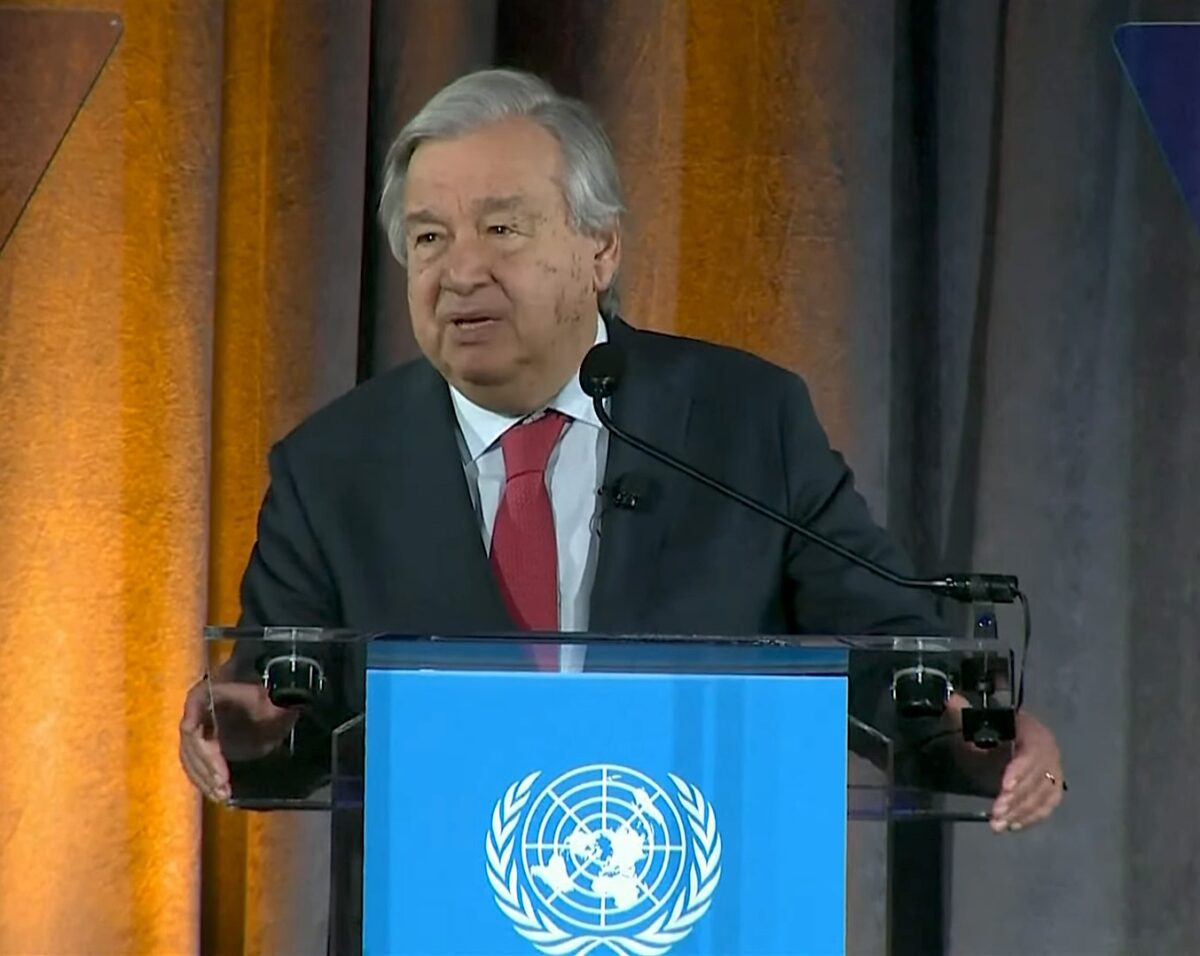
In late April, the U.N. Intergovernmental Panel on Climate Change admitted that Representative Concentration Pathway 8.5, or RCP8.5, the high-emissions climate model scenario that dominated climate research and policy, was “implausible.” [some emphasis, links added]
This represented a tidal wave in the climate science and policy community.
For more than a decade, the IPCC has treated RCP8.5 as the “business-as-usual” pathway, projecting global temperatures to rise by 4.3℃ or more by 2100 with all manner of “end of the world” results.
The IPCC has wielded RCP8.5 like a cudgel during treaty negotiations to beat government climate negotiators into multiple unjustified climate treaties restricting the use of fossil fuels.
The fact that RCP8.5 was “implausible” should have come as no surprise because many climate researchers were on the record noting from the outset that RCP8.5 was very unlikely and shouldn’t be treated as expected or business as usual.
Yet that didn’t stop the vast majority of scientists publishing in the peer-reviewed literature and speaking to the mainstream media from treating it as such, calling on government leaders to impose a rapid transition away from fossil fuels to prevent the disastrous social, economic, and environmental outcomes that RCP8.5 forecast.
The Heartland Institute critiqued RCP8.5 from the start, noting it was not just implausible but likely impossible as far back as 2017. It was debunked in detail in Climate Change Reconsidered II: Fossil Fuels in 2019.
So, concerning the IPCC’s belated admission, in the immortal words of celluloid Die Hard hero John McClane, “Welcome to the party, pal.”
Better late than never.
Sadly, in the interim between the time RCP8.5 was officially released as “business as usual” and the IPCC’s recent mea culpa, tens of thousands of peer-reviewed climate studies used RCP8.5.
By early 2020 alone, researchers were publishing roughly 20 studies per day using it, with estimates of more than 8,500 papers in 18 months.
There were many reasons to consider RCP8.5 a false rallying point for climate policy from its inception, foremost among them perhaps being the fact that not enough recoverable coal exists in the world to produce the assumed fivefold increase in use by 2100.
In addition, the human population is not on any foreseeable track to increase to the 12.6 to 14.5 billion range assumed in the RCP8.5 scenario.
The IPCC and the lapdog media are treating this conclusion as if it’s a discovery, but it is not. RCP8.5’s implausibility, indeed impossibility, was known to its promoters from the start. But instead of jettisoning it, they built a massive edifice of publications, laws, and regulations based upon its false predictions.
In this, they simply followed the advice of an early climate alarmist, the late Dr. Stephen Schneider, who admitted that being honest about the science would undercut efforts to get governments to enact the policy prescriptions alarmists desired.
“On the one hand, as scientists we are ethically bound to the scientific method, in effect promising to tell the truth, the whole truth, and nothing but — which means that we must include all doubts, the caveats, the ifs, ands and buts,” Schneider told Discover magazine.
“On the other hand, we are not just scientists but human beings as well, and like most people we’d like to see the world a better place, which in this context translates into our working to reduce the risk of potentially disastrous climate change.”
“To do that we need to get some broad-based support, to capture the public’s imagination, [which] of course, means getting loads of media coverage, so we have to offer up scary scenarios, make simplified, dramatic statements, and make little mention of any doubts we might have,” Schneider continued.
Science, as a way of expanding knowledge and discovering truths, is undermined when its practitioners practice Plato’s art of the (ig)noble lie in the pursuit of political ends. That’s just what the IPCC and its fellow travelers have been doing.
Recently, the American Energy Institute, headed by the Hon. Jason Isaac, created an entire website, “They-knew.com,” dedicated to bringing to light the whole sordid RCP8.5 scandal.
They-Knew.com is a comprehensive public record documenting the systematic misuse of RCP8.5, which powered nearly every alarmist headline, regulation, court filing, and school curriculum on climate change since 2011.
As Isaac points out in a press release,
“Scientists flagged RCP8.5 as unrealistic as early as 2017, published those warnings in the world’s most prestigious journals, and watched as governments, central banks, courts, educators, and advocacy organizations kept using it anyway. That makes RCP8.5’s promotion and seemingly continued use — since its repudiation by the IPCC, RCP8.5 has been used as a reference case in more than 70 peer-reviewed articles — one of the most consequential scientific integrity failures of the century.”
They-knew.com documents the organizations and individual power brokers in both the public and private sectors who used RCP8.5 to push flawed, costly, liberty-crushing laws, regulations, and economic policies.
Aside from lost jobs, mounting public debt, squandered and wasted resources, and reduced consumer freedom resulting from the counterproductive energy policies premised on RCP8.5, arguably the most damaging long-term impact of its promotion was its use to scare a generation of children into the belief that the world was ending because of their and their parents’ energy choices.
Kids have experienced unnecessary anxiety, misplaced guilt, unjustified outrage, and psychological harm as a result of the blind promotion of RCP8.5’s apocalyptic projections as truth.
In the aftermath of RCP8.5’s public downfall, the only honest thing to do scientifically would be to withdraw from publication the tens of thousands of articles relying on this modern-day Piltdown man hoax.
Politically, the only honest and honorable result of this whole fiasco would be to rescind every treaty, law, and regulation enacted to prevent the harms forecast by the false RCP8.5 — harms that we now know, if we didn’t before, were never realistic.
Read more at Western Journal


You say … “Yet that didn’t stop the vast majority of scientists publishing in the peer-reviewed literature and speaking to the mainstream media from treating it as such, calling on government leaders to impose a rapid transition away from fossil fuels to prevent the disastrous social, economic, and environmental outcomes that RCP8.5 forecast.”
No. The vast majority were seeking media publicity in the form of “… as much as …” and the mainstream media, plus the UN and its agencies, were very happy to provide. The vast majority wanted it to ensure that they funding sources continued, the media for the audience it would get and the UN and its agencies to try to prop up the exaggerations that it had been spinning for years because if the truth got out the UN would look foolish and lose credibility.
This has long been the way of climate alarmism. No conspiracy per se but multiple actors supporting it for their own reasons.
RCP 8.5 was replaced in 2021, and the 2021 version will be replaced in 2027The two new worst case high end CO2 growth rate assumptions are for slower growth than RCP 8.5
Every prediction of the future climate is not plausible because humans have no ability to make accurate long term climate forecasts. in 100 years … The climate will be warmer, unless it is cooler (that’s my prediction)
The other CO2 growth scenarios are just as bad as RCP, for different reasons: all the other CO2 growth rates scenarios assume net zero will be success and CO2 emissions will stop rising between 2015 and 2100. That’s not plausible
at least give the high end CO2 growth rates credit for assuming net zero will fail and CO2 will keep rising after 2100
RCP 8.5 did not create the goal of net-zero, but it was the primary “scare scenario” that successfully accelerated the political will to adopt those targets quickly. Intermediate scenarios (like 2.5°C to 3°C of warming) presented risks that were used to justify chasing net-zero.
Unfortunately, net zero is a waste of money and a green dream that will fail
The IPCC may have replaced RCP 8.5 in 2021, but as late as 2026 articles have been published based on that scenario. That climate model serves the climate change political agenda so well that many will not give it up.
I have told Greene that exact thing more than once but either he doesn’t read those replies or he doesn’t care.