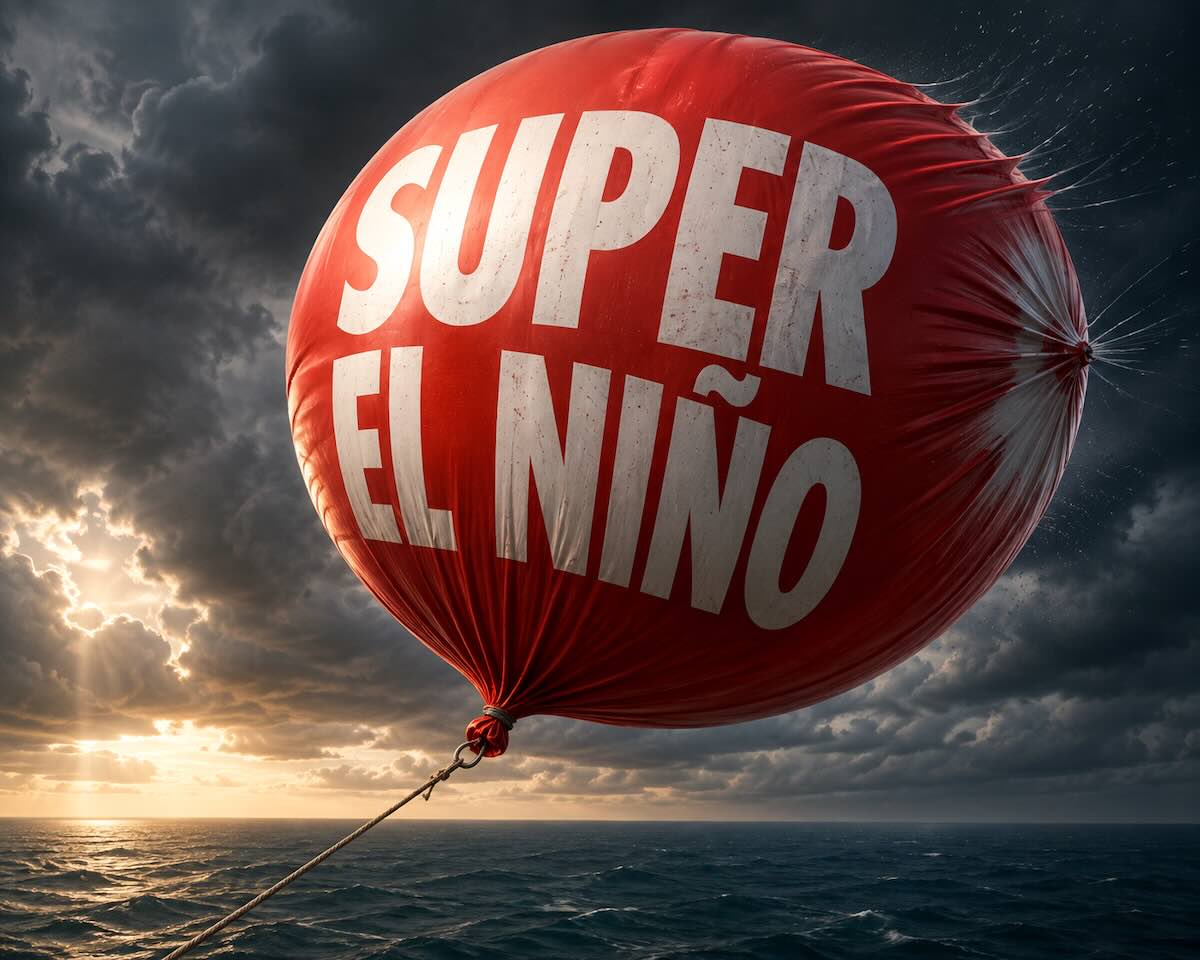
Deutsche Welle (DW) claims in “How climate change is teaming up with ‘Super El Niño'” that a developing “Super El Niño,” combined with climate change, could make 2026 one of the hottest years on record while increasing the risks of heat waves, wildfires, droughts, hurricanes, and marine heat waves around the world. [some emphasis, links added]
This is highly misleading.
El Niños are long-recognized naturally recurring ocean-atmosphere cycles that have operated for thousands of years, and strong El Niño events have occurred periodically throughout history, long before industrial greenhouse gas emissions began to increase.
The first red flag appears in the headline itself. There is no official meteorological definition of a “Super El Niño.”
Neither the World Meteorological Organization, the National Oceanic and Atmospheric Administration’s Climate Prediction Center, nor the American Meteorological Society recognizes “Super El Niño” as a formal scientific classification.
Meteorologists describe El Niño events by measuring sea surface temperature anomalies in the Niño 3.4 region of the tropical Pacific. They may characterize an event as weak, moderate, strong, or very strong, but “Super El Niño” is largely a media invention designed to make a naturally occurring climate pattern sound unprecedented.
That alone should make readers skeptical.
El Niño is not a new phenomenon, nor is it evidence of climate change. Long before automobiles, coal-fired power plants, or industrial emissions existed, El Niño events periodically warmed the tropical Pacific Ocean, temporarily altering normal weather patterns around the globe.
Paleoclimate records from corals, lake sediments, and other shell middens, and other proxy data show that El Niño events have repeatedly occurred for thousands of years.
Nothing about its existence is evidence of a climate crisis. DW also suggests that climate change is “teaming up” with El Niño to produce record warmth.
That statement reverses cause and effect.
El Niño transfers enormous amounts of stored ocean heat into the atmosphere. That is precisely why global temperatures often spike during strong El Niño years and then decline as La Niña conditions return. This pattern has repeated for centuries.
The strong 1997-98 El Niño produced record global temperatures.
The powerful 2015-16 El Niño did the same.
More recently, the 2023-24 El Niño contributed to another jump in global temperatures before they began moderating as the event weakened. [This sequence is not unprecedented], as shown in the Figure below.
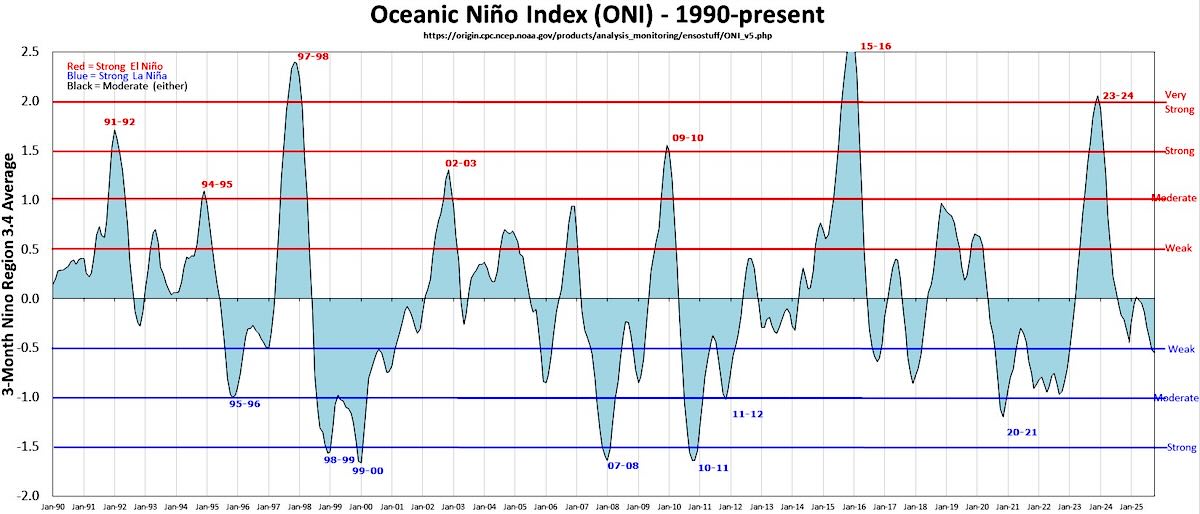
It is exactly what climatologists expect from a strong El Niño. DW further claims that El Niño could intensify heat waves, wildfires, droughts, hurricanes, and marine heat waves worldwide.
Some of those statements contain a speck of truth, but mostly they are misleading talking points.
El Niño does influence weather patterns globally. It can make some regions temporarily wetter and others drier. It can suppress Atlantic hurricane activity while increasing hurricane activity in parts of the Pacific. It affects rainfall, temperatures, and storm tracks across much of the globe.
But that is very different from claiming El Niño automatically causes more weather disasters worldwide.
Wildfires depend on ignition sources, fuel loads, forest management, humidity, and local weather. Heat waves have occurred throughout recorded history, long before anyone worried about greenhouse gases. Droughts and floods are influenced by regional circulation patterns that vary considerably from one El Niño event to another.
Simply invoking El Niño and climate change together does not establish that either is responsible for any particular extreme weather event, much less every such event. DW also repeats a common media refrain: climate change remains “the main driver” of rising temperatures while El Niño merely amplifies its effects.
DW presents the claim as settled fact, but offers no evidence to support it.
In reality, year-to-year changes in global temperature are overwhelmingly dominated by natural variability, particularly the transition between El Niño and La Niña. That is why global temperatures can rise sharply during a strong El Niño and then level off or even decline afterward.
Over decades and centuries, other natural oceanic current patterns, like the Atlantic Meridional Overturning Circulation and the Pacific Meridional Overturning Circulation, are significant factors in climate change as they redistribute ocean heat.
Natural variability remains a major driver of short-term climate fluctuations. Perhaps the biggest journalistic failure is that DW never distinguishes between weather forecasting and climate attribution.
Forecasting that a strong El Niño may influence global weather over the coming months is reasonable science. Claiming that climate change is “teaming up” with El Niño to produce nearly every type of extreme weather is speculation. Those are not the same thing.
The article also hints that 2027 could be even hotter, even as it acknowledges that the future evolution of El Niño remains uncertain. That is another projection built upon assumptions, not observations.
No one knows today what the global average temperature will be in 2027 because it will depend on countless variables, including the evolution of ENSO, volcanic activity, cloud cover, ocean circulation, and other natural influences that cannot be predicted with certainty years in advance.
Good journalism should help readers understand the difference between natural climate variability and long-term climate trends. DW’s story linking the developing strong El Niño to climate change is not good journalism.
Readers deserve better than catchy labels and speculative headlines. They deserve reporting that distinguishes between what scientists actually know, what climate models project, and what remains uncertain.
In this case, DW chose drama over clarity, turning one of Earth’s oldest natural climate cycles into yet another vehicle for climate alarmism.
Read more at Climate Realism