

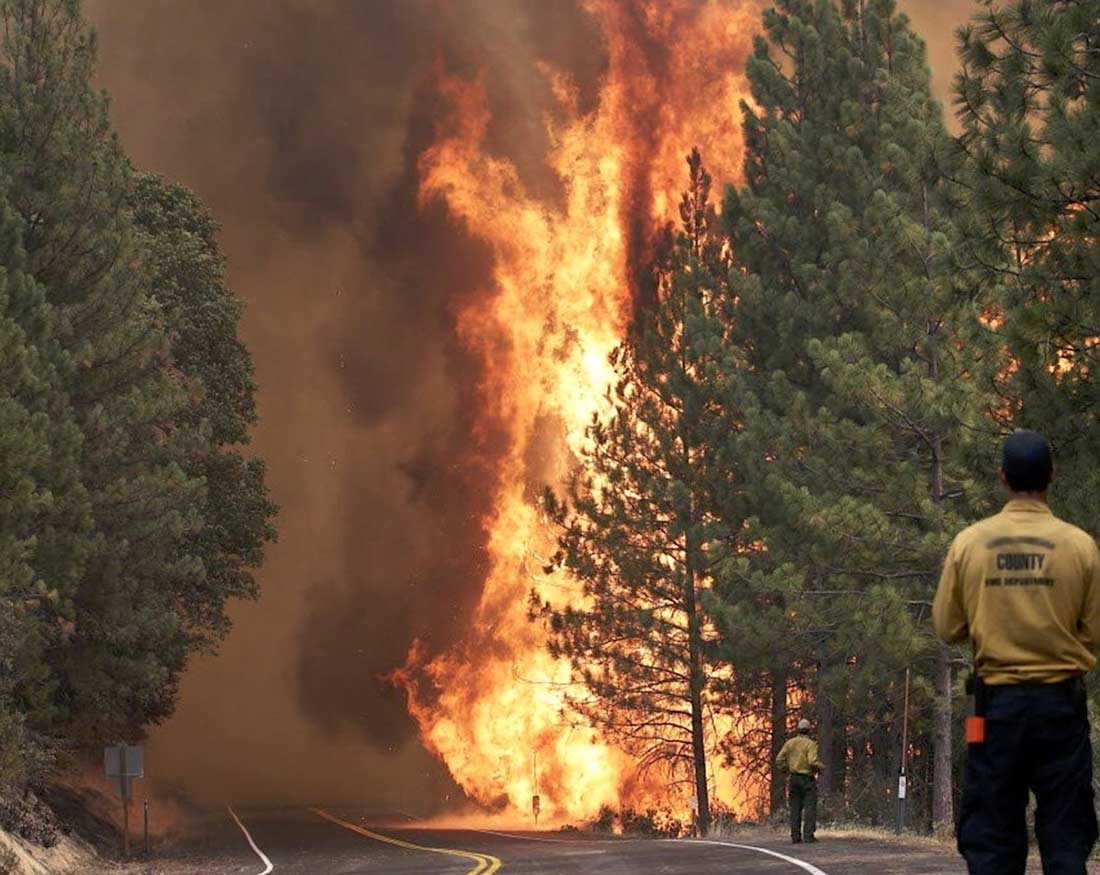
A recent article at the Los Angeles Times (LAT) titled, “Georgia blaze shows how climate change has led to more wildfires in the East,” claims that the Eastern United States is suffering from more extreme and frequent wildfires due to climate change. [some emphasis, links added]
This is false. Data show no trend in an increase in fires, though it is not unreasonable to be concerned about fire-fuel buildup from hurricane damage.
The LAT writes that “wildfires are becoming more intense, frequent and damaging in the East, such as last week’s blaze that destroyed dozens of homes in Georgia, fire scientists said.”
The fire scientists attribute the fires to “climate change causing fuel to dry out and be more flammable, a record drought, tens of millions of tons of dead trees from Hurricane Helene, and the vast area where dense forests and high numbers of people try to coexist,” with the article really emphasizing the climate angle.
There are a few parts to this claim: Are wildfires getting worse in Georgia? Are climate conditions in Georgia becoming more conducive to fire outbreaks? And is this because of global climate change?
In support of its claim, the LAT article relies on a 2023 study, “Increasing Large Wildfire in the Eastern United States,” published in Geophysical Research Letters by fire ecologists from the University of Florida.
The study, especially for the state of Georgia in particular, uses a seriously flawed methodology.
Their data were taken from the Monitoring Trends in Burn Severity Database (MTBS), a joint project of the U.S. Department of Agriculture (USDA), the U.S. Forest Service, and the U.S. Geological Survey.
In particular, it uses the MTBS’ “burned area boundary product” to account for wildfire perimeter data combined with the USDA’s Fire Program Analysis Fire Occurrence Database for information on how the fires were started (human or lightning).
The study specifically targets what they define as “large” wildfires, relying entirely on statistical analysis rather than a straightforward mapping of the number of fires in a region and totaling up the acreage burned across time.
Statistical modeling and analysis can be reasonable when data are sparse or incomplete, but are unnecessary for measurements like this when straightforward measured data exist.
Relying on p-values and tau can sometimes “find” a trend where there really isn’t one, especially if a year has “freak” wildfires that really are not indicative of any long-term trend.
The study looks not at particular states, but the EPA determined “ecoregions,” and Georgia is crossed by three of their listed regions that span very long longitudinal (North-South) areas, designated as the “Piedmont” region, “Southeastern Plains,” and “Southern Coastal Plain,” the latter two making up most of the state.
With a wildfire count of three, the Southern Coastal Plain has the highest total wildfire count of all the ecoregions examined.
An examination of the MTBS data using their exploration tool to chart the annual burn severity for Georgia shows this as an output:
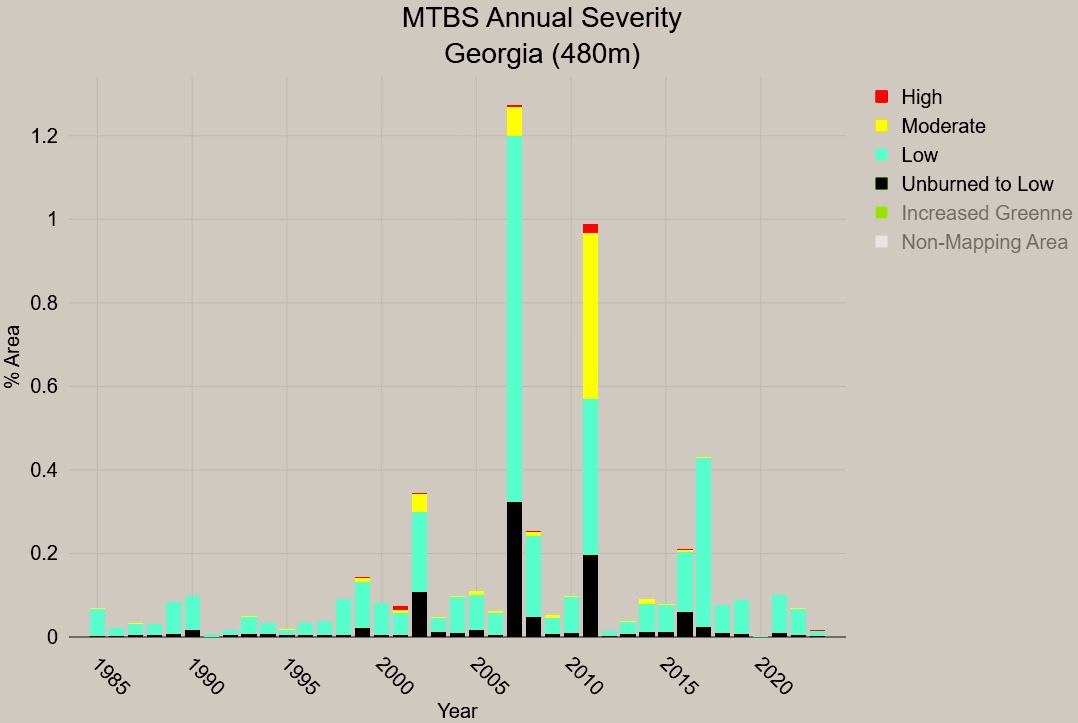
There are a few years in that dataset that show spikes in burn areas, all of which correspond to periods of extended multi-year droughts combined with known heavy fuel loads.
Long periods of drought are a natural part of Georgia’s climate, especially in the coastal plains, because of a periodic and known pressure system offshore called “The Bermuda High.” When it comes closer to shore and extends into the Southeast, and is combined with La Niña years, severe drought follows.
There is no particular long-term trend of extended periods of drought in the state, with the driest years in state history occurring in the 1930s, ’50s, and ’80s, decades of greenhouse gas emissions and global warming ago.
Looking closer at more on-the-ground wildfire reporting, the National Interagency Fire Center keeps state-by-state wildfire data. From 2006 to 2025, there is again no particular trend in fires in Georgia.
In fact, the number of fires seems to have declined over the past 20 years.
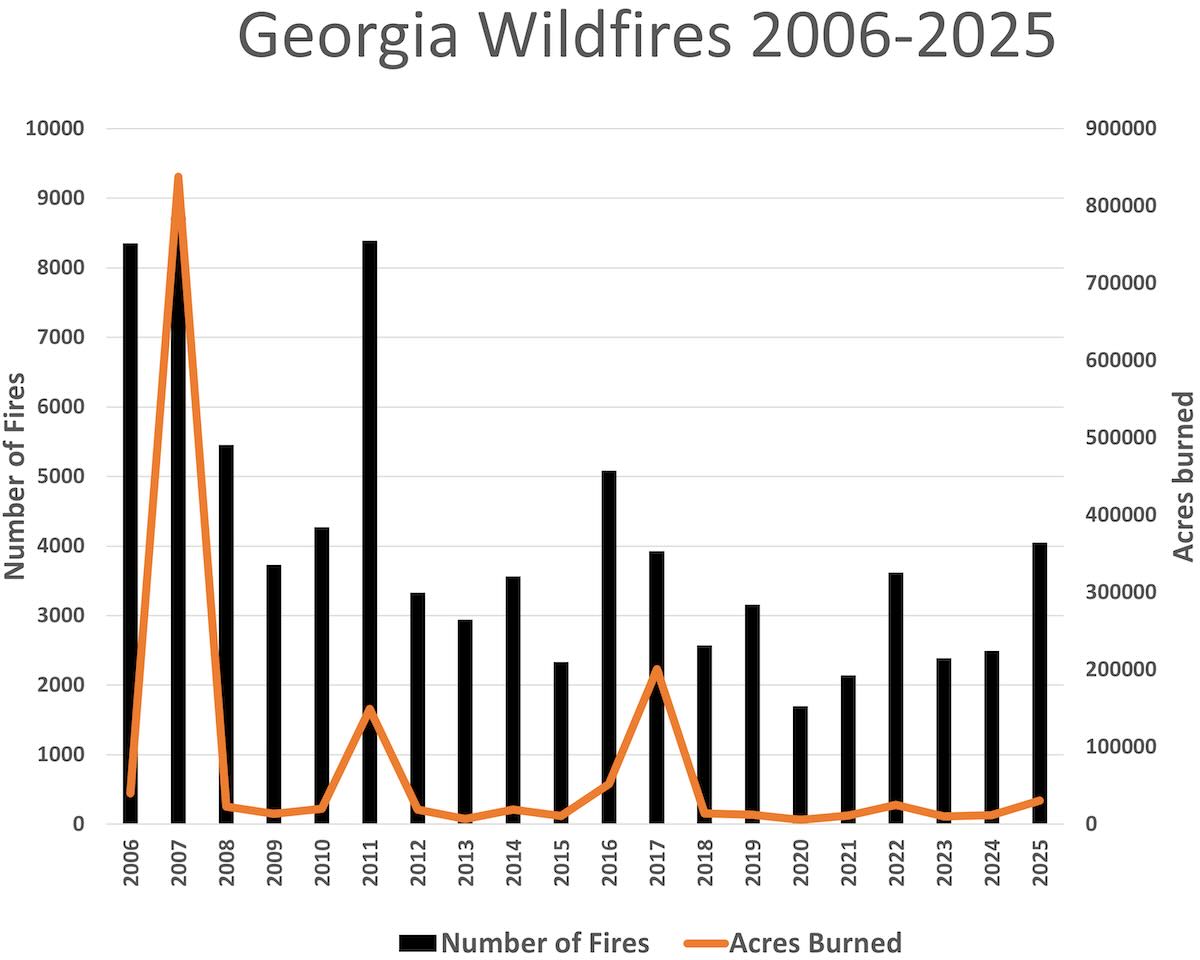
This is unsurprising since data from NASA and the European Space Agency both show a marked decline in wildfires globally over the past few decades. Georgia is part of the larger trend of less severe, less frequent wildfires across the planet.
Also, fires that burn larger areas are not necessarily because of conditions resulting from climate change, but are heavily influenced by land-use changes and, as the paper acknowledges, human encroachment on wild areas and an excess of burnable material.
This is particularly a problem for Georgia right now, as the LAT article explains:
“13,954 square miles of forest land was hit by Hurricane Helene, downing more than 26 million tons of pine and 30 million tons of hardwood,” which an interviewed scientist called “a ticking time bomb.”
This is especially true in drought conditions. But this is a problem that can be fixed with the clearing of that burnable material. It is a local, politically induced environmental problem, not a climate problem.
The timber could have been recovered and used. Instead, Georgia officials decided to let nature take its course.
As this post is written, two wildfires are burning in Georgia that are very severe. They have already destroyed more than 100 homes and tens of thousands of acres of land.
The fact of the matter is that wildfires are massively influenced by land use and management, and they can get out of control when conditions are right. High winds and drought have considerably added to the spread of these fires, similar to the conditions in 2007.
But since there is no long-term trend in worsening drought in Georgia, rather just a couple of bad years similar to dozens recorded historically, and given there is no evidence that climate change is changing wind speeds in Georgia or elsewhere, climate change can’t be blamed for the present fire conditions.
There is no need to focus on climate change when discussing these natural disasters, especially when it is the supposed villain in the climate discussion – petroleum products—which make it possible to fight these fires in the first place by fueling aircraft and vehicles, and delivering fast, reliable power to aid efforts and disaster cleanup.
Perhaps, when reporting on disasters, especially disasters out of state, the Los Angeles Times should do a little research rather than referencing a single, flawed study to claim a climate-induced disaster is happening.
Real-world data trumps both theory and statistical analyses, and it’s time the LAT acknowledged that.
Read more at Climate Realism



This article is about fuel loads and simply highlights that fire will not exist without fuel. It is the one element to fire that we humans can control. We can’t control ignition or fuel (vapours) oxygen mix.
Here in Australia, control burnings in early spring and late autumn are never up to date re the area to be burnt. The added problem to this is arsonists who are for whatever reason, determined to cause damage to people and their property.
In regard to the effects of drought, most often those areas (in Australia) are free of ground based fuel because nothing has grown – a result of the drought. This is especially the case in central Australia.
The best solution to arson, which is always near populated areas, is gaol time for offenders and watchful authorities and communities. Use of hidden cameras is really good.
Two of the largest and most destructive fires — the Pineland Road Fire and the Highway 82 Fire — started on April 23, 2026. The Pineland Road Fire ignited after sparks from welding a gate fell onto private forest land, while the Highway 82 Fire began when a mylar balloon landed on a power line, creating an electrical arc that ignited the ground
the causes of these fires were human just like 90% of the forest fires in the united states
the fires are not started by poor forest management
Georgia experienced record-breaking dryness from January through March 2026, with precipitation deficits far below normal and drought conditions worsening across the state
the fires were not started by drought conditions
while wildfire season in Georgia can vary year to year,
most fires occur between January and April