

You’d think that the Iran war would have been good news for EV sales, given the boost in gasoline prices and general uncertainty it sparked. Instead, it might someday mark the beginning of the end of the left’s EV dreams. [some emphasis, links added]
New EV sales in April – the second full month of the war – were down 6.2% compared with March, and down a whopping 23% from the year before, according to Cox Automotive.
True, overall car sales were down last month, but just by 5.4% year over year, and 1.9% from March.
In other words, people were increasingly turning to gasoline-powered cars when they bought in April. And that’s even though searches for EV cars were up.
More people are searching for EVs, and fewer are buying them. That’s not exactly something you’d want to put in a promotional campaign.
And check out this chart from S&P Global.
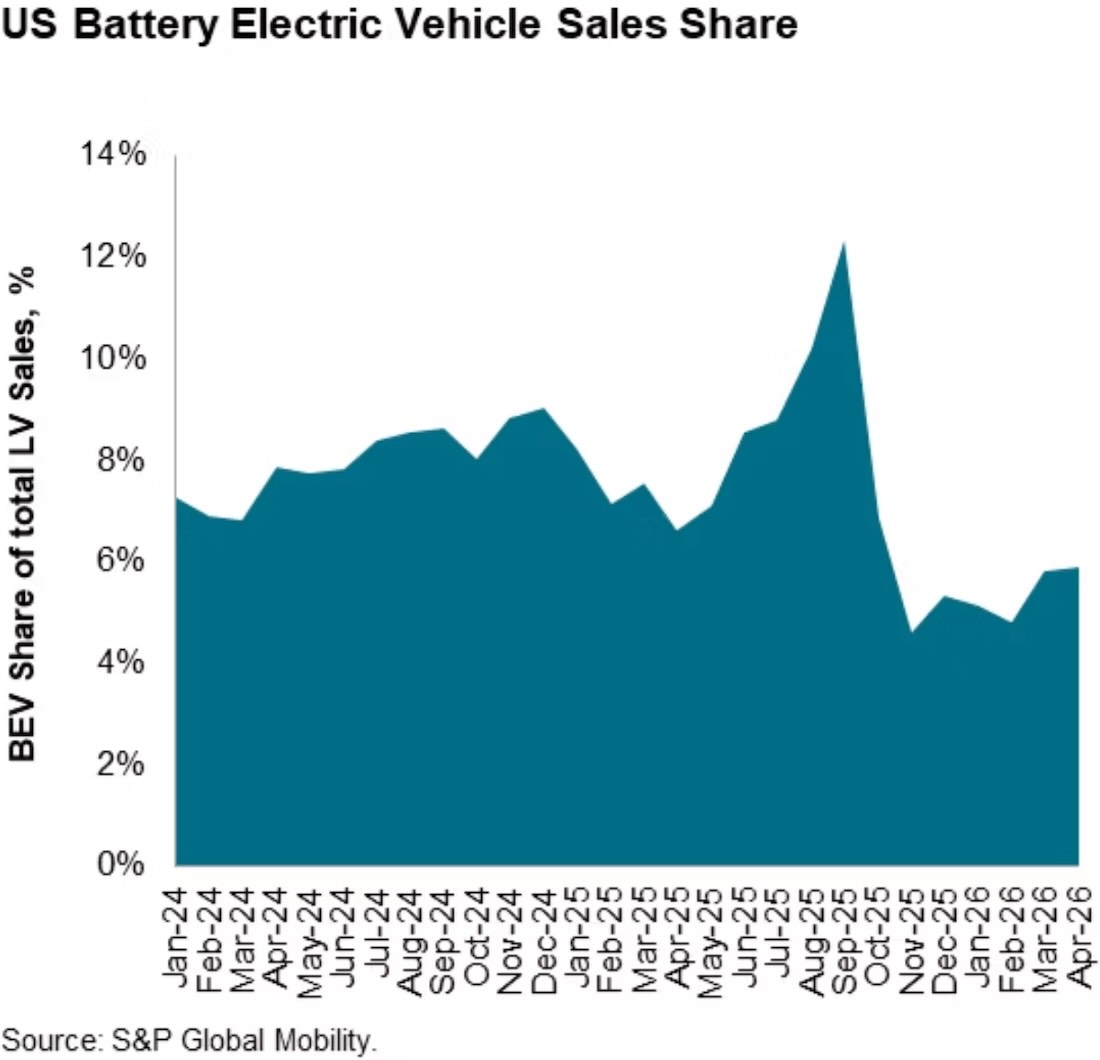
It shows that EVs’ market share was heavily dependent on federal taxpayer subsidies, which have been down ever since they were canceled at the end of September. (The spike before that was the result of buyers trying to beat the end of this EV welfare program.)
But here’s the really juicy tidbit. The New Car Dealers Association reports that registrations of new EVs in California in the first quarter of this year were 40% below Q1 2025.
This is the state that has done the most to force people into electric cars, including high gasoline prices, currently above $6 a gallon.
Read rest at Issues & Insights








In April 2026, combined US plug-in electric vehicle (PEV) sales—which include battery-electric vehicles (BEVs) and plug-in hybrid electric vehicles (PHEVs)—fell to roughly 82,800 units, representing a sharp 35.9% decline compared to the same period in April 2025.
April 2026 v. April 2025
Hybrid Volume (HEV) Up 10.1%
Battery Electric Vehicles (BEV) Down 23.1%
Plug-In Hybrids (PHEV) Down 35.9%
Internal Combustion (ICE Gas Only) Down 6.5%
The cost of gas will eventually go down but the price of electricity that is corrupted by intermittent inputs from wind and sun will continue to go up especiaaly due to the massive demand for transmission lines.
Not a surprise that EV sales are tanking as the chart shows. And that in Trump’s first year in his second term that the sales spiked just before the federal gravy train ended (same with solar panels and wind turbines). But a certain individual who posts here regularly doesn’t seem to understand how government subsidies actually do change behavior and that the lack of those subsidies causes buying decisions to revert to actual demand.