

A recent post at Phys.org, “Climate change makes extreme West Africa rainfall five times likelier, study finds,” relies on a weather attribution study to assert that recent heavy rainfall and subsequent flooding in West Africa were made more likely in what the attribution group calls a “pre-industrial climate.” [some emphasis, links added]
This is misleading.
History shows heavy rains and flooding are not uncommon across West Africa. The regional rainy seasons are driven by a combination of factors, including long-term ocean patterns and the West African monsoon.
Citing claims from World Weather Attribution (WWA), a climate-activist group formed specifically to link climate change to weather events, Phys.org reports that heavy rains, once considered rare, are becoming more frequent. This is false.
Seasonal heavy rain is a characteristic feature of the regional climate pattern. Although recent decades might be seeing a local (albeit sporadic) trend towards heavier rainfall, it’s largely due to recovery from a larger multi-decadal climate pattern.
In addition, even WWA’s authors admit that urbanization and land subsidence have a large impact on flooding that cannot be blamed on climate change alone. This means that human interventions can significantly influence any potential danger posed by weather, whether or not warming is involved.
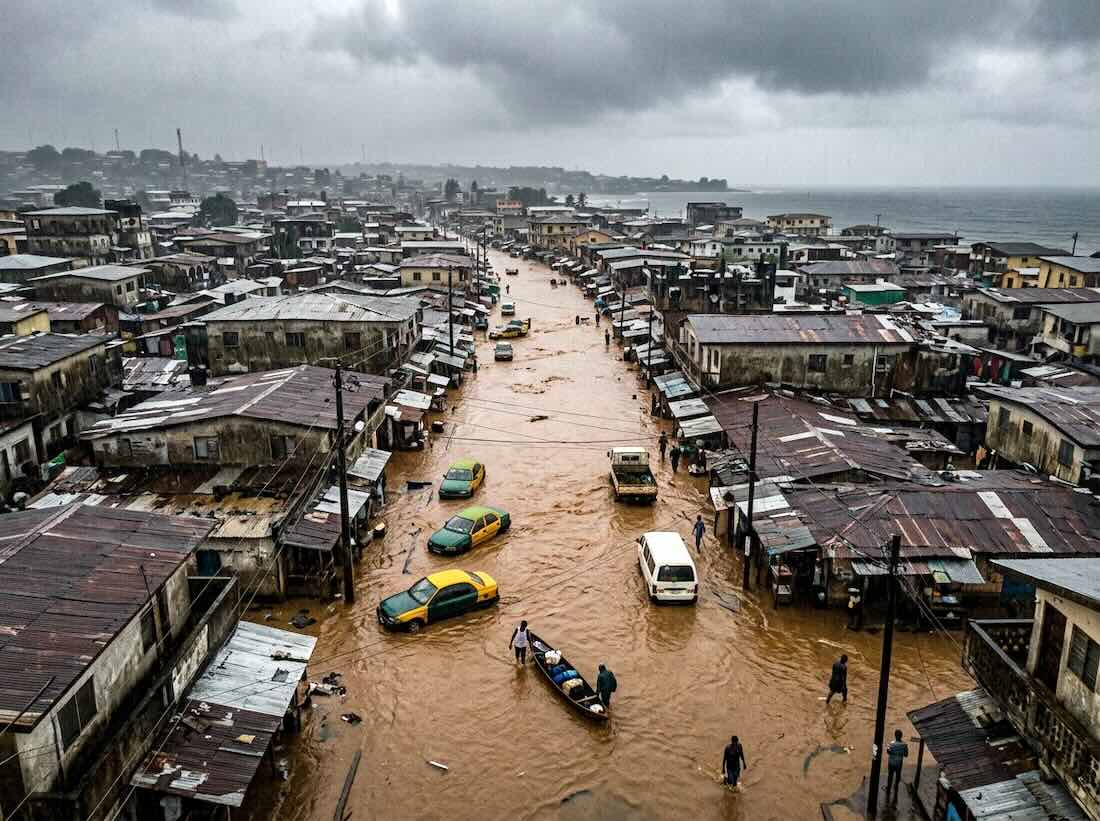
The Phy.org post reports on May and June’s heavy rainfall in West African coastal countries, from the Ivory Coast to Nigeria, which led to deadly flooding and structural damage.
Phy.org cites WWA, which wrote that “climate change driven by human greenhouse gas emissions had increased the likelihood of the rains that caused the floods while also boosting their intensity by between 4% and 23%.”
WWA goes on to claim that the events were “once considered rare” but now are “expected every two or four years in the region.” It should be noted that 4% and 23% are very different; this is a massive range of uncertainty.
The study relies on the idea that warmer air holds more moisture, and thus leads to heavier rainfall. Although this is true in general in isolation from local conditions, there are multiple problems with this simplistic model as presented in the mainstream media.
The maximum amount of water vapor the air can hold does go up with warmer temperatures—under certain pressure conditions. Temperature highs do not correlate directly in all scenarios with precipitable water and humidity.
For example, 100℉ temperatures in the high plains desert do not lead to heavier rainfall than 90℉ temperatures in Florida.
Topography also impacts rainfall: orographic lift describes when air is driven up the side of a mountain; on the windward side where the air is rising, moisture condenses and precipitates out. There will be heavier precipitation on the windward side, which in West Africa is on the side of the coastal villages.
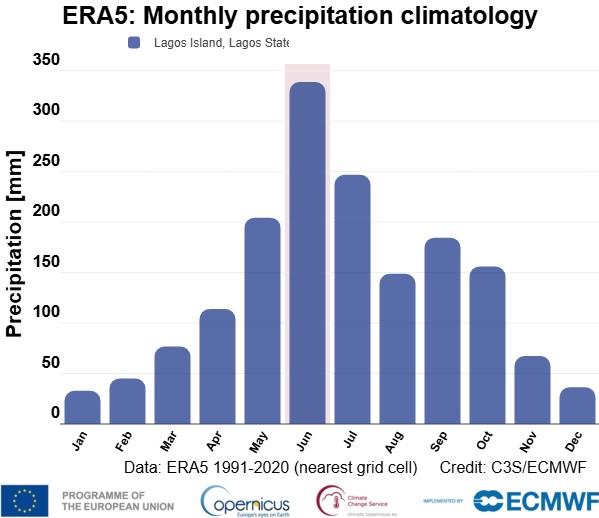
June is by far the rainiest month for West African coastal cities. Lagos, Nigeria, for instance, has historically experienced a significant increase in rainfall average from May to June. (See chart below)
In the northern region of West Africa, countries like Mali, Niger, and Burkina Faso experience a three-month rainy season annually, typically running from July through September.
The coastal countries in southern West Africa—Ghana, Togo, Benin, and Nigeria—experience two rainy seasons, April through July, and a shorter rainy season from September to October.
Across the region, these rainy seasons are driven by a long-term climate pattern called the Atlantic Multidecadal Oscillation, which drives changes in sea surface temperatures over several decades, swinging from negative (dry) to positive (wet) phases.
A 2025 study published in Springer’s Bulletin of the National Research Centre finds that the current trend towards more “extreme” rain has only been happening since the AMO entered a positive phase in the 1990s; before that, it was suffering from very dry conditions caused by previous negative AMO:
The Atlantic Multidecadal Oscillation (AMO) is one of the key drivers of long-term rainfall variability in West Africa.
Different studies have pointed out that rainfall variability in the tropics, including Nigeria, is an important factor due to complex interactions between global and regional climate drivers such as the El Niño–Southern Oscillation (ENSO) and the Atlantic Multidecadal Oscillation (AMO) (Ogunrinde et al. 2024; Okonkwo et al. 2015). South-Western Nigeria has [transitioned] from the negative AMO period of the 1980s and early 1990s with aridity to the favourable AMO period of the late 1990s to the [present] with more frequent extreme rain events (Zhang et al. 2021).
WWA’s study looks at the Gulf of Guinea region, which includes several countries, averaging out “extreme precipitation” over the entire area, which necessarily ignores regional and local differences.
But, of course, a nuanced description of conditions on the ground undercuts the assertion that global warming alone has led to a general widespread increase in precipitation.
This is typical of the advocacy-driven, rapidly produced work released by WWA, as Climate Realism has discussed in multiple posts before.
In fact, various studies come to different conclusions. Each study uses a different kind of statistical analysis, and it is notable that even within a single country the trend in extreme rainfall varies regionally.
WWA admits that the rainfall in Ghana was not unprecedented, with June rainfall being described as the “highest level since 1995.”
What they also admit in the first bullet point of their press release is that urbanization plays a big role in the dangerous flooding itself — an acknowledgment that Phys.org devotes only a partial single sentence to.
All Phys.org reports is that the researchers “said fast-growing coastal cities were particularly vulnerable because of rapid urbanization in flood-prone areas.”
But WWA was more explicit, writing “rapid urbanization and the expansion of formal and informal settlements into floodplains and conversion of natural vegetation to croplands have reduced natural drainage capacity and increased exposure to flooding.”
Deforestation both for agriculture and urban expansion is a big problem across West Africa. This contributes to flooding in two ways.
First, forests slow the flow of precipitation, allowing it to seep into the soil where it is used by the trees and underbrush.
Second, denuded soil, when not simply washed away, becomes hardened and compacted in the heat, meaning when rain falls it runs swiftly into streams and rivers, increasing flooding.
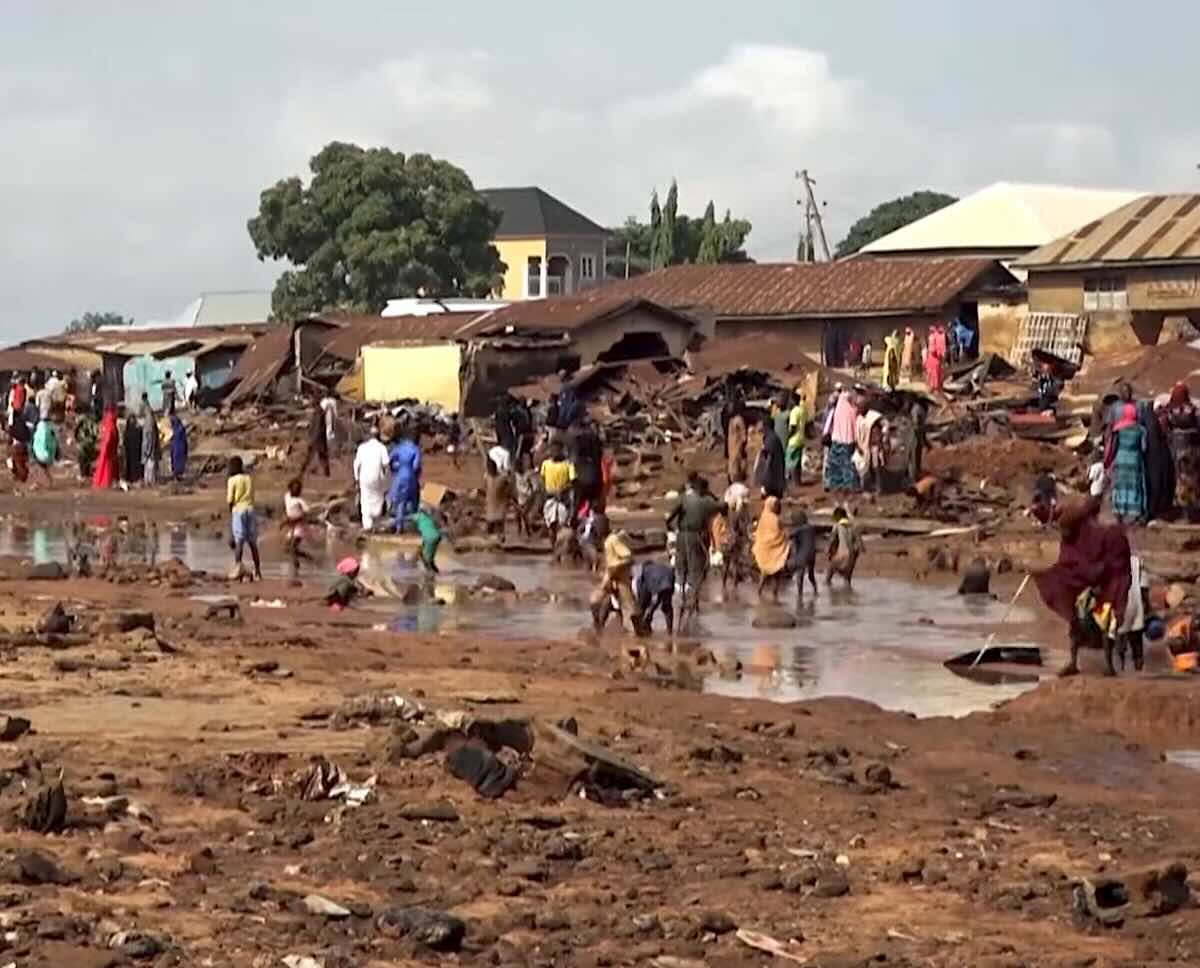
Here, WWA accidentally highlights (and Phys.org buries) the main issue, the actual danger to human wellbeing in the region. As Climate Realism has pointed out previously (here, here, and here), flooding in urbanized parts of West Africa and other parts of Africa is largely due to poor urban planning, the infilling of wetlands, lack of water-handling infrastructure, and often careless deforestation.
Towns destroyed by floods are rebuilt without accounting for potential future weather disasters, even in areas known to get heavy rainfall.
Scientists and urban planners have pointed out that poor water-handling infrastructure greatly exacerbates flooding from heavy rainfall, regardless of climate change.
The good news is, these are problems that can be fixed, unlike the weather itself.
Phys.org, among other media outlets, loves latching on to the climate change-related claims made by alarmist groups like WWA, while downplaying contributing or leading factors that can result in ordinary cyclical weather patterns hitting people and communities harder.
It is lying by omission and needs to stop. Until reporting becomes more honest, perhaps audiences should stop listening.
Read more at Climate Realism




Just like the climate models “attribution studies” are garbage. This group can make any event attributable to “climate change” via these attribution studies. And yet the gullible press just spew out whatever they are given. No critical thought, no asking questions, no checking experts in those fields that aren’t bought and paid for by governments and left-wing groups.
Gullible press? Newspapers make money from advertising. The greater the circulation, the more they can charge for that advertising. Circulation relies on ‘grabbing’ the public’s attention. Horror stories do that. A stanza from a song in Australia in the 1960’s:
They asked me on a TV show, to sing a song the viewers would know,
I rehearsed ‘Where have all the flowers gone”, they said “Cut a verse it’s a bit too long”,
I explained the song had a message to tell, they said “We’ve got a new toilet tissue to sell.”
It’s all about the money.