An under-the-radar legal switcheroo should concern every business leader, investor, and taxpayer in America. Now, 23 state attorneys general have taken notice and sent a letter to the Administrative Office of U.S. Courts that bolsters the efforts of three eminent scientists who sounded the alarm. [some emphasis, links added]
Climate activists have found a way to get their preferred evidence standards into the hands of roughly 6,000 federal and state judges—before those judges hear more than 1,000 pending climate cases that could reshape the American economy.
They did it through a handbook.
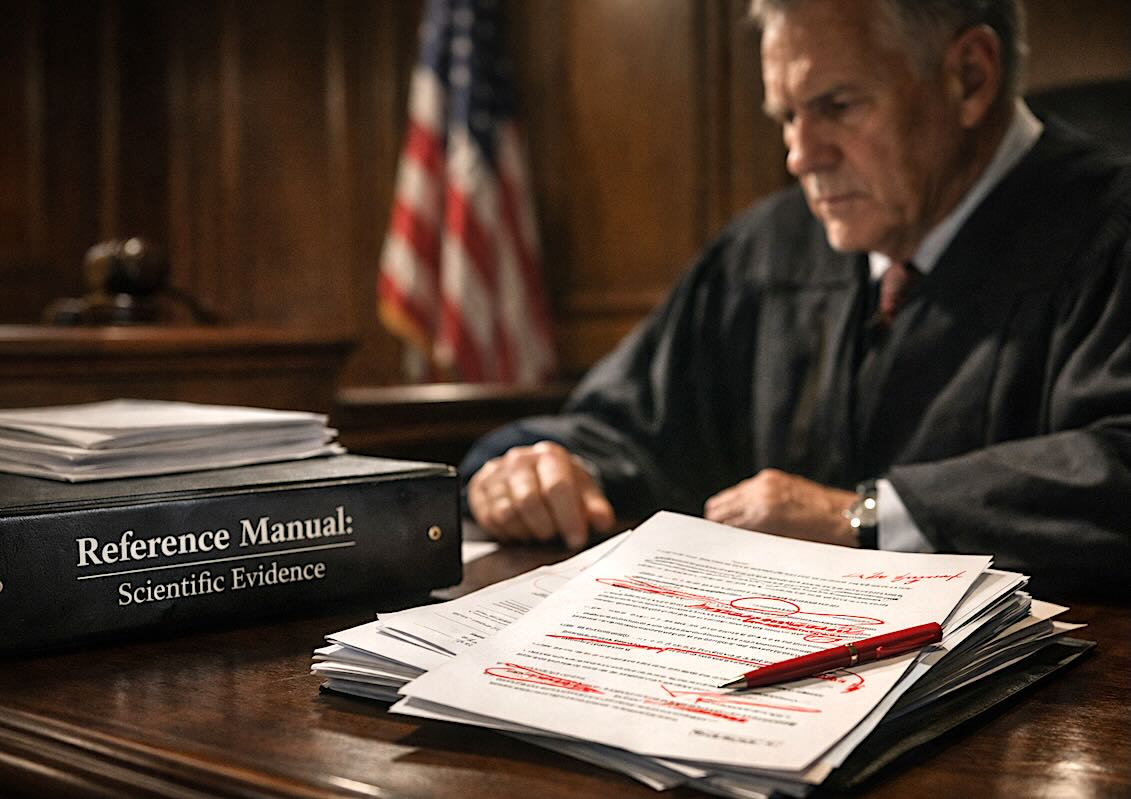
The Federal Judicial Center (FJC) and the National Academy of Sciences (NAS) jointly publish the Reference Manual on Scientific Evidence.
Very few Americans realize that Congress established the FJC in 1967 as the research and education arm of the federal courts and made the chief justice of the U.S. its chair.
For decades, the FJC collaborated with the NAS, giving judges objective, apolitical guidance on evaluating scientific claims in the courtroom.
The motivation is obvious, if often taken for granted by the American public: give judges the tools and standards to admit scientific evidence that is objectively true, and reject quackery and scientifically invalid hypotheses that would bias the judicial proceedings.
The manual is that guidance, and the fourth edition has just been released.
Three eminent scientists who’ve read the manual immediately started ringing alarm bells. According to Richard Lindzen of MIT, William Happer of Princeton, and Steven Koonin of Stanford’s Hoover Institution, the new chapter on “How Science Works” has a problem.

In an April 1 letter to Chief Justice John Roberts, the three scientists argue that the chapter—which balloons from 18 pages in the prior edition to 65—quietly swaps out the scientific method for something inherently more political: “scientific consensus.”
In so doing, the new version flies in the face of Supreme Court precedent that has shaped the legal evaluation of scientific evidence since 1993.
That distinction matters more than it sounds.
The scientific method is a familiar process: form a hypothesis, design an experiment that could prove it wrong, and let the data speak. A claim that cannot in principle be falsified isn’t science.
Consensus, by contrast, is a survey of opinions. It can reflect rigorous work, or it can reflect fashion, funding pressure, or institutional inertia. The two are not interchangeable. The Supreme Court has already said so.
In Daubert v. Merrell Dow Pharmaceuticals (1993), the Supreme Court ruled that the scientific method must govern scientific evidence. Is the theory testable? Has it been tested? Is there a known error rate? Has it been subjected to peer review?
Daubert marked a deliberate move away from consensus and toward method. The scientists writing to Roberts argue that the new chapter walks that back—instructing judges to admit evidence on precisely the grounds Daubert rejected.
The Daubert standard, as it became known, guided judges on what scientific evidence to allow based on academic method, not popularity. Lindzen, Happer, and Koonin argue that the rewritten chapter reverses that standard.
The timing could not be more consequential. The letter from the scientists points out that more than 1,000 climate-related cases are now working through state and federal courts, many pursuing damages from energy producers under theories that require attributing specific harms to specific emissions.
The EPA is simultaneously moving to reconsider its 2009 “endangerment finding”—the Obama-era rule declaring carbon dioxide a pollutant under the Clean Air Act, the regulatory linchpin that has justified sweeping federal climate policy ever since.
Challenges to that finding have already begun working their way through the courts. The endangerment finding was itself the result of a 2007 Supreme Court ruling, Massachusetts v EPA. The Obama EPA then interpreted that ruling to give them wide latitude to create new rules that the defining statute didn’t explicitly permit.
How judges evaluate scientific evidence in these cases carries stakes that measure, without exaggeration, in the trillions of dollars—in compliance costs, regulations, energy prices, permitting timelines, and the wider investment climate.
For those making capital allocation decisions today, the question of whether courts will apply Daubert‘s methodological standard or a softer consensus test is a material variable, not an abstraction.
A second Supreme Court decision makes the manual’s influence even larger. Last year’s Loper Bright Enterprises v. Raimondo overturned Chevron deference, ending four decades of practice in which judges deferred to federal agencies’ interpretations of ambiguous statutes.
Judges must now read the law themselves. That shift places more weight on the scientific record that courts independently assemble—and on the manual that shapes how they read it.
A handbook that quietly rehabilitates “widespread acceptance” as a standard achieved through evidentiary backchannels, what Loper Bright foreclosed through statutory ones.
Reasonable scientists disagree about how much weight consensus should carry, and the climate field in particular has long blurred the line between empirical findings and policy preferences.
But a manual distributed to thousands of judges is not the place to take a side in that argument. The manual should give judges the cleanest possible account of how to tell rigorous work from advocacy dressed up as consensus.
According to scientists, the earlier 18-page version did that; Lindzen, Happer, and Koonin simply asked for it back.
Chief Justice John Roberts has a straightforward option. As chair of the FJC, he can direct the center to restore the previous chapter or commission a new one written tightly around the methodology Daubert requires. It is a simple act of housekeeping to insist that a handbook for judges reflect the Court’s own evidence standard.
Roberts has the institutional lever to correct course.
By directing the FJC to revert to the earlier, concise, and methodologically sound chapter, he can reaffirm that American jurisprudence rests on evidence tested by the scientific method—not agenda-driven narratives.
The result would support lower energy costs, greater consumer choice, and economic growth unburdened by regulations lacking a rigorous scientific foundation.
Happer, Lindzen, and Koonin have done a public service by bringing this to the chief justice’s attention. Chief Justice Roberts should heed it. The integrity of the courts and the prosperity of the American people depend on it.
Read more at RealClearEnergy