

Despite several peer-reviewed, “overly alarmist” predictions of sea-ice-free summers by 2020 published in the 2010s, there has been “no statistically significant decline in September sea ice area since 2005.” [some emphasis, links added]
It is not just in the annual monthly minimum (September) that sea ice losses have paused for the past two decades; the “current pause in Arctic sea ice is seen in every single month throughout the year.”
The lack of statistically significant sea ice decline is “robust across observational datasets, metrics, and seasons,” and the length of the pause is unprecedented in the last 47 years of observations.
“[T]he 2005-2024 trend is the slowest rate of sea ice area loss over any 20-year period since the start of the satellite record.”
The paper’s polarbearsinternational.org press release details how “remarkable” it is that 2025 was the 13th year in a row (2012) in which there was no new record minimum.
Last September (2025) was the 10th lowest September minimum in the 1979-present data.
Internal Variability Explains Trends
Arctic sea ice indeed did decline rapidly from about 1995 to 2005.
However, the authors suggest internal variability (AMO, PDO) was “perhaps more” important than anthropogenic forcing in explaining this decade-long decrease.
“[I]nternal variability is at least as important, perhaps more, for explaining the steep decline during that period [1990s-2000s].”
The scientists assert internal climate variability can “totally counteract” human impacts, even driving sea ice growth in the coming decades.
The pause is expected to continue for “another five to 10 years.”
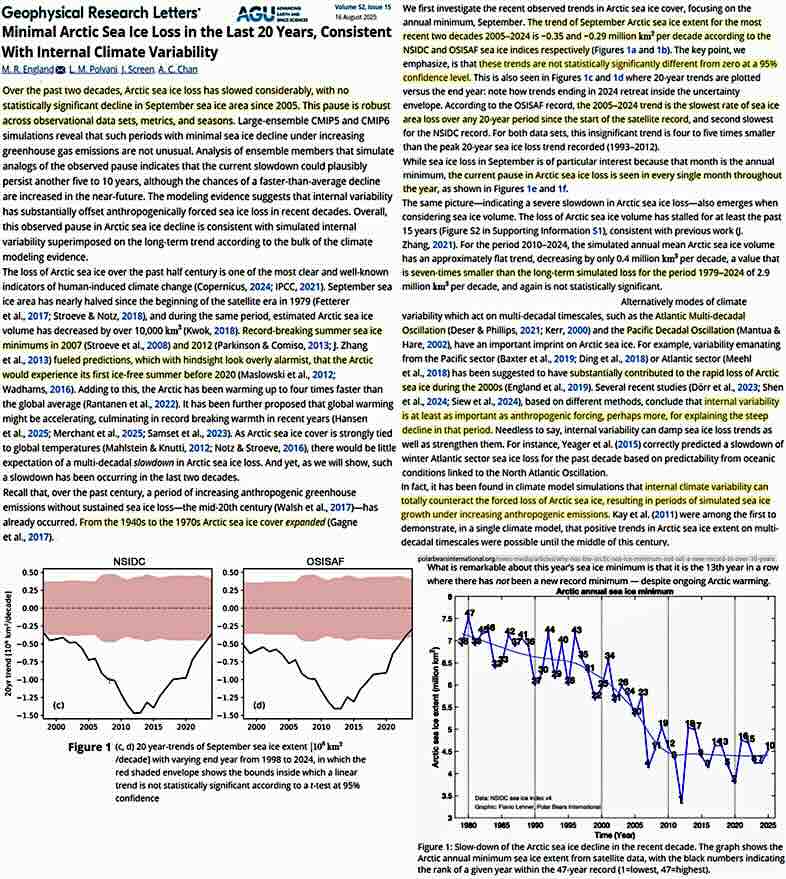
England et al., 2025, and polarbearsinternational.org press release
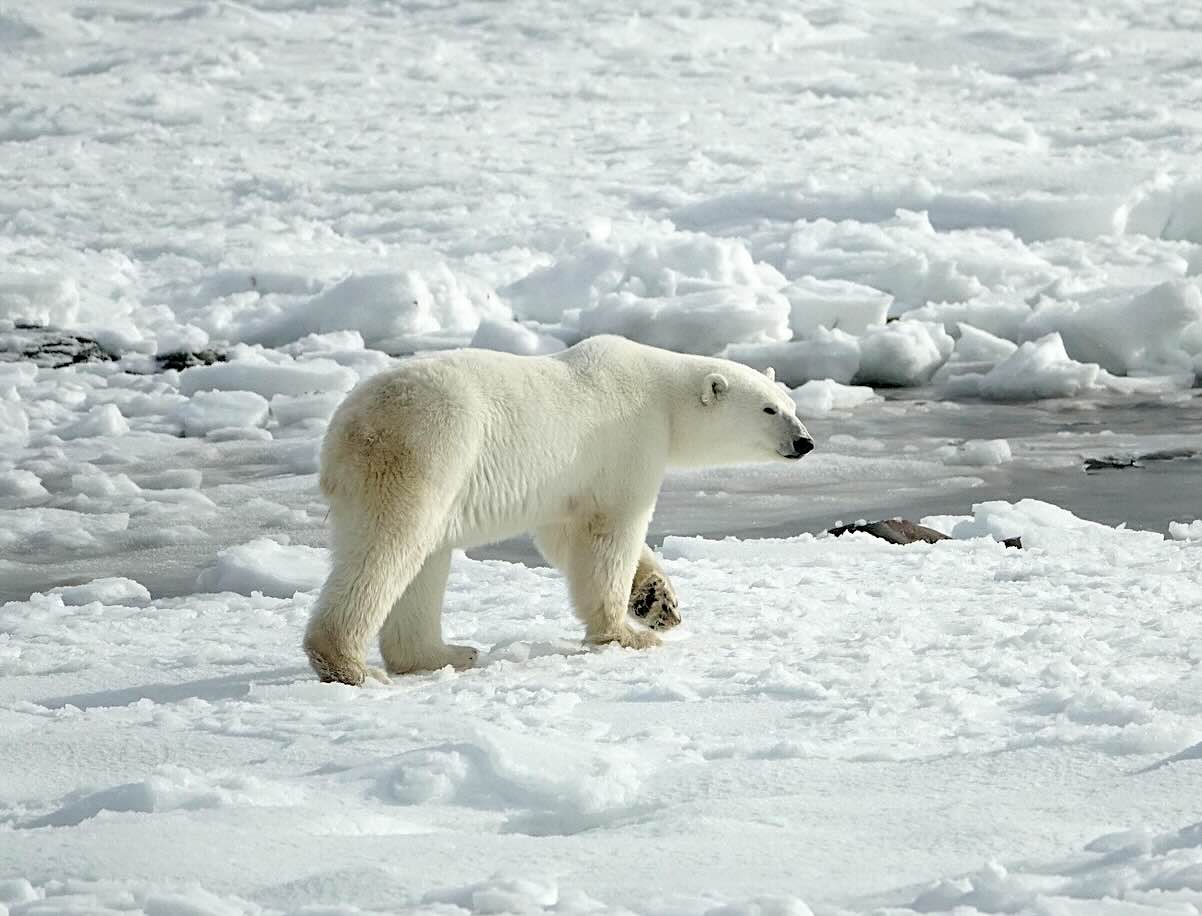
Top: Polar bear image by Margo Tanenbaum from Pixabay
Read more at No Tricks Zone





richard is the most unreliable inaccurate climate writer i have discovered in 28 years of reading
Satellite records since the late 1970s show a steady reduction in summer sea ice extent, with more melting in summer and less ice formation in winter
The National Snow and Ice Data Center (NSIDC) reports that since the start of the satellite record, the Arctic has lost about 30,000 square miles (77,800 km²) of ice per year NASA.
This loss is part of a broader decline of roughly 60% since 1900, with most of the change occurring since 1980
Recent years have seen record-low extents.
For example, in September 2024, Arctic sea ice reached its 7th lowest minimum in the satellite record, about 750,000 square miles (1.94 million km²) below the 1981–2010 average.
In 2025, the annual maximum extent was the lowest on record, and the September minimum was the 10th lowest in the 47-year record
While there have been short-term fluctuations — such as a slowdown in loss between 2007 and 2021 linked to the Arctic dipole anomaly — these are temporary.
The underlying trend remains downward, driven by Arctic amplification, where the region warms faster than the global average due to the loss of reflective sea ice
In summary, the decline in Arctic sea ice has continued for the past 40 years and is still underway, with no evidence of a long-term halt.
The rate of loss has accelerated in recent decades,
So Greene, did you go to the study that Thomas is referencing? If not, perhaps you should. If you did, how to you state that it is wrong? Otherwise shut your trap!
https://agupubs.onlinelibrary.wiley.com/doi/10.1029/2025GL116175
I did. Makes it clear it’s temporary. “sea ice conditions will inevitably revert back toward the longer term forced sea ice loss trend. In fact, there is substantial agreement among the model simulations that, for the five year period following the identified pause (2024–2028), members with pauses exhibit a more rapid loss of sea ice extent than members without pauses “