

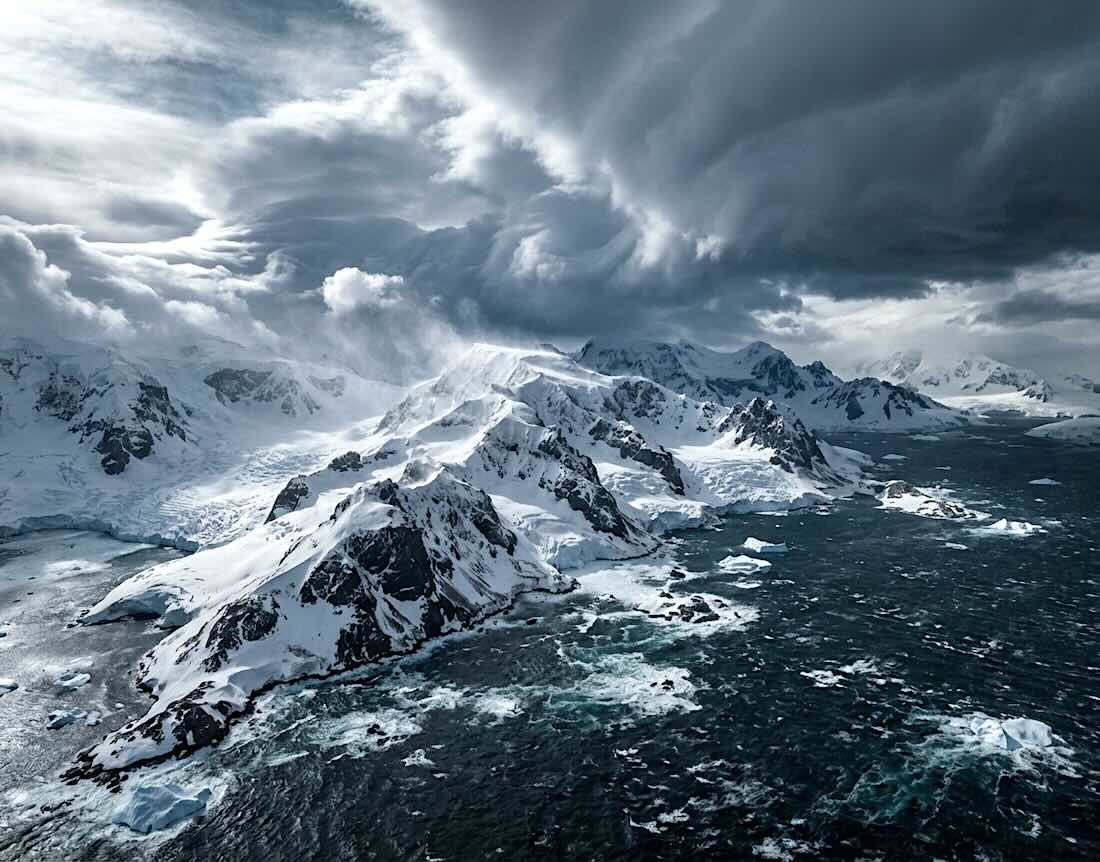
A recent article in the online journal Futurism, titled “Scientists Horrified as Huge Heatwave Hits Antarctica,” claims climate change caused a “huge heatwave” in Antarctica, bringing temperatures on the Antarctic Peninsula nearly 36°F above average and briefly pushing readings above freezing. [some emphasis, links added]
This is highly misleading.
A single weather event says nothing meaningful about long-term climate trends, and the article ignores both Antarctica’s enormous geographic variability and the exceptionally cold conditions simultaneously occurring elsewhere on the continent.
The heatwave Futurism suggested wasn’t a continent-wide crisis but a localized, unalarming event.
The article is largely a rewrite of a Guardian story focused on temperatures measured on the Trinity Peninsula, the northernmost extension of Antarctica. Researchers reported temperatures reaching approximately 15.4°C (59.7°F) during a brief warm spell on June 6.
What readers are not told is that the Antarctic Peninsula is not representative of Antarctica as a whole.
In fact, the warmest part of Antarctica is the Antarctic Peninsula. Nicknamed the “banana belt,” it stretches northward toward South America and experiences milder maritime conditions. During the austral summer, temperatures can occasionally exceed 10°C (50°F).
The peninsula extends northward toward South America and is heavily influenced by maritime weather patterns and ocean currents. It is by far the warmest part of Antarctica and has long experienced periodic warm-air intrusions, föhn wind events, rain episodes, and above-freezing temperatures.
These events are unusual, but they are not unprecedented.
In fact, the article itself acknowledges that the warmth was associated with “extremely strong westerlies.” In other words, this was a weather event driven by warmer atmospheric circulation patterns, not a direct measurement of climate change.
What Futurism misses is the fact that weather is not climate.
Climate is measured over decades. A single day, a single week, or even a single season tells us very little about long-term temperature trends.
If every unusually warm day is presented as proof of climate catastrophe, then intellectual consistency would require every unusually cold day to be presented as evidence against it. The media rarely applies that standard.
The timing of this story is especially revealing because while headlines were breathlessly reporting a temporary warm spell on the Antarctic Peninsula, much of the rest of Antarctica was experiencing brutally cold conditions.
According to observations highlighted by meteorologist Cap Allon, the Amundsen-Scott South Pole Station recorded a temperature of -73.6°C (-100.5°F) on June 16, with a daily maximum of only -69.9°C (-93.8°F). That was the South Pole’s first sub–70°C reading since 2023.
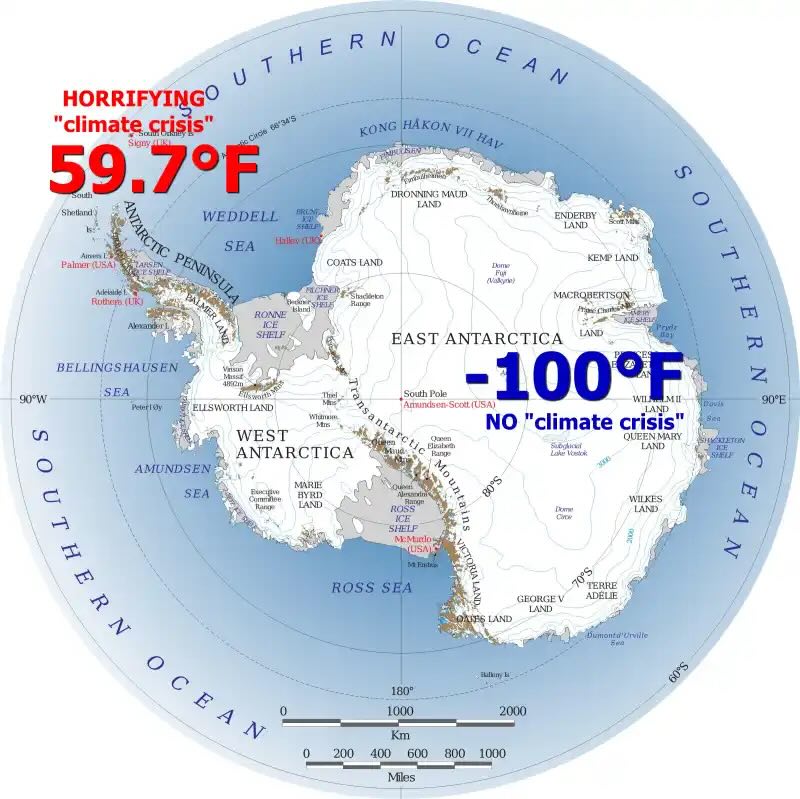
One part of Antarctica briefly experiences an unusually warm episode, while another part of the continent drops below -100°F. That is how weather works on a continent larger than the United States and Mexico combined.
Yet only one of those events, specifically the anomalously high temperature, generated international headlines.
The article further claims that the heatwave follows “decades of increasingly warm temperatures observed on the white continent.” That statement is false.
Antarctica is not heating up uniformly. While portions of the Antarctic Peninsula have warmed during parts of the late twentieth century, numerous studies have shown little warming or even cooling across large sections of East Antarctica, with the latter covering the bulk of the continent.
Antarctic sea ice has also exhibited substantial variability from year to year and decade to decade.
The continent is governed by complex interactions involving ocean currents, atmospheric circulation, volcanic influences (including subsurface heating under West Antarctica where the peninsula lies), sea ice dynamics, and natural climate oscillations. That complexity disappears in Futurism’s opinionated article.
Instead, readers are given the now-familiar formula: identify a dramatic weather event, attach it to climate change, mention the “Doomsday Glacier,” and imply that catastrophe is around the corner. Climate Realism has repeatedly debunked claims of Thwaites Glacier’s imminent collapse.
The article’s reference to Thwaites Glacier is a particularly misleading red herring because it has nothing to do with the reported weather event. The mention serves one purpose: reinforcing a broader climate crisis narrative.
This is increasingly common in climate reporting. Any unusual weather event becomes an opportunity to recycle the same talking points about glaciers, sea levels, tipping points, and future disasters, regardless of whether they are directly related to the event being discussed.
Concerning the Antarctic Peninsula, the facts are these: Antarctica has always been susceptible to periodic warm-air intrusions because of its geography and proximity to relatively warmer ocean waters; the Southern Ocean, atmospheric rivers, and strong westerly winds can occasionally transport substantial heat into the region.
These processes existed long before climate change became a political issue.
Most importantly, a single warm event cannot establish a trend. Scientists understand this principle when analyzing climate data. Journalists should understand it as well.
A proper climate analysis requires decades of observations across the continent, careful examination of regional variability, and separation of weather noise from climate signals, not the slapdash presentation of misleading, sensational claims assembled by Futurism.
Antarctica remains the coldest continent on Earth. While the Antarctic Peninsula briefly experienced unusually mild conditions, the South Pole itself was simultaneously plunging near or below -100°F in multiple other locations.
That fact alone should remind readers that one weather event, no matter how dramatic the headline, is not evidence of a “climate emergency”; it’s simply weather.
One warm spell on the Antarctic Peninsula becomes proof of climate catastrophe, while simultaneous temperatures below -100°F at the South Pole are ignored. That’s not objective journalism; that’s agenda-driven alarmism.
Top: Westerly winds blow snow across the Antarctic Peninsula’s jagged ice ridges and turbulent Southern Ocean.
Read more at Climate Realism








most of antarctica has a permanent temperature inversion
which causes a negative greenhouse effect
a negative greenhouse effect causes cooling rather than warming
the lower elevation peninsula and the ice shelves
do not have a negative greenhouse effect &
they do melt from warm air & warm ocean water
one reason for local warming is underseas volcanoes
near the ice shelves