First, the good news. Some commercial users may be enjoying free electricity at some point this summer – or better still, they may even be paid to consume it. Now the not-so-good news: at other times, it will mean us all having to pay even more for our electricity than we already do. [some emphasis, links added]
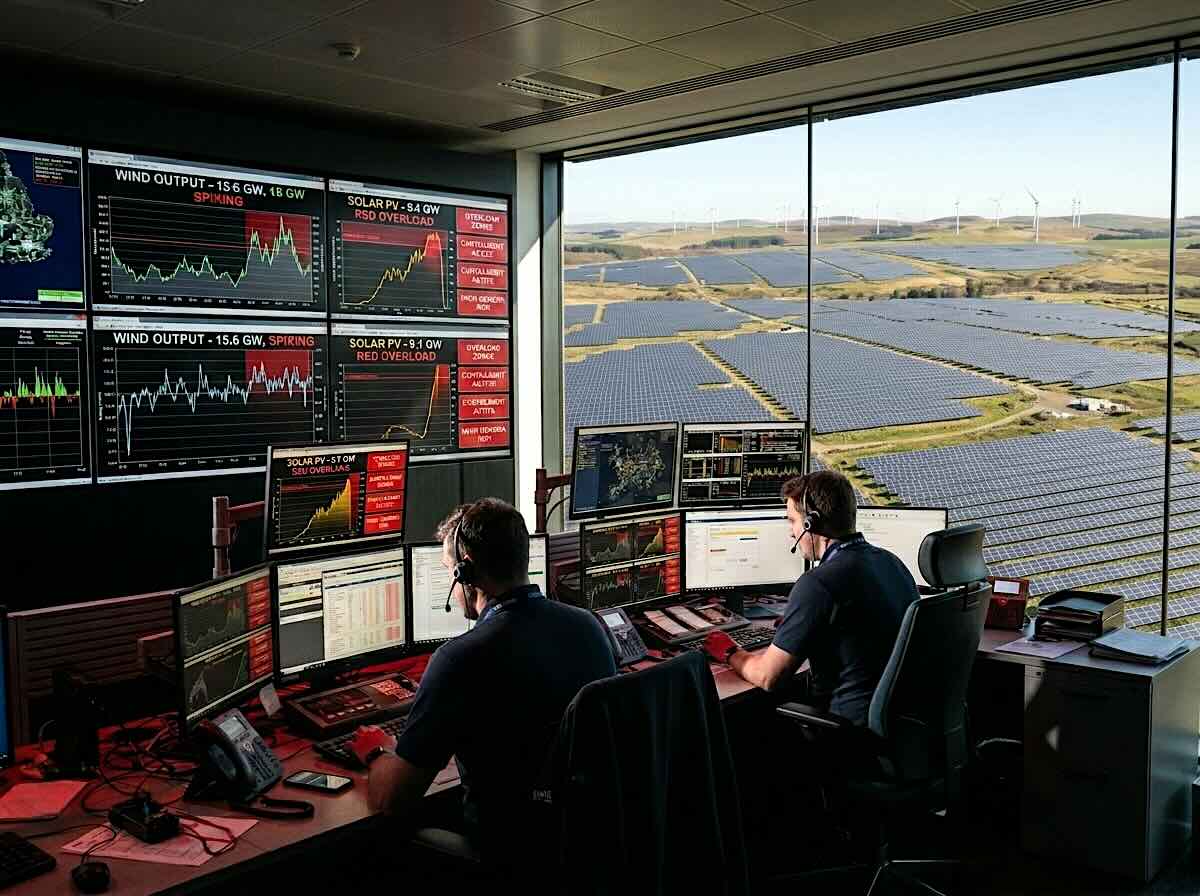
The National Energy System Operator (NESO) – the nationalized body which manages the grid in Britain – is reported to be drawing up emergency plans in case it becomes too sunny.
Thanks to Ed Miliband, there is now so much installed wind and solar capacity that in sunny and windy conditions, it threatens to overload the grid.
Here is the problem.
Currently, the UK has 32 gigawatts of installed wind capacity and 22 gigawatts of installed solar capacity. Of course, wind and solar hardly ever run at capacity because the country is not always windy and bathed in sunshine, but the renewables capacity has reached the stage at which it could theoretically overload the grid.
Averaged over the year, Britain uses around 37 gigawatts of power, but on summer afternoons, when few people have any need for heating or lighting, this can fall appreciably. Unfortunately, this is also when solar power production reaches a maximum.
We already have periods when the grid cannot accept all the wind power that could be generated. Unfortunately, this doesn’t usually mean free electricity, because the wind turbines tend to be situated on the fringes of Britain, a long way from where it is consumed, and the grid cannot handle the transfer of power.
Instead, wind farm operators are paid handsome ‘constraint payments’ to brake their turbine blades. These cost consumers £380 million last year, plus a further £1.08 billion to switch on gas plants in the south of England to make up for wind energy foregone.
With solar, however, there is no mechanism in place to handle excess power output. This is especially difficult in the case of small-scale solar installations on domestic rooftops, which feed directly into the distribution grid – the local side of the national grid.
NESO has no control over domestic solar panels, which continue feeding energy into the grid regardless.
We could theoretically store the excess energy generated on sunny, windy days, but the provision of energy storage is running a long, long way behind the construction of wind and solar farms.
Even after a bumper year for construction, we have only 12.9 gigawatt-hours’ worth of battery storage – enough to meet average UK demand for 20 minutes. Even at the height of summer, it is a long, long night before the sun comes up again.
There is a good reason why we do not have more energy storage capacity: it is extremely expensive to store energy.
Over the lifetime of a battery storage facility, it will cost around three times as much to store energy as it costs to generate it in the first place. As a result, the UK national grid is still turning to gas when solar and wind capacity is short.
Read rest at The Spectator