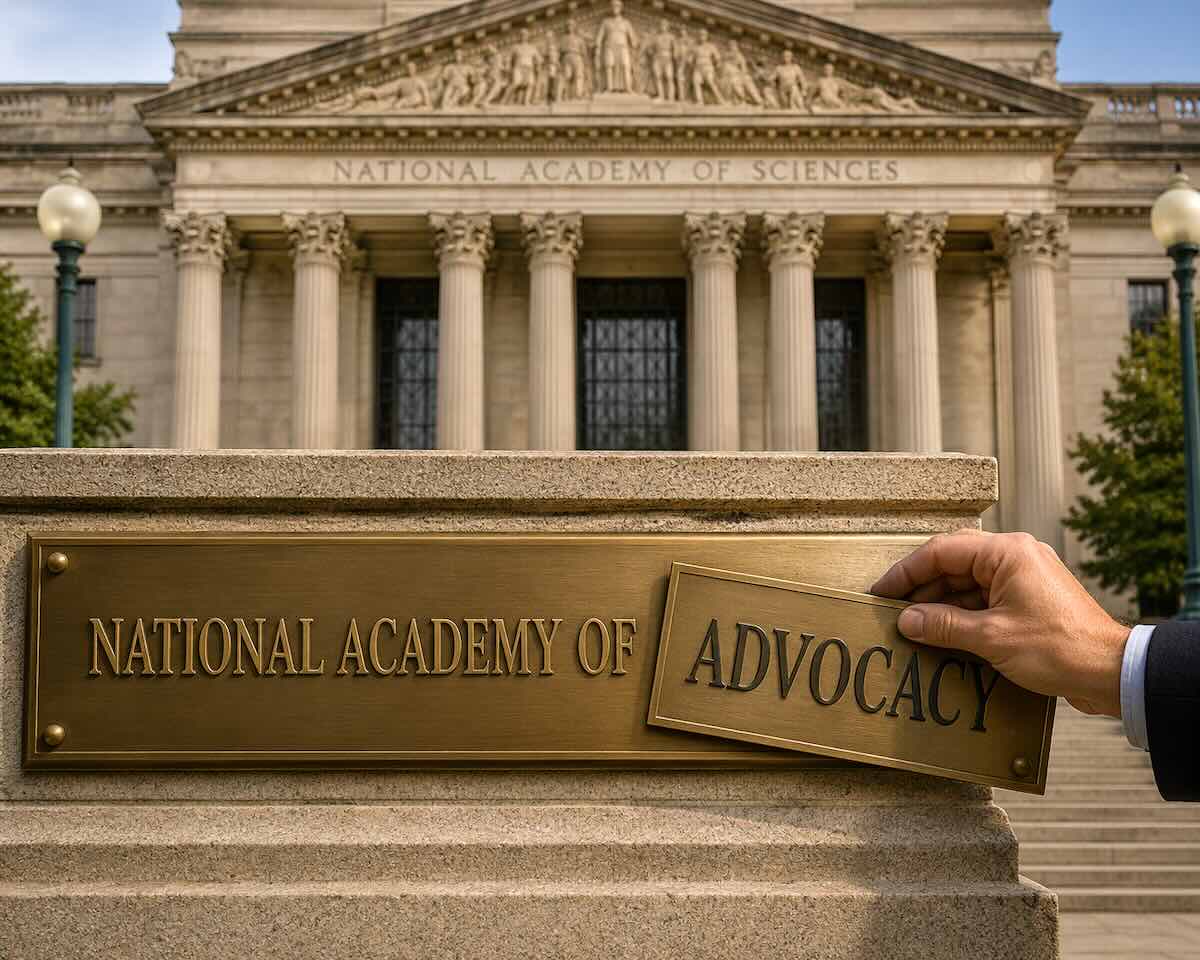
The National Academies of Sciences, Engineering, and Medicine (NASEM) — a storied institution signed into law by Abraham Lincoln in 1863 through an act of Congress — finds itself at the center of a growing controversy over how it has mixed climate change science and politics in violation of its Congressional mandate and the organization’s commitment to objectivity, independence, and excellence. [some emphasis, links added]
It would be easy to dismiss the issues here as just another arena where pathological partisan politics has taken root — science institutions have certainly not been immune.
While it is certainly true that universities and many institutions of expertise have become increasingly politicized and political targets of the current administration, partisan battles are not all that is going on.
A real scandal is unfolding at NASEM.
Today’s post explains a new element of the growing scandal, why it matters, and recommends that Congress amend NASEM’s federal charter in the near term.
Let’s start with what NASEM is and what it does. NASEM is a private, nonprofit, tax-exempt 501(c)(3) organization operating under the congressionally chartered National Academy of Sciences (NAS).1
Congress mandates that NAS mobilize the nation’s scientific and technical expertise in service of the public welfare. Its functions include:
- stimulating and coordinating research; identifying important scientific, environmental, economic, health, and national-security problems;
- organizing research to address them;
- connecting domestic and international researchers with the federal government;
- reducing duplication while preserving individual initiative;
- and collecting and disseminating scientific and technical information to government and the public.
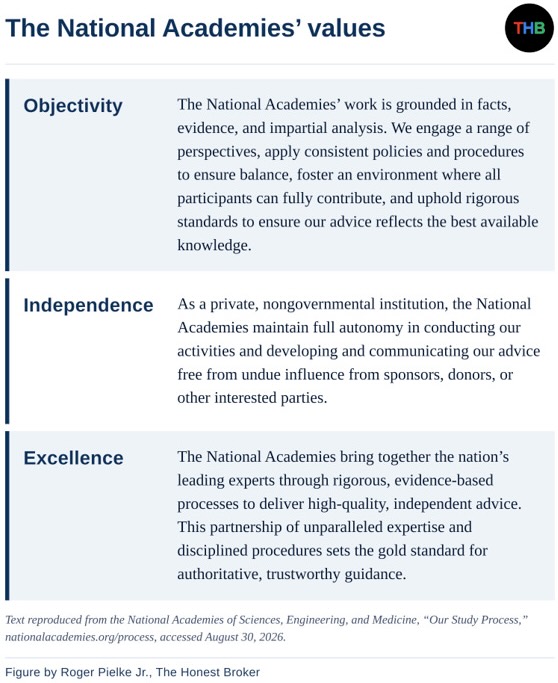
The figure above displays how NASEM describes its values. The organization exists to serve the national interest, improve public policy and public understanding, benefit the public welfare, and furnish scientific and technical advice to government and other organizations. NASEM serves everyone.
The scandal is that NASEM has been acting well beyond this mandate as a political advocate — trading on its authority and legitimacy to serve special interests, whether those are its nongovernmental funders, those charged with executing its projects, or its leaders.
In my book The Honest Broker — which inspired this site’s name — I explain that:
The Issue Advocate focuses on the implications of research for a particular agenda. . . Issue Advocates are found everywhere, and science is no exception. Whether the issue is a presidential election, the Nuclear Test Ban Treaty, or the Kyoto Protocol, many scientists are willing to take sides in a contested political issue, and use their status as scientists, or invoke their specialized expertise, to argue for their cause.
I argue that issue advocacy is fundamental to a healthy democracy, and I draw a straight line to the importance of its functions as described by James Madison in Federalist 10. In general, advocacy by scientists or organizations is not problematic at all — it is an important contribution to democracy.
However, NASEM was established to serve a role other than issue advocacy — by design and in practice. Consider how the institution characterizes its role with respect to advocacy:
“We will NOT undertake work that is inconsistent with scientific evidence, for which an evidence base is insufficient, or that appears to be advocacy or have a foregone conclusion. We will avoid projects that would require us to make value judgments or that would be viewed as advocacy for specific policy or social outcomes, and we will avoid sponsors that may be viewed as advocates for such outcomes. Partaking in such work would serve to undermine our credibility.”
The unfolding climate scandal is a scandal because NASEM has undeniably and egregiously violated these principles.
After that long wind-up, let’s jump straight to a smoking gun.
The image below was included in a letter sent on August 28 from Rep. James Comer (R -KY) — chairman of the House Committee on Oversight and Government Reform — to Neil Shubin, president of NAS.
In the letter, Shubin’s predecessor as NAS president, Marcia McNutt (whose term ended June 30, 2026), is asking a donor to NAS, Carol Cicerone, for permission to use the donated funds to prepare a NASEM report.
The report was to be submitted to the Environmental Protection Agency (EPA) in support of “federal investment in CO2 reduction” and to counter “a handful of climate deniers” whose work McNutt feared would lead to the rescission of the EPA’s Endangerment Finding on greenhouse gases.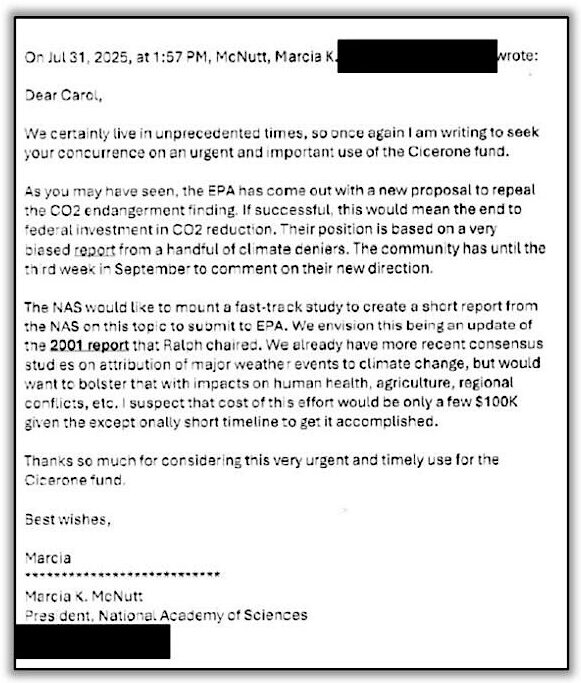
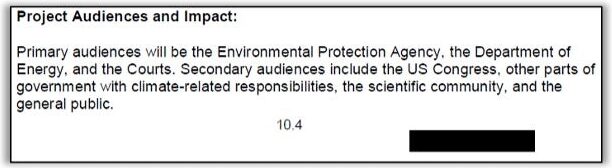
The figure below, also from the Comer letter, comes from the NASEM unit that organized the climate report, and makes clear that the report was intended to influence the EPA and Department of Energy — the scientific community and the general public were “secondary audiences.”
In his letter, Comer concludes:
“Read together, this evidence suggests NAS’ intent to salt the scientific battlefield against EPA’s proposed action for purposes of both litigation challenging any EPA rescission of the Endangerment Finding and other policy efforts aimed at undoing a rescission.”
There can be little doubt that Comer’s reading of this evidence is correct. The letter’s purpose was to request from NASEM further internal documentation associated with the climate report’s production that NASEM has thus far refused to provide — if that documentation offers an alternative explanation, why not provide it?
Let’s go beyond Comer’s letter.
The internal unit of NASEM that led the production of the climate report to be submitted to the EPA is called Climate Crossroads, which has a mission to harness:
“the breadth of the National Academies’ expertise, resources, and advice to catalyze actions to meet the climate crisis.”
Climate Crossroads operates with an explicit advocacy orientation. Among its external funders is the Waverly Street Foundation, which also funds the Sabin Center for Climate Change Law at Columbia University, which is a focal point of climate litigation.
As chance has it, NASEM selected two people affiliated with the Sabin Center to author the climate science chapter in the Federal Judicial Center’s Reference Manual on Scientific Evidence.
I earlier showed that the chapter’s authors work in support of climate litigation, with a plaintiffs’ attorney — and another Sabin Center affiliate — apparently ghostwriting portions of that chapter.
Small world.
The advisory board of Climate Crossroads includes:
- Peter Frumhoff, formerly chief climate scientist at the Union of Concerned Scientists, now at Harvard, and who focuses his work on advancing climate litigation;
- Carlton Waterhouse, a board member of the Environmental Law Institute, which operates the Climate Judiciary Project, accused of “attempts to influence the impartiality of judges” involved in climate litigation.
- Cynthia Atherton, who until 2023 (when she joined the advisory board) was the Science Program Director at the Heising-Simons Foundation, which is among the funders of Columbia’s Sabin Center (discussed above) and a funder of NASEM’s climate-attribution committee (another part of this growing scandal).
As I said, small world.
Many other members of the advisory board make clear that the orientation is advocacy, far removed from NASEM’s normal activities.
As NASEM’s role in climate advocacy and its embedding into the philanthropic climate activism ecosystem has become exposed, public statements by NAS officials have shown the organization struggling to justify its activism.
In April 2025 on X, several people pressed NAS president Marcia McNutt on why the Academies had never studied COVID-19’s origins, with the full exchange shown below.
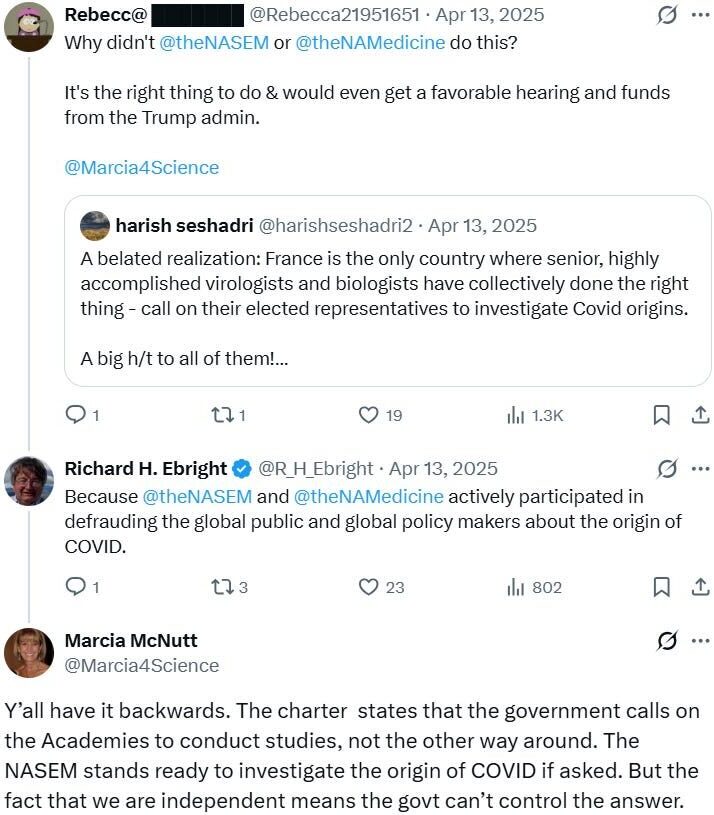
McNutt explained that NASEM could not study COVID origins because the government had not called on NASEM to do so: “Y’all have it backwards,” she told them. “The charter states that the government calls on the Academies to conduct studies, not the other way around.”
Four months later, NAS launched, financed, completed, and publicized its fast-track climate study to the EPA, yet no federal agency had requested that study. The climate report was initiated from within NASEM and paid for with nongovernmental funds.
McNutt’s letter to Cicerone also contradicts what NASEM says about itself. Testifying to the House Science Committee in 2019, McNutt stated:
“We do not advocate for specific policy positions.”
That is obviously not true.
Shirley Tilghman of Princeton, who chaired the committee that prepared the fast-track climate report, said the committee worked toward the “ultimate aim of informing the EPA, following its call for public comments.” The report describes the work as a response to “EPA’s request for public input.”
At the September 2025 release of the report, committee members pointed to Clean Air Act language directing the EPA to consider National Academies input; they said the money came from two NAS endowments “to ensure the independence of the project.”
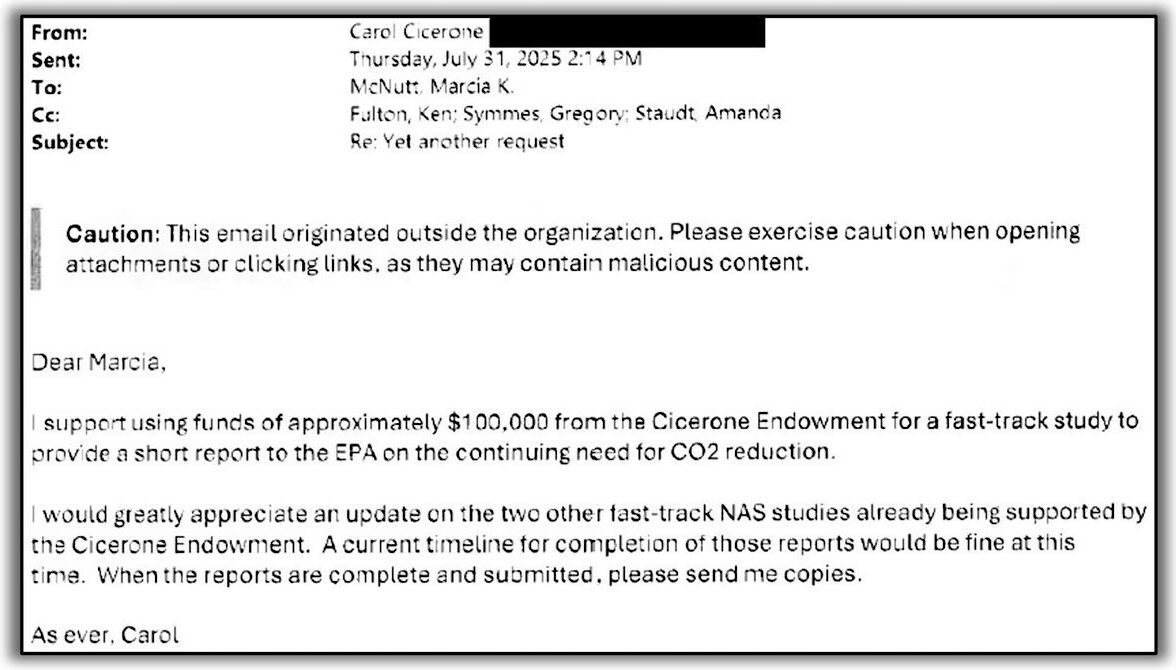
The Cicerone Endowment holds outside money, given by Ralph and Carol Cicerone and apparently required donor approval for its particular use — hence McNutt’s request to Carol Cicerone in the letter I shared near the top of this post.
That is the opposite of independence — funding was predicated on the specifics of the promised policy advocacy.
This is clear from Cicerone’s reply to McNutt, shown below, which approved the use of the funds for the fast-track report and shows that she clearly understood what the report would conclude: to advocate to the EPA the continuing need for CO2 reduction and opposition to rescission of the Endangerment Finding.
…snip…
I searched for any other situation where NASEM may have convened a fast-track study to provide input to a Federal Register notice related to any federal regulation. I could find nothing remotely analogous.
In July 2018, the presidents of NAS, NAE, and NAM filed a comment in EPA’s docket on transparency in regulatory science, warning that the rule would discard valid evidence and pointing the agency to NAS reports already published — but no new study was commissioned.
In March 2020, [blue] state attorneys general and city attorneys asked NAS to review EPA’s supplemental proposal in that same docket, and I find no public record of a response.
The Academy has a precedent for weighing in on climate science in highly political contexts — but it did so in response to government requests.
On May 11, 2001, John Bridgeland, director of the White House Domestic Policy Council, wrote to NAS President Bruce Alberts asking where climate science held the greatest certainties and uncertainties, and for an answer as soon as possible.
Less than a month later, a committee chaired by Ralph Cicerone produced a report on June 6, 2001, Climate Change Science, telling the White House — which was then reviewing its stance on the Kyoto Protocol — that temperatures had risen and human activity likely drove most of the recent change.
Two days later, NAS convened a closed-door forum at Senator Larry Craig’s request with about ten climate researchers, three senators, and a cabinet member. I happened to be one of those ten researchers — small world!
That forum prompted a leading climate scientist to contact me ahead of time and suggest that I downplay my work on the role of growth and development in explaining rising disaster losses, lest it take away from calls for emissions reductions. I wrote about it at the time— but I digress.
NAS’s turn to climate advocacy has occurred as NAS has come to rely more and more on non-federal funding, mostly philanthropic and from organizations with political aims.
The figure below shows that from 2011 to 2023, NAS’s share of federal funding dropped from about 85% to under 60%.2
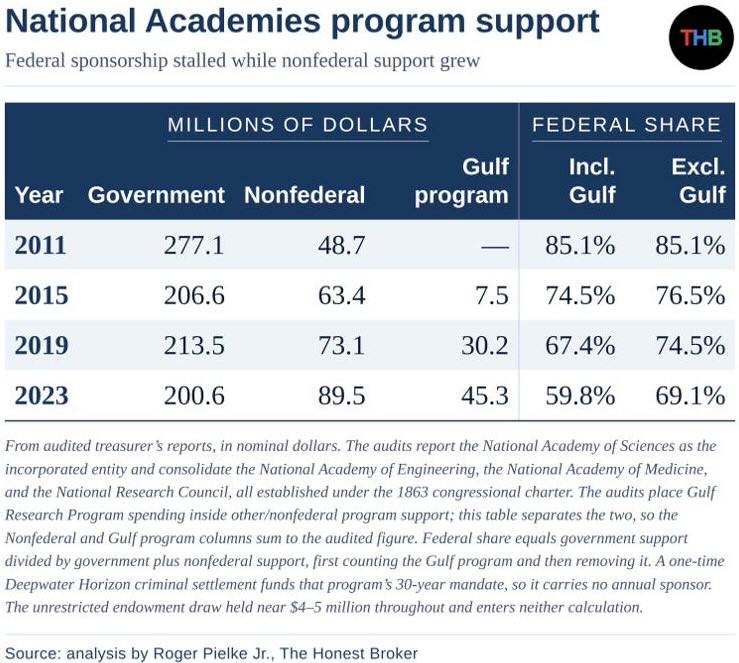
Government support peaked in 2011 at $277 million and fell to $201 million in 2023, before inflation. In response, NAS has increasingly sought, and collected, other sources of funding.
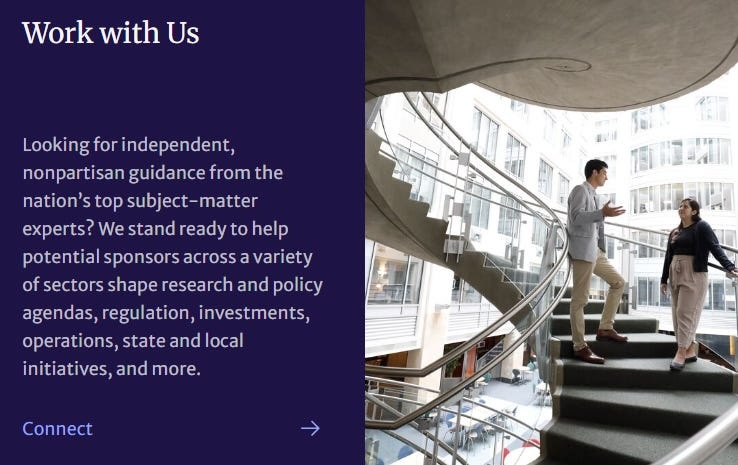
That has led to mission creep: Climate Crossroads cultivates sponsors, raises money, and coordinates communications and congressional engagement. NAS even has a pitch on its website inviting sponsors interested in shaping “policy agendas.”
In 2026, little distinguishes the storied National Academy of Sciences from the myriad partisan NGOs advocating for everything under the sun—like the Union of Concerned Scientists or the Heartland Institute.
NASEM has become just another 501(c)(3) organization pushing an agenda.
Ironically, in the end, NASEM’s fast-track climate report proved irrelevant to EPA’s case for rescission of the Endangerment Finding in its final rule.
The Honest Broker is written by climate expert Roger Pielke Jr and is reader-supported. If you value what you have read here, please consider subscribing and supporting the work that goes into it.
Read rest at The Honest Broker