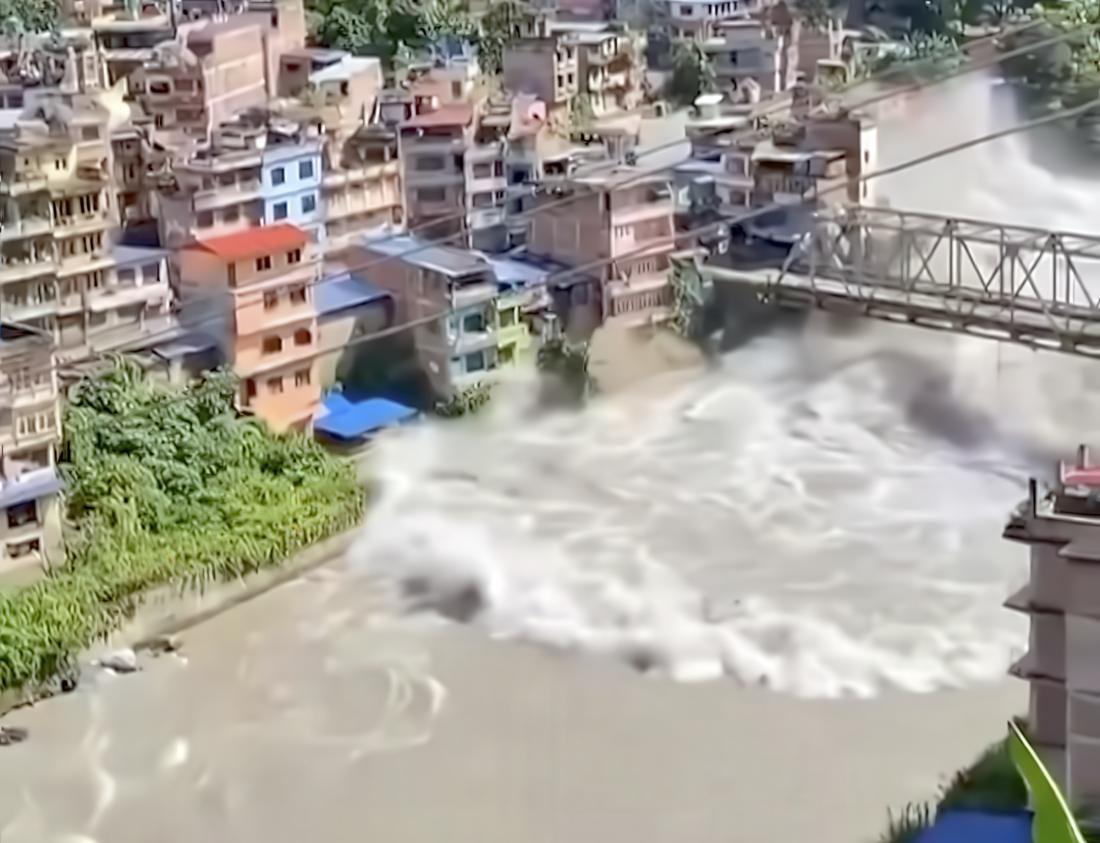
Reports of the devastation in Nepal following a massive landslide now indicate that the death toll from Wednesday’s devastating flash floods in Nepal and China has risen to 800, with around 3,000 people still missing. [some emphasis, links added]
“Nepal’s disaster agency said Sunday the death toll had climbed to 788 with 2,502 missing, while Chinese authorities reported 16 deaths and 546 missing on the Chinese side of the border.
“Poor weather and challenging terrain have hampered aerial rescue operations.
“In Nuwakot, one of the Nepali districts devastated by the floods, helicopters resumed operations before noon Saturday after poor weather temporarily obstructed their activities. Some helicopters were loaded with boxes and bags of aid, including clothes, instant noodles, crackers and rice. Others returned from the flood-hit areas carrying survivors.
“…More than 3,700 people have been rescued in Nepal so far, according to authorities there. Hundreds of the missing are foreigners who were in the area to work, trek or make a pilgrimage to a sacred peak on the Tibet side of the border.”
Nepal’s deadly Himalayan flash flood this week has predictably produced a familiar ritual. Before rescue crews had finished counting bodies, climate cultists and their political acolytes were already racing to slot the disaster into their favorite narrative.
Outlets from the New York Times to CNN to Forbes rushed out pieces insisting that “climate change” primed the catastrophe.
Suddenly everyone became an expert on the Himalayan climate.
Climate change is leading to conditions that can destabilize high-mountain rock and ice, which may cause disasters such as the flood along the border between Nepal and Tibet, scientists say, though it might not be the sole trigger https://t.co/qS76HHtT5c pic.twitter.com/QlNuFJ9uWx
— Reuters (@Reuters) August 29, 2026
Three clear-eyed voices on X pushed back: Dr. Matthew Wielicki (Director – United States Global Change Research Program), meteorologist Chris Martz, and Jim Steele (ecologist and author of Landscapes & Cycles).
They deserve amplification, not the usual media silence.
So, let’s take a deep dive into Himalayan geology and geography with them.
The flooding in Nepal and Tibet is devastating.
Hundreds of people have died in these catastrophic floods and over 2,000 are still missing.
No, President Trump. Climate change is not a hoax. It is causing devastating crises all over the planet.
— Sen. Bernie Sanders (@SenSanders) August 28, 2026
What actually happened in Nepal?
The disaster began when an enormous chunk of a glacier on Langtang Lirung, high in the Himalayas, sheared off and slammed into the valley below with such force that it registered as a magnitude 5.2 seismic event, according to the US Geological Survey.
The ice and rock mass blocked the Lhende Khola river, and when the makeshift dam gave way, it unleashed a wall of water, mud, and boulders the size of cars that buried villages downstream.
Even the outlets pushing the climate narrative admit the actual trigger is still “under investigation” and that no formal attribution study has been done.
This newly surfaced video shows the landslide that occurred just a few hours after the main glacier collapse.
The event formed a barrier lake that dammed the Lhende Khola River along the Nepal–Tibet border. pic.twitter.com/U99m3uURaq
— Massimo (@Rainmaker1973) August 30, 2026
That inconvenient detail didn’t stop the parade of quotes about “what climate change looks like.” One geologist told CNN, “Whether this particular event can be tied to climate change or not, this is what we expect.” This is not science, but a talking point dressed up as science.
The mountains have been doing this for millions of years.
Meteorologist Chris Martz cut through the noise by noting that landslides and avalanches in Nepal have occurred for tens of millions of years, long before humans existed, let alone burned fossil fuels.
As he noted, the V-shaped valleys carved through the region were carved by exactly these landslide-flood events at preindustrial carbon dioxide (CO2) levels, a geologic fact that climate cultists conveniently skip.
Long story short, this is BS.
Landslides / avalanches in Nepal have happened for tens of millions of years. In fact, floods associated with landslides are how the V-shaped valleys in the region were carved out millions of years ago at pre-industrial atmospheric carbon dioxide… https://t.co/oud6rlrZqH pic.twitter.com/sRGsVHISIB
— Chris Martz (@ChrisMartzWX) August 29, 2026
Geologist Dr. Matthew Wielicki, who has done fieldwork sitting above the Himalaya’s “enormous, deeply incised” river systems in Tibet, made the same point: This landscape is robustly geologically active on its own, independent of anything happening in the atmosphere.
I’ve spent many weeks doing fieldwork in Tibet, sitting above these enormous, deeply incised Himalayan river systems and seeing firsthand just how geologically active this landscape is.
So spare me the climate-change grift every time a natural disaster strikes.
Catastrophic… pic.twitter.com/I08oXu5jmy
— Dr. Matthew M. Wielicki (@MatthewWielicki) August 27, 2026
Both men are pointing to something the peer-reviewed record supports.
The Himalaya is a young, still-rising mountain range, formed by the Indian plate colliding with Eurasia roughly 40 to 65 million years ago, and it remains one of the most tectonically active zones on Earth.
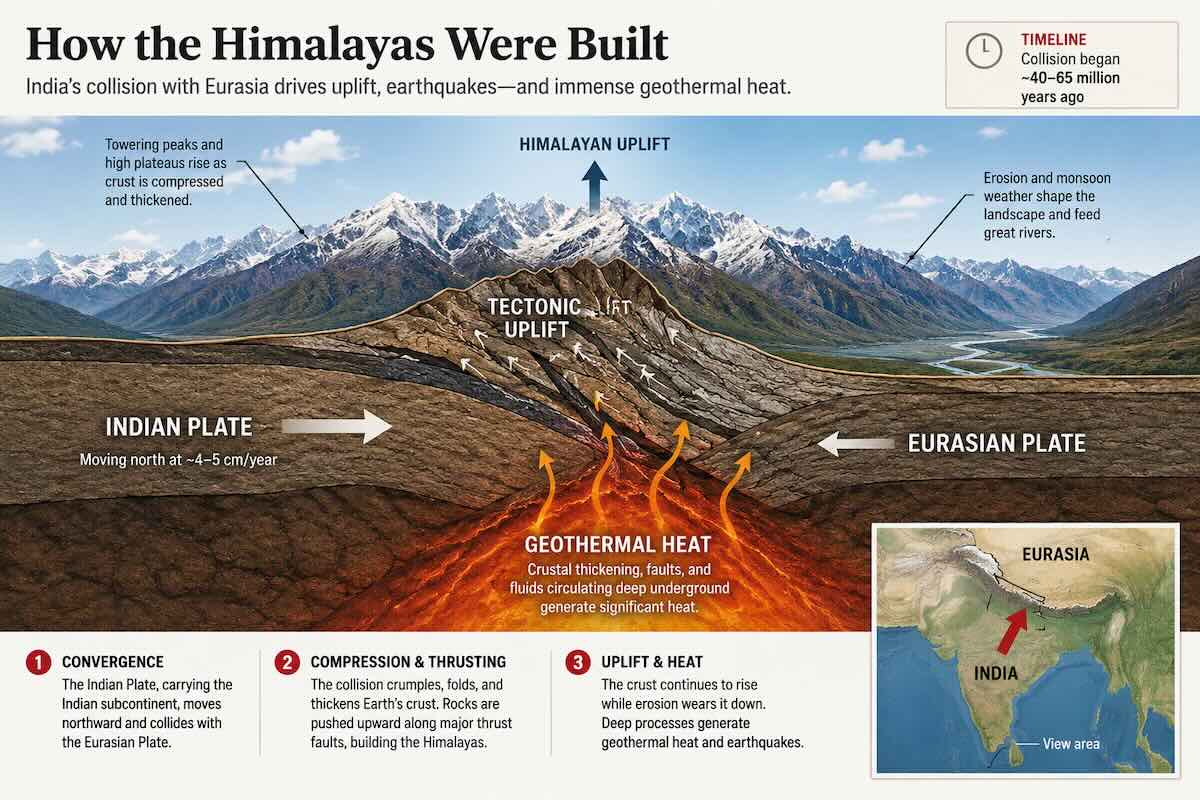
Research into the region’s landslide history documents “giant rock slope failures” tied to the North Himalayan Fault system going back tens of thousands of years, driven by the constant interplay between tectonic and glacial activity—not modern emissions.
In fact, Wielicki wrote a paper noting that southern Tibet rapidly eroded and exposed rock from about 17–16 million to 12–11 million years ago, probably because tectonic uplift and steep rivers drove intense erosion.
Around 10 million years ago, enhanced uplift in the Himalayas (likely driven by crustal thickening and fault-related rock stacking) shifted drainage divides southward and diverted rivers away from southern Tibet.
This tectonic restructuring strengthened the Himalayan rain barrier, dried southern Tibet, reduced river power, and largely shut down erosion even as the mountain belt continued to develop.
In other words, this event is an example of Earth-caused climate change.
Rain, snow, and mountains that manufacture their own weather.
Another detail missing from the climate-panic coverage is that the Himalayas don’t just sit there passively, waiting to be affected by global climate. The mountains are so large that they actively create their own extreme weather.
Keep in mind that the Great Himalayas’ average high crest is about 3.8 miles high, with the iconic Mount Everest reaching roughly 5.5 miles.
The sheer height of these peaks forces monsoon moisture upward, and the precipitation released drives erosion and landslides for eons.
Add seasonal snowmelt and near-vertical topography, and you have a landscape engineered by nature to periodically fail catastrophically, regardless of CO2 levels and with or without an added tenth of a degree of global average temperature.
Geothermal heat melts ice from below.
Where there is a collision of two tectonic plates, there is a great deal of geothermal heat that arises FROM THE SURFACE, not THE ATMOSPHERE. SUVs are not responsible for this heat. Furthermore, glacial forces themselves can elevate temperature.
The following analysis is from Jim Steele:
“However, on Langtang Lirung, at the 5200 meter elevation where the rock-ice block first separated to start the 2026 avalanche, the average summer temperature is still below freezing at -6°C to -8°C (21°F to 17°F). During the warmest summer period, midday averages reach 2°C to 6°C (36°F to 43°F) but night temperatures stay near -2°C to -5°C (28°F to 23°F). Furthermore, science suggests air temperatures are not affecting the surface ice.
“The top few meters of a glacier, rapidly respond to air temperature, sunshine, and seasons. Nonetheless winter cold and summer warmth only penetrate about 10–20 m from the glaciers’ surface. Thus, changes in atmospheric temperature are unlikely to provide “lubricating” melt water in 200-meter thick glaciers. Below the shallow ‘seasonal layer,’ temperature is steady and often close to the local mean annual air temperature, which again averages summer temperature below freezing at -6°C to -8°C (21°F to 17°F).
“Still studies show the glacier-ground interface is almost always warmer than the ice above it for 3 main reasons: 1) Because ice is such a good insulator, the geothermal heat rising from Earth’s interior accumulates at the glacier’s bottom. 2) Frictional heat from ice sliding over rock adds to the temperature. 3) Under thick ice, the melting point is lower due to pressure effects. So even if the surface is –30 °C or colder, the bed of a 2–3 km ice sheet can sit at or very near 0 °C. Global warming is not a factor.”
Parting thoughts
The International Centre for Integrated Mountain Development (ICIMOD), the regional scientific body actually based in Kathmandu, remarked that it’s simply “too early to determine what role climate change played in this specific event”. That’s the honest scientific position.
Everything past that point is ghoulish narrative-laundering that uses dead villagers as a backdrop for a political talking point and ignores tens of millions of years of plate tectonics and its consequences, and completely dismisses well-established mountain-weather dynamics.
Top image via AP/YouTube screencap.
Read more at Legal Insurrection