Progress and Progress(ive)… two words with somewhat similar spelling but with entirely different meanings. I asked Grok to help identify the distinctions. Progress: a forward movement, advancement, or improvement over time. It’s about actual results or the process of getting better. Progressive: favoring or promoting reform, change, and new ideas (especially social or political change), happening gradually or in stages … supporting “progress’ as an ideology. [some emphasis, links added]
There may be no better way to illuminate the difference between the two than with Maryland energy policies. There is little disagreement that electricity prices are rapidly increasing, but little agreement as to the causes.
Maryland residential electricity rates have risen 50.9% in the past five years. Maryland Governor Wes Moore, including other blue state governors, place blame for rising electricity prices on utility profiteering and their ‘double dipping’ on energy infrastructure projects.
He blames the PJM grid operator and data centers “as the largest single driver of capacity prices.” The Maryland legislature, in an attempt to slow the rate of increases, has even capped the compensation for utility executives.
To give citizens relief, state officials passed the Utility Relief Act, which will rebate $150 toward the cost of electricity (essentially giving people back their own tax dollars). Increased electricity demand, including from data centers, is indeed causing a power shortage and rising electricity prices.
But are there other important factors that some politicians are conveniently failing to consider, such as state government mandates that are contributing to the shortage of reliable power supply?
What about the impact on supply from decarbonization policies designed to combat climate change and the push for an all-electric economy, requiring electric cars, electric buildings, and electric heating?
Maryland passed the Climate Solutions Now Act of 2022, mandating a 60% reduction in state greenhouse gas emissions from 2006 levels by 2031 and net-zero emissions by 2045. Other legislation requires all electric heating in larger buildings.
Maryland also wants to phase out natural gas and oil heating and replace them with electric heat pumps. Maryland is also a member of RGGI, the Regional Greenhouse Gas Initiative, which is a carbon tax on fossil fuel power plant emissions.
According to a Baltimore Sun article, RGGI fees in 2024 were equivalent to a 44% tax on Maryland fossil-fuel plant revenues. This can’t be passed on to utility customers because Maryland’s deregulated power industry prevents common ownership of power generation and distribution.
The current RGGI auction price of $35 per ton of CO2 emissions is equivalent to an annual tax of $100 million for a 1GW natural gas power plant.
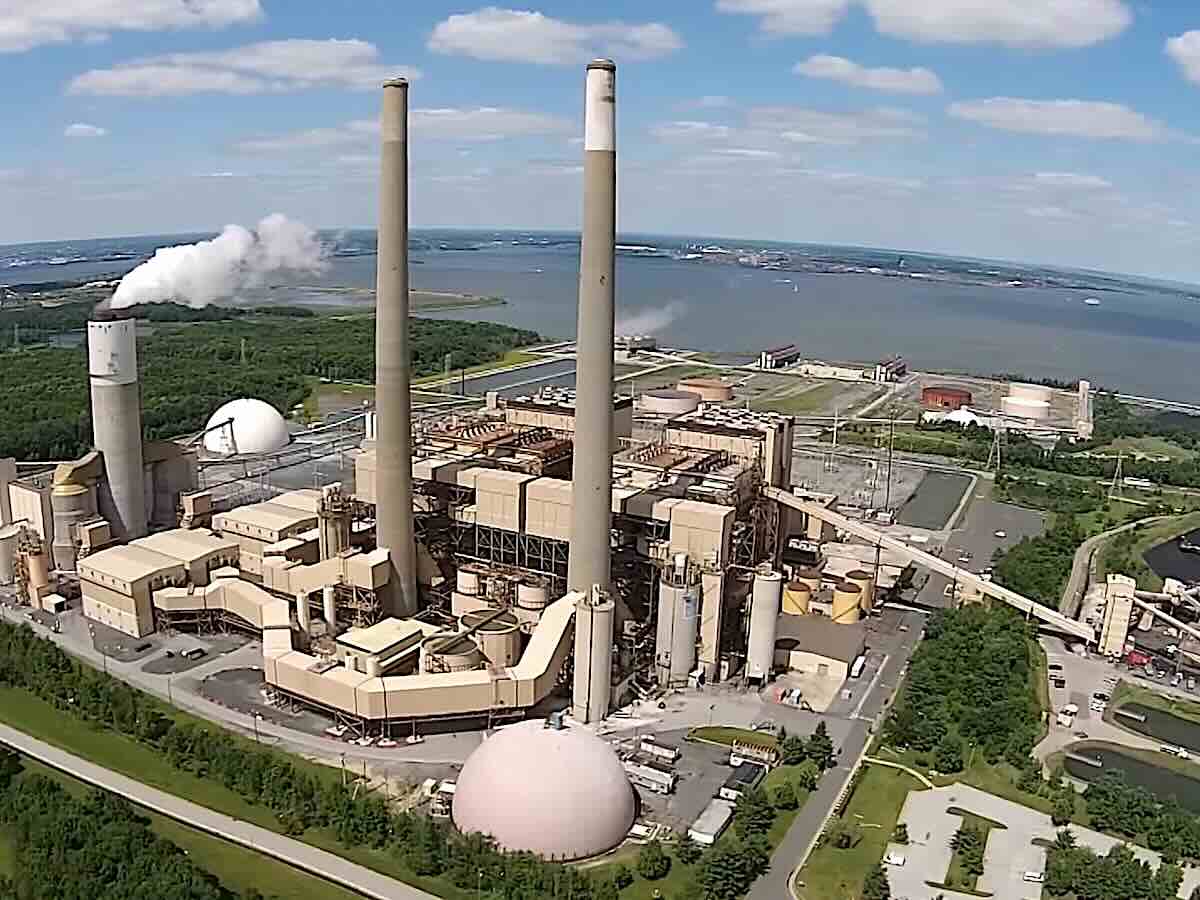
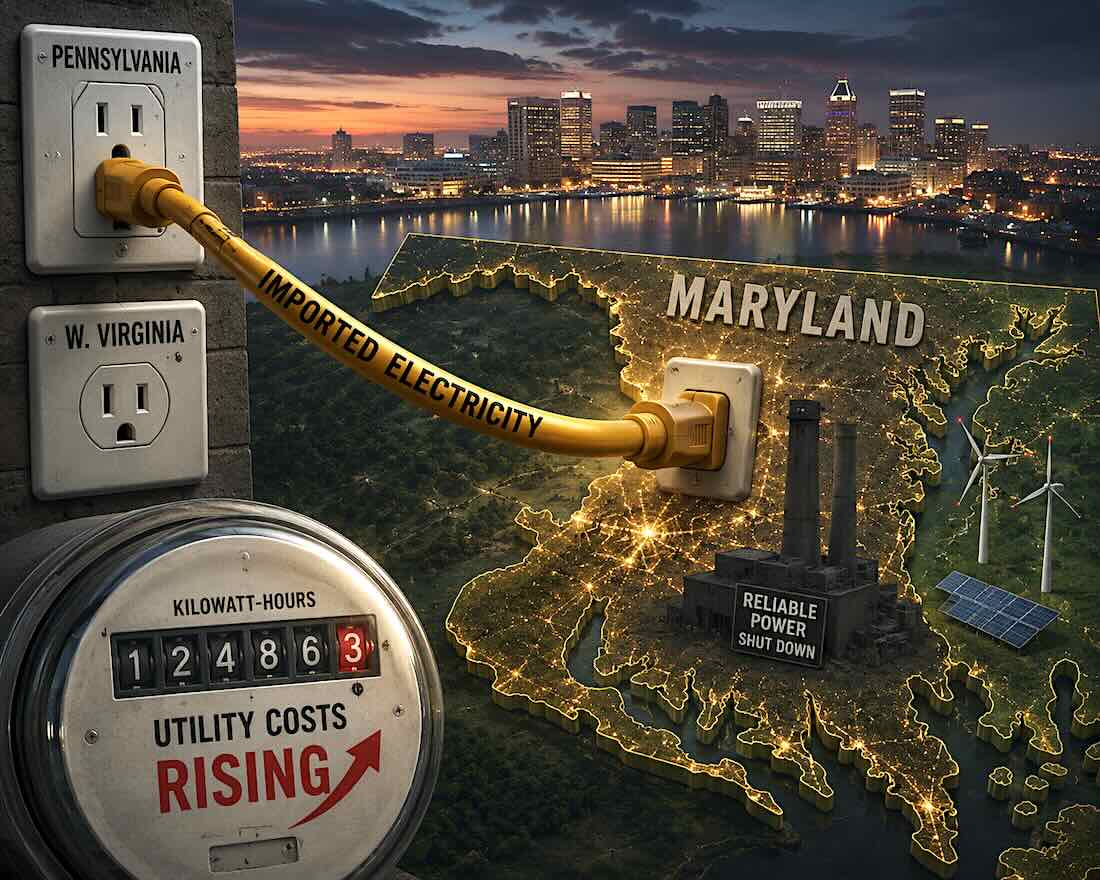
The combination of decarbonization policies and RGGI fees has made many fossil fuel power plants (and especially coal power plants) uneconomic to operate and has led to voluntary closures.
Maryland has lost a significant amount of in-state energy generation since 2018 and now imports 43% of its electricity from neighboring Pennsylvania (natural gas, nuclear, and coal) and West Virginia (coal).
Maryland’s imported electricity equals the state’s entire residential electricity consumption. To meet its net-zero emissions goal, “many, if not all, of Maryland’s fossil-fuel power plants may need to retire earlier than planned”.
The shortage of in-state energy generation is not limited to Maryland; it is also found in VA, DC, DE, OH, and NJ. All are within the PJM grid.
Maryland has indeed reduced in-state carbon emissions, which progressives celebrate, but how can moving these emissions across the state border be considered actual progress? Imported electricity costs more and often pollutes more.
Due to increased electricity demand, Maryland has pricey plans to import even more power from neighboring states. Three new power lines are in the planning stages: the Mid-Atlantic Resiliency Link, the Piedmont Reliability Project, and the Tri-Country Transmission Upgrade.
These lines will cost Maryland utility customers billions and only add to its dependence on neighboring states.
In fact, one of the power lines will result in less in-state power generation since imported electricity is required after the closures of the Brandon Shores coal and Wagner oil power plants in Baltimore, which have a combined capacity of 2.1 GW.
Progressives want to close the last Maryland coal-fired power plant and have kneecapped the oil-fired Wagner power plant, allowing it to operate only up to 5% of the time.
This overreliance on imported electricity is one reason why electricity transmission costs are rising significantly faster than the cost of energy generation. … Increasing reliance on imported power incurs higher transmission and congestion fees.
Governor Moore supports increasing in-state energy generation, but his primary focus is on offshore wind, solar energy, and battery storage. The large offshore wind project off the Maryland Atlantic coastline has faced significant opposition from the shore community and is unlikely to be built anytime soon.
The PJM grid operator gives solar energy a reliability factor of less than 7%. Wind and solar energy are intermittent power sources and are very unreliable without expensive battery [and fossil fuel] backup.
Combining wind and solar power with battery backup is one of the most expensive sources of electricity generation.
Maryland will have to act soon to find more reliable sources of electricity because utilities are warning that the state could suffer a voltage collapse and rolling blackouts by the Summer of 2027.
Read more at RealClearEnergy