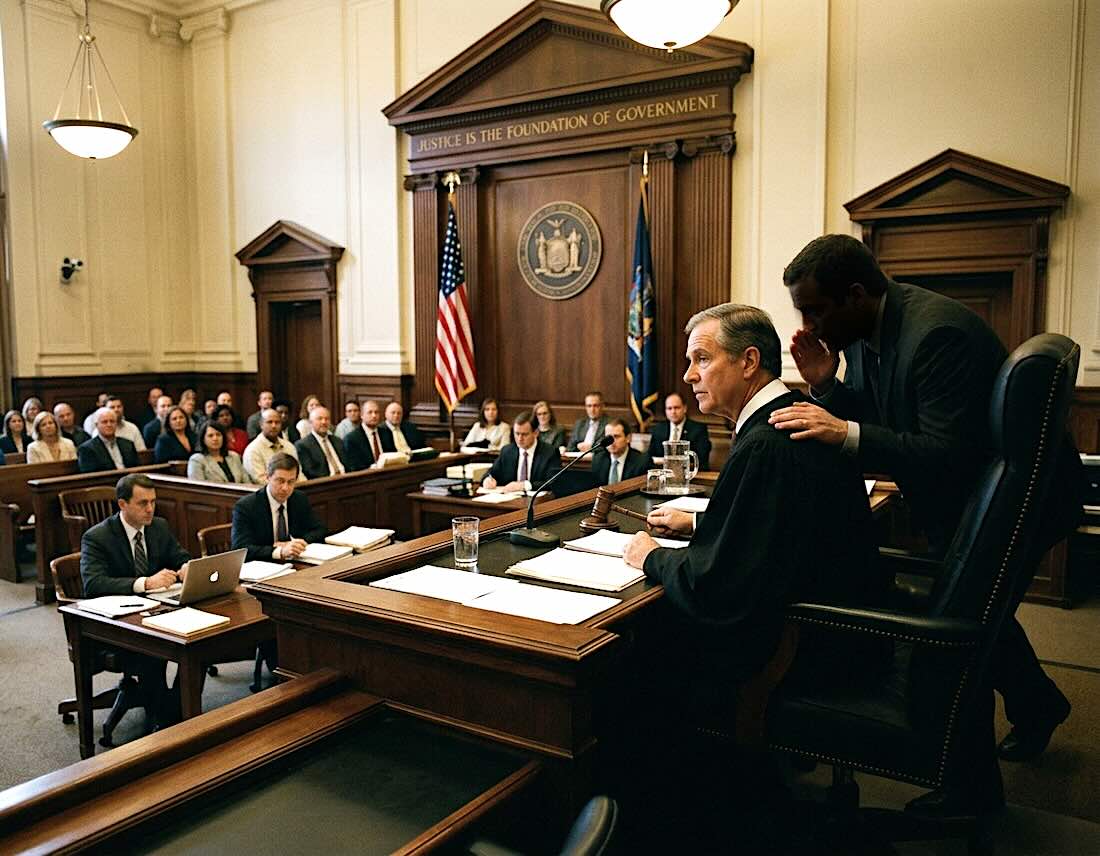
The U.S. House Judiciary Committee has issued what appears to be the first congressional subpoena in its ongoing probe into the nationally coordinated climate litigation campaign against American energy companies, E&E News reports. [some emphasis, links added]
The investigation was launched in 2025 by House Judiciary Chairman Jim Jordan and Subcommittee Chairman Darrell Issa with a primary focus on the Environmental Law Institute (ELI) and its Climate Judiciary Project (CJP), which critics say have improperly attempted to influence judges who may one day preside over climate lawsuits.
The Subpoena
On May 15, the committee sent a letter to Roger Worthington, the plaintiffs’ attorney representing Multnomah County, Oregon, in its 2023 lawsuit seeking more than $51 billion from energy companies.
Worthington had refused multiple prior requests to testify voluntarily about his interactions with ELI and CJP. The committee responded by subpoenaing him to appear on June 4, 2026.
According to the letter, as part of his initial response to the committee’s request in January, Worthington “produced emails with an ELI- and CJP-affiliated expert regarding climate-change-related litigation.”
The letter then states:
“Evidence uncovered in our investigation raises questions about whether, and to what extent, there has been coordination between ELI or CJP and third parties, including your law firm, seeking to secure favorable judgments in climate-related cases.” (emphasis added)
According to the letter, the committee issued the subpoena because it believes Worthington possesses additional information relevant to this investigation, saying that his testimony is “necessary to further our oversight.”
Communication between Worthington – an attorney actively representing a municipality that’s suing the industry – and ELI and CJP would directly violate those organizations’ publicly stated mission to stay neutral in their activities:
“CJP does not participate in litigation, support or coordinate with any parties related to any litigation, or advise judges on how they should rule on any issue or in any case.” (emphasis added)
Additionally, the committee may seek information on how Worthington obtained access to a nonpublic draft “module” used by ELI’s CJP to train judges on climate science.
The Wall Street Journal editorial board identified Michael Wehner as the expert with whom Worthington was in contact.
According to the editorial board, Wehner coauthored the CJP module, is a scientist at the Lawrence Berkeley National Laboratory, and is one of CJP’s listed experts.
Oregon Judge’s Rebuke Adds Context to Worthington’s Conduct
Last year, an Oregon Circuit Court Judge reprimanded Worthington after it came to light that he had been involved in preparing and funding studies that the county cited in court filings.
The judge called Worthington’s actions:
“Almost a gob-smacking failure by plaintiff to do anything close to what we expect a counsel and a party to do in litigation, especially in litigation that is well-funded, that is hard-fought, that is complicated, that is about important issues.
“I just want to say it clearly, it is not acceptable to submit a declaration by an expert that is based in part on a reliance on a scientific article that plaintiff’s counsel helped to fund without pointing out to the Court that that is so.” [emphasis added]
Tellingly, Worthington’s counsel conceded that they should have disclosed the funding, and the draft CJP module has since been removed from his firm’s website [archived here].
Sunshine State Shines Light On Judicial System Hijacking
The Judiciary Committee’s subpoena comes on the heels of a similar action taken by Florida Attorney General James Uthmeier, who issued a subpoena to ELI and CJP in April – demanding documents on their funding sources, involvement in climate-related litigation, and interactions with Florida judges. Those documents were due May 15.
Attorney General Uthmeier put it plainly:
“The Climate Cartel is trying to hijack our judicial system to accomplish their net-zero carbon agenda. But the Courts are not the place to push policy, let alone policy that can’t win at the ballot box. We are going to protect the integrity of our court system and hold anyone who is trying to deceive Floridians—especially its judiciary—accountable.” (emphasis added)
Bottom Line
The Judiciary Committee’s subpoena is the most serious escalation yet in any of the investigations into the coordinated climate lawfare campaign.
The committee’s investigation has also turned up that ELI and CJP’s claim that they do not coordinate with parties related to litigation appears to be false.
Read more at EID Climate