• Privacy Policy
  • About Us
  • Contact Us
Climate Change Dispatch
  • Home
  • Videos
  • Who We Are
  • Facts Vs. Fearmongering
    • Real science vs Junk Science
      • 1100-plus Peer-Reviewed Studies
      • Michael Crichton: Aliens Cause Global Warming
      • Climate change and its causes
      • Climate Science Primer
      • CO2 is not pollution
      • Deceptive Surface Temperature Records
      • Editorial: Great Global Warming Hoax
      • Rules for Climate Radicals: Part 1
      • Rules for Climate Radicals: Part 2
      • Rules for Climate Radicals: Part 3
      • Why CO2 Is A Minor Player In Global Climate
      • Why Politicized Science Is So Dangerous
    • Facts Not Fear
      • A Simple Question For Climate Alarmists
      • Climate Change – The Facts
      • Climate Change Fears Are Empirically Baseless
      • Global Warming 101
      • Global Warming Q&A
      • Understanding The Medieval Warm Period
      • Ocean Cycles and Climate
      • Overview of Plate Climatology Theory
      • Precautionary Principle
      • Should We Celebrate Carbon Dioxide?
      • The Skeptics Handbook
      • Weather Versus Climate
      • Why I’m a GW skeptic
      • Winning the climate debate with facts
      • Why Aliens Cause Global Warming
    • Greenhouse FAQs
      • CO2, Plants, & Industry
      • How much have temps changed?
      • How much have temps changed?
      • How much have temps changed?
      • Is global warming real?
      • Measuring temperature
      • Swimming in CO2?
      • Scientists urge caution?
      • Today’s warming trend
      • Variations in temperature
    • Gore’s Greatest Goofs
      • Deconstructing the Truth
      • Fact-Checking Al Gore’s Latest Predictions
      • How Gore Created The Global Warming Hoax
    • Inside Real Climate
      • Closer look at the 97% Consensus
      • GW’s Amazing Story
      • IPCC gets failing grade
      • Real Climate Exposed!
      • Truth about Real Climate
      • We’ve Been Conned
      • What is there a 97% consensus about?
    • Behind the IPCC
      • 1,000 Scientists Dissent
      • Climategate: Caught Green-Handed!
      • Climategate Inquiries
      • Climategate Inquiries 2
      • NIPCC Report Now Available
      • Understanding the Climategate Inquiries
  • Submissions
  • Contact Us
No Result
View All Result
  • Home
  • Videos
  • Who We Are
  • Facts Vs. Fearmongering
    • Real science vs Junk Science
      • 1100-plus Peer-Reviewed Studies
      • Michael Crichton: Aliens Cause Global Warming
      • Climate change and its causes
      • Climate Science Primer
      • CO2 is not pollution
      • Deceptive Surface Temperature Records
      • Editorial: Great Global Warming Hoax
      • Rules for Climate Radicals: Part 1
      • Rules for Climate Radicals: Part 2
      • Rules for Climate Radicals: Part 3
      • Why CO2 Is A Minor Player In Global Climate
      • Why Politicized Science Is So Dangerous
    • Facts Not Fear
      • A Simple Question For Climate Alarmists
      • Climate Change – The Facts
      • Climate Change Fears Are Empirically Baseless
      • Global Warming 101
      • Global Warming Q&A
      • Understanding The Medieval Warm Period
      • Ocean Cycles and Climate
      • Overview of Plate Climatology Theory
      • Precautionary Principle
      • Should We Celebrate Carbon Dioxide?
      • The Skeptics Handbook
      • Weather Versus Climate
      • Why I’m a GW skeptic
      • Winning the climate debate with facts
      • Why Aliens Cause Global Warming
    • Greenhouse FAQs
      • CO2, Plants, & Industry
      • How much have temps changed?
      • How much have temps changed?
      • How much have temps changed?
      • Is global warming real?
      • Measuring temperature
      • Swimming in CO2?
      • Scientists urge caution?
      • Today’s warming trend
      • Variations in temperature
    • Gore’s Greatest Goofs
      • Deconstructing the Truth
      • Fact-Checking Al Gore’s Latest Predictions
      • How Gore Created The Global Warming Hoax
    • Inside Real Climate
      • Closer look at the 97% Consensus
      • GW’s Amazing Story
      • IPCC gets failing grade
      • Real Climate Exposed!
      • Truth about Real Climate
      • We’ve Been Conned
      • What is there a 97% consensus about?
    • Behind the IPCC
      • 1,000 Scientists Dissent
      • Climategate: Caught Green-Handed!
      • Climategate Inquiries
      • Climategate Inquiries 2
      • NIPCC Report Now Available
      • Understanding the Climategate Inquiries
  • Submissions
  • Contact Us
No Result
View All Result
Climate Change Dispatch
No Result
View All Result

Histrionics over Arctic temps and sea ice extent: implications for polar bears

by Dr. Susan J. Crockford
February 26, 2018, 8:42 AM
in News and Opinion
Reading Time: 11 mins read
A A
1

Panic over Arctic temperatures got smeared across news networks last week, so I think a bit of perspective is in order, including an assessment of what this means for polar bears and their prey (because some of the hysteria is being amplified from that corner).

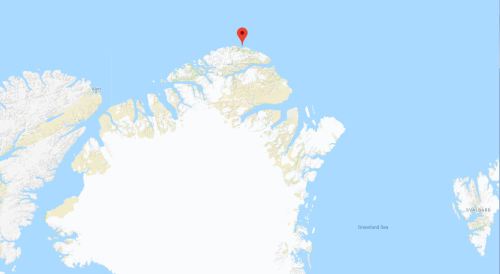
The region causing all the kerfuffle is at the northernmost tip of Greenland (see map below), where there is a weather station at Cape Morris Jesup. Next-nearest stations are at Alert, Canada (to the west) and Longyearbyen, Svalbard (Norway, to the east).
Arctic temps spike over 30 degrees in the midst of winter (The Weather Network, Friday, February 23, 2018) included the tweet below, showing a fracture of sea ice north of Greenland so transient that it does not show up on daily sea ice maps:

#Arctic craziness continues at the northernmost tip of #Greenland: break-up of coastal landfast ice at the freak sea ice fracture. pic.twitter.com/6FRFqcGh34

— Lars Kaleschke (@seaice_de) February 23, 2018

“Along with those spikes in temperature, Lars Kaleschke’s tweet, above, also shows the large rift in the sea ice that opened up just north of Cape Morris Jesup, at the same time. Kaleschke is a professor of sea ice remote sensing at the Center for Earth System Research and Sustainability, at the University of Hamburg, in Germany.“

Summary: Temperature and sea ice “aberrations” in northern Greenland are transient phenomena that have clearly happened before (e.g. 2011) without major consequences except perhaps through impacts on the eastern Arctic and subArctic weather conditions (including the UK).

Lack of sea ice north of Svalbard in the Barents Sea occurred last year and in 2012 in February. But by mid-to-late March, when seals are beginning to give birth on the ice and polar bears are busy hunting them, ice had again covered the region.

This year is likely to be the same. However, we won’t know until the end of March or early April if a recovery will or won’t happen, so any alarm-ringing about impacts on Arctic fauna survival have no foundation in fact until then.
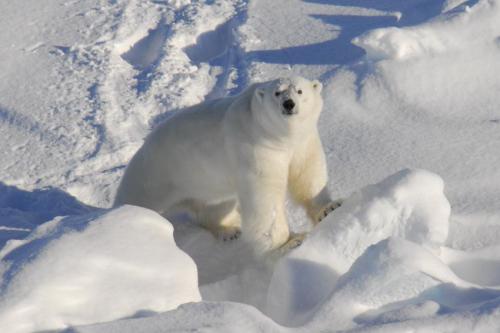
Scorsby Sound, East Greenland bear in March 2011. Rune Dietz, press photo.

In the Bering Sea, ice extent is well below average for this time of year but studies show the one consistent feature of Bering Sea ice is its variability. Low ice levels have distressing impacts for St. Lawrence island seal and whale hunters.

However, there is certainly enough ice in the Bering Sea/Chukchi Sea region for polar bears and Arctic seals to do what they do this time of year (which is try to survive until early April, at which time seals start giving birth to their pups and polar bears start to eat them, with gusto).

And the ice season isn’t over: maximum extent of ice in the Bering sea doesn’t usually come until late-April or May, and the dramatic decline of mid-February already shows signs of reversing.

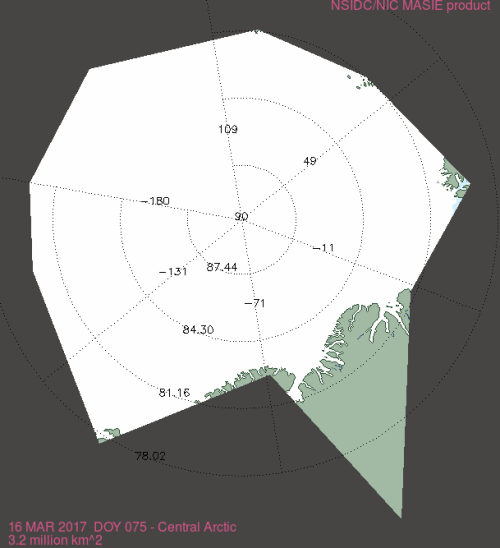
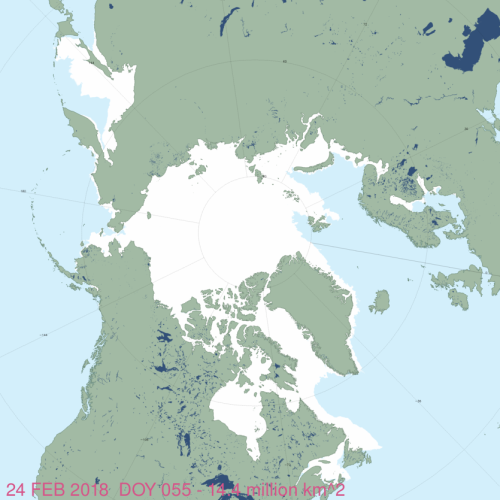
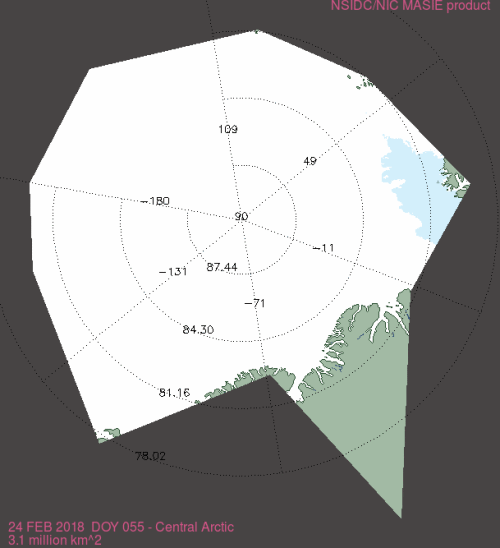
Details below this ice map for 24 February 2018, courtesy NSIDC Masie:
PS. I’m off within hours to Toronto for the launch of my State of the Polar Bear Report in honour of International Polar Bear Day, 27 February. Watch for reports in the news and for my op-ed 27 February at the Financial Post.

Arctic temperature spikes

Arctic temperatures soar 45 degrees above normal, flooded by extremely warm air on all sides (Washington Post, 22 February 2018) [story also carried by the National Post, same day]

“On Monday and Tuesday, the northernmost weather station in the world, Cape Morris Jesup at the northern tip of Greenland, experienced more than 24 hours of temperatures above freezing according to the Danish Meteorological Institute.

“How weird is that?” tweeted Robert Rohde, a physicist at the University of California at Berkeley. “Well it’s Arctic winter. The sun set in October and won’t be seen again until March. Perpetual night, but still above freezing.”

This thaw occurred as a pulse of extremely mild air shot through the Greenland Sea.

Warm air is spilling into the Arctic from all sides. On the opposite end of North America, abnormally mild air also poured over northern Alaska on Tuesday, where the temperature in Utqiaġvik, previously known as Barrow, soared to a record high of 31 degrees (minus-1 Celsius), 40 degrees (22 Celsius) above normal.

The warmth over Alaska occurred as almost one-third of the ice covering the Bering Sea off Alaska’s West Coast vanished in just over a week during the middle of February, InsideClimateNews reported.

Temperatures over the entire Arctic north of 80 degrees latitude have averaged about 10 degrees (6 Celsius) above normal since the beginning of the calendar year, sometimes spiking over 25 degrees (14 Celsius) above normal (the normal temperature is around minus-22, or minus-30 Celsius).

…

The mercury at the North Pole could well rise above freezing between Thursday and Sunday.

This next batch of abnormally warm air is forecast to shoot the gap between Greenland and northern Europe through the Greenland and Barents seas. Similar circumstances occurred in December 2016, when the temperature at the North Pole last flirted with the melting point in the dark, dead of winter. We documented similarly large jumps in temperature in November 2016 and December 2015.”

Today (25 February) Robert Rohde was busy tweeting that temperatures at Cape Morris Jesup had broken records but had to recant a short time later:

So, apparently DMI has a reading from Morris Jesup of +7.8 C on Feb. 12, 2011.

The GSOD archive of Morris Jesup that I have been relying on only gives a high of +5.4 C on that day.

Assuming the DMI reading is authoritative, then the recent +6 C is actually not a record.

— Robert Rohde (@rarohde) February 25, 2018

[“So, apparently DMI has a reading from Morris Jesup of +7.8 C on Feb. 12, 2011. The GSOD archive of Morris Jesup that I have been relying on only gives a high of +5.4 C on that day. Assuming the DMI reading is authoritative, then the recent +6 C is actually not a record.” 9:25 AM – 25 Feb 2018]

This confirms my own internet search for today’s weather at Morris Jesup, which varied from above zero to well below zero on 25 February. For example, here are the current conditions and forecast (all below zero) from a Norwegian weather service:
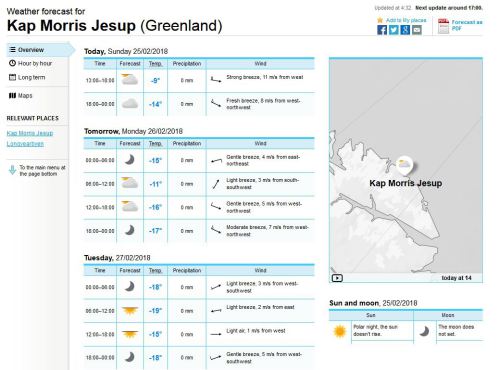
So, which is correct? I have no idea. I also don’t know why the temperatures reported are so different from the same weather station.

Not only that, but it looks like temperature spikes aren’t such a rare occurrance anyway:

Extreme Arctic temperature spikes occur frequently as warm, moist oceanic air arrives either from the Pacific, Atlantic, or thru the Labrador Sea. This chart looks like a heart EKG but highlights the wild winter-time variability in the Arctic w/temp spikes 2004-2018. pic.twitter.com/7jLpGEGyD5

— Ryan Maue | weather.us (@RyanMaue) February 25, 2018

See also “Temperature rises above freezing near North Pole, as frigid air slinks toward Europe” (Mashable, 20 February 2018)

Sea ice north of Svalbard

There’s no doubt that a big patch of open water north of Svalbard in the Barents Sea looks odd and out of place in the middle of winter, see map below at 22 February 2018:
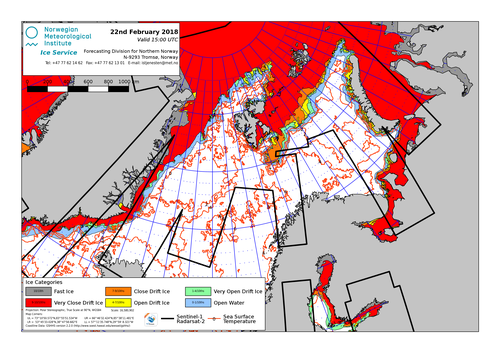
Seen from the Arctic Basin, that open water looks like this (where Svalbard is on the right side of the map):
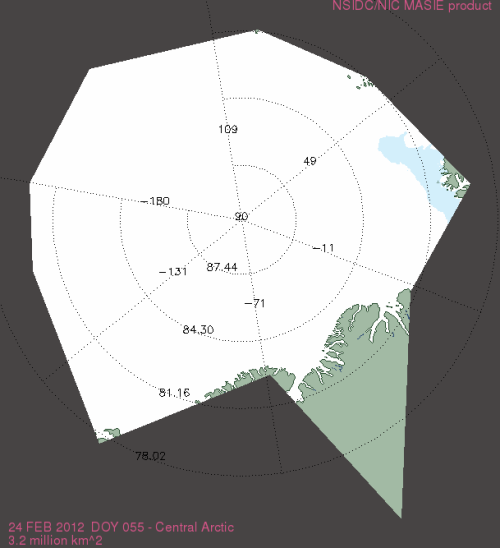
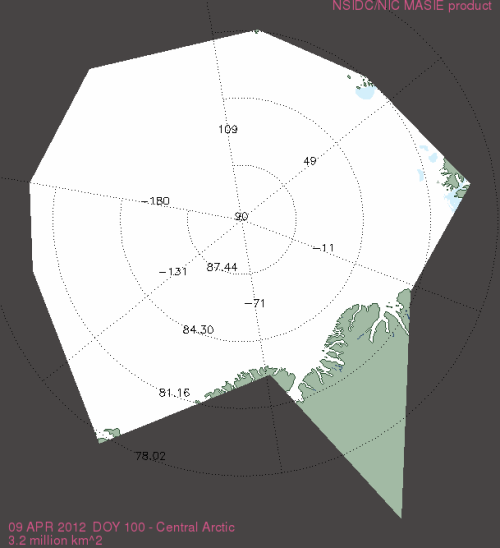
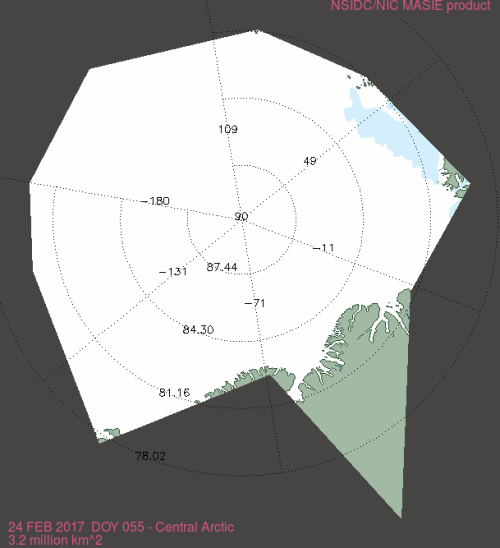
However, a similar phenomenon occurred in 2012 (and to some extent last year) at about the same time but several weeks later ice had moved south from the Arctic Basin. You can see that in the two maps below, one for the Arctic Basin in mid-February 2012 and the other in early April same year (where Svalbard is on the right side of the map):
Last year the open water in late February was ice-covered in ice by mid-March:
So, let’s hold off on the predictions of doom for Svalbard and Barents Sea polar bears until we see what the ice does over the next few weeks.

Sea ice in the Bering Sea is low
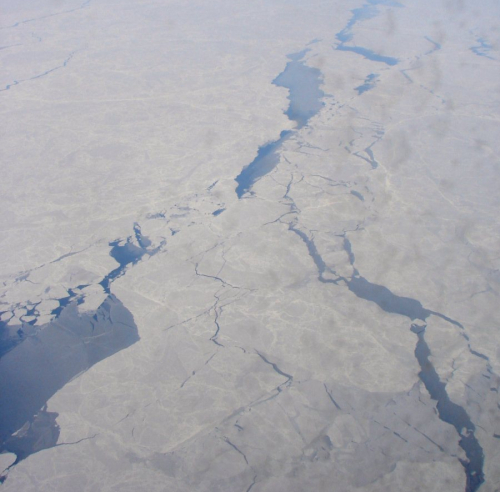
Open leads in the Chukchi Sea pack ice, April 2009, north of Bering Strait. Wikipedia.

Several outlets are making a big deal of the low ice extent in the Bering Sea this season and the rapid drop that happened mid-month.

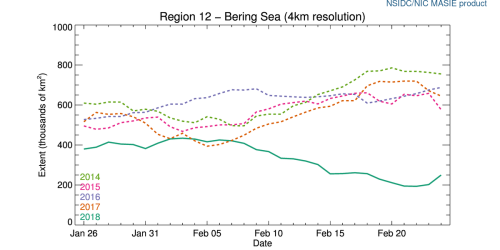
And while it’s clear the coverage is lower than usual, what’s not clear is whether that matters an iota to marine mammals that live in the Bering/Chukchi Sea complex. You can see the drop in ice going into mid-month in NSIDC Masie’s regional day-by-day plot for February:
It’s certainly true that lack of ice around St. Lawrence Island in the southern region of the Bering Strait will impact seal and whale hunting for residents there.

Mark Serreze of Arctic Death Spiral fame (2010) had this to say [InsideClimateNews, Alaska’s Bering Sea Lost a Third of Its Ice in Just 8 Days; 17 February 2018):

“It used to be just the summer when the ice was breaking low records, but we’re starting to see winter really get into the act now,” said Mark Serreze, the director of the National Snow and Ice Data Center.

“Both the atmosphere and the ocean are really conspiring to keep sea ice levels down,” he said.”

USAToday has chimed in: ‘Unprecedented’: Bering Sea loses half its sea ice over two weeks; 23 February 2018):

“This is unprecedented,” said Brain Brettschneider, a climate researcher at the University of Alaska Fairbanks. “The amount of ice is less than it’s ever been during the satellite era on any date between mid-January and early May.”

This comes as much of western Alaska, including places like Saint Paul Island and Utqiaġvik, formerly known as Barrow, is in the midst of its warmest winter in recorded history.”

So, potential impacts on humans living in the Bering Sea but not necessarily the animals, who are free to move to where conditions suit them.

Note that Utqiagvik, formerly known as Barrow, in on the Chukchi Sea, not the Bering Sea: the Bering Sea starts south of the Bering Strait.
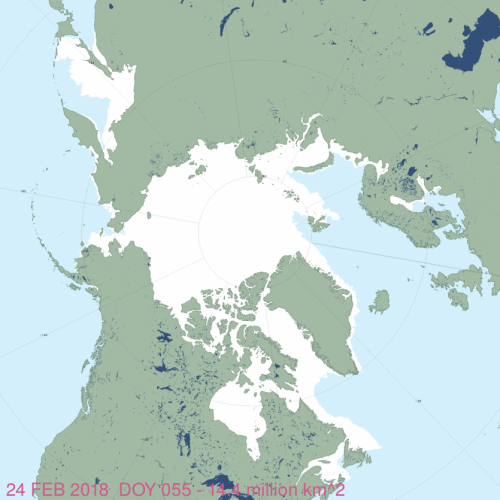
The NSIDC Masie map above show lots of ice along the coasts of Chukohtka and Alaska, and surrounding Wrangel Island. There does not yet appear to be a polynya opening up around Barrow yet, as did in May 2015 and also in 1975.

However, I posted about Bering Sea ice years ago: in 2012, actually.  And what I discovered is that the literature shows Bering Sea ice is naturally variable.

“In a study published last year (2011), Zachary Brown and colleagues Gert van Dijken and Kevin Arrigo report that while the Bering Sea was thought to be “rapidly warming and losing sea ice,” the results of their study indicate that “mean annual sea ice extent in the Bering Sea has exhibited no significant change over the satellite record (1979-2009)” and that “the Bering Sea as a whole has undergone no significant change in the timing of ice retreat or advance, or in the length of the ice-free season.”

Brown et al. also say that sea ice cover in the Bering Sea ice is “most aptly characterized by its intense interannual variability.” Sea ice extent in the Bering Sea varied over their period of study (1979-2009) from a low of 130,000 km2 (in 1979) to a high of 256,000 km2 (in 1999).”

And like the situation in the Barents Sea, Bering Sea ice does not usually peak until late April or May, so we are a long way off from concluding this is all the ice there will be this year. You can see on the Masie plot above that extent is already picking back up after the mid-February decline.

However, there is certainly enough ice in the Bering Sea/Chukchi Sea region for polar bears and Arctic seals to do what they do this time of year (which is try to survive until early April, at which time seals start giving birth to their pups and polar bears start to eat them, with gusto).

NOAA biologists tagging ribbon seal pups in the Bering Sea, April 2014.

References
Brown, Z.W., van Dijken, G.L. and Arrigo, K.R. 2011. A reassessment of primary production and environmental change in the Bering Sea. Journal of Geophysical Research 116 :C08014. doi:10.1029/2010JC006766.

Read more at Polar Bear Science
  • Truth
  • Twitter
  • Facebook
  • LinkedIn
  • Gettr
  • Threads
  • gab-logo Gab
  • Mastodon
  • Buffer
  • Telegram
  • Email
  • Copy Link
  • Share Using More Networks…

Popular Posts

Bipolar

New Study: Ice Core Data Shows Modern Warming Is Statistically Unremarkable

Mar 05, 2026
Electric Vehicles (EVs)

The ‘Green’ Scam Of The Century: How ‘Renewables’ Increase Fossil Fuel Demands

Oct 23, 2024
News and Opinion

Antarctica Is Colder, Icier Today Than At Any Time In 5,000 Years

Apr 15, 2024

Comments 1

  1. Spurwing Plover says:
    8 years ago

    Some people are dumb enough to beleive everything their told and think if their car wont start in the morning its becuase of Global Warming Climate Change

Stay Connected!

gab-logo

Donate Today

Beating back the alarmist narrative takes time and money. Please donate today to help!

Get notified when new posts are published!

Subscribe to receive a digest of daily stories, or get emailed once they're published. Check your Junk/Spam folder for a verification email.

Recent Posts

  • north sea oil rigMiliband Vows Permanent North Sea Drilling Shutdown, Legal Ban On Fracking
    May 14, 2026
    Labour's energy bill permanently bans new North Sea drilling and fracking, defying industry leaders who warn the timing couldn't be worse. […]
  • french farmer protestFrench Farmers Protest En Masse Over Soaring Diesel Costs, Green Fuel Taxes
    May 14, 2026
    French farmers blockaded a Lyon refinery, protesting diesel costs, fuel taxes, and EU trade policies that are flooding markets with cheap imports. […]
  • corn ethanol fuel foodGroups Blast E15 Bill As Hidden Tax Disguised As Consumer Choice
    May 14, 2026
    Free-market groups urge Congress to reject adding E15 to gasoline year-round, which would burden consumers, refiners, and engines. […]
  • bangor daily HLClimate ‘Migrants’ From Texas Feel ‘Lucky’ To Find Vagrant Feces On Maine Porch
    May 13, 2026
    Climate 'migrants' who fled Texas for Maine's progressive politics say they feel 'lucky' after waking to find human feces on their porch. […]
  • nyc power demandNew York’s Green Energy Gamble Looking A Lot Like Cuba’s Grid Collapse
    May 13, 2026
    New York’s push toward solar and wind while aging natural gas plants deteriorate could bring reliability problems, higher costs, and blackout risks. […]
  • miliband field turbinesEd Miliband’s Ludicrous Net Zero Plan Is Costing UK Taxpayers Billions
    May 13, 2026
    Ed Miliband's wind farms can't deliver electricity to consumers—so Britain pays them to turn off while natural gas generation and emissions rise. […]
  • starmer construction siteReport: Britain Faces 160,000 Job Losses This Year Over Soaring Energy Costs
    May 13, 2026
    A major economic forecaster predicts over 160,000 UK job losses this year, driven by rising energy costs and Labour's Climate Change Levy increases. […]
  • Algiers Point, New OrleansMeteorologist Debunks Guardian’s Sea Level Panic: New Orleans Isn’t Drowning
    May 12, 2026
    The Guardian claims New Orleans must evacuate due to sea level rise. Tide gauge data tells a very different story—one of land sinking, not drowning. […]
  • science class professorGerman Physicist Dismantles The Climate Crisis Narrative One Claim At A Time
    May 12, 2026
    German physicist Dr. Bernd Fleischmann systematically challenges climate alarmism, arguing CO2 benefits outweigh risks and warming favors humanity. […]
  • gas station pumpTrump Says Temporarily Suspending Federal Gasoline Tax A ‘Great Idea’
    May 12, 2026
    President Trump supports temporarily suspending the federal gas tax as pump prices surge amid the Iran war, a move requiring congressional approval. […]

Submit a tip

Please enter your email, so we know you're human.

Books You May Like

Cold Facts About the Great Global Warming Scam

Climate prn book

Have a suggestion? Let us know! We swap out books based on your input. We participate in the Amazon Services LLC Associates Program. See here.

  • Privacy Policy
  • DMCA Policy
  • About Us
  • Contact Us

© Portions copyright Climate Change Dispatch

No Result
View All Result
  • Home
  • Videos
  • Who We Are
  • Facts Vs. Fearmongering
    • Real science vs Junk Science
      • 1100-plus Peer-Reviewed Studies
      • Michael Crichton: Aliens Cause Global Warming
      • Climate change and its causes
      • Climate Science Primer
      • CO2 is not pollution
      • Deceptive Surface Temperature Records
      • Editorial: Great Global Warming Hoax
      • Rules for Climate Radicals: Part 1
      • Rules for Climate Radicals: Part 2
      • Rules for Climate Radicals: Part 3
      • Why CO2 Is A Minor Player In Global Climate
      • Why Politicized Science Is So Dangerous
    • Facts Not Fear
      • A Simple Question For Climate Alarmists
      • Climate Change – The Facts
      • Climate Change Fears Are Empirically Baseless
      • Global Warming 101
      • Global Warming Q&A
      • Understanding The Medieval Warm Period
      • Ocean Cycles and Climate
      • Overview of Plate Climatology Theory
      • Precautionary Principle
      • Should We Celebrate Carbon Dioxide?
      • The Skeptics Handbook
      • Weather Versus Climate
      • Why I’m a GW skeptic
      • Winning the climate debate with facts
      • Why Aliens Cause Global Warming
    • Greenhouse FAQs
      • CO2, Plants, & Industry
      • How much have temps changed?
      • How much have temps changed?
      • How much have temps changed?
      • Is global warming real?
      • Measuring temperature
      • Swimming in CO2?
      • Scientists urge caution?
      • Today’s warming trend
      • Variations in temperature
    • Gore’s Greatest Goofs
      • Deconstructing the Truth
      • Fact-Checking Al Gore’s Latest Predictions
      • How Gore Created The Global Warming Hoax
    • Inside Real Climate
      • Closer look at the 97% Consensus
      • GW’s Amazing Story
      • IPCC gets failing grade
      • Real Climate Exposed!
      • Truth about Real Climate
      • We’ve Been Conned
      • What is there a 97% consensus about?
    • Behind the IPCC
      • 1,000 Scientists Dissent
      • Climategate: Caught Green-Handed!
      • Climategate Inquiries
      • Climategate Inquiries 2
      • NIPCC Report Now Available
      • Understanding the Climategate Inquiries
  • Submissions
  • Contact Us

© 2026 Climate Change Dispatch

 
Share via
  • Facebook
  • Twitter
  • Pinterest
  • LinkedIn
  • Digg
  • Tumblr
  • VKontakte
  • Print
  • Email
  • Reddit
  • Buffer
  • Love This
  • Weibo
  • Pocket
  • Xing
  • Odnoklassniki
  • WhatsApp
  • Meneame
  • Blogger
  • Amazon
  • Yahoo Mail
  • Gmail
  • AOL
  • Newsvine
  • HackerNews
  • Evernote
  • MySpace
  • Mail.ru
  • Viadeo
  • Line
  • Flipboard
  • Comments
  • SMS
  • Viber
  • Telegram
  • Subscribe
  • Facebook Messenger
  • Kakao
  • LiveJournal
  • Yammer
  • Edgar
  • Fintel
  • Mix
  • Instapaper
  • Copy Link
  • Truth
  • gab-logo Gab
  • Gettr
  • Baidu
  • Mastodon
  • Threads
  • Bluesky
Share via
  • Tumblr
  • VKontakte
  • Print
  • Email
  • Reddit
  • Buffer
  • Love This
  • Weibo
  • Pocket
  • Xing
  • Odnoklassniki
  • WhatsApp
  • Meneame
  • Blogger
  • Amazon
  • Yahoo Mail
  • Gmail
  • AOL
  • Newsvine
  • HackerNews
  • Evernote
  • MySpace
  • Mail.ru
  • Viadeo
  • Line
  • Flipboard
  • Comments
  • SMS
  • Viber
  • Telegram
  • Subscribe
  • Facebook Messenger
  • Kakao
  • LiveJournal
  • Yammer
  • Edgar
  • Fintel
  • Mix
  • Instapaper
  • Copy Link
  • Truth
  • gab-logo Gab
  • Gettr
  • Baidu
  • Mastodon
  • Threads
  • Bluesky