

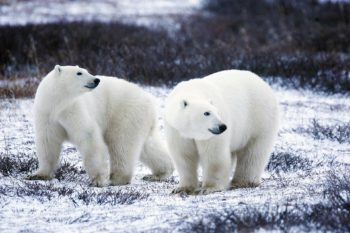
 Last week’s media coverage made me realize that James Hansen’s testimony to a US Senate committee in 1988 provided a well-timed answer to a vexatious problem facing polar bear biologist Ian Stirling.
Thirty years ago, Stirling was struggling to understand why polar bear productivity in Western Hudson Bay had dropped. He was ripe for the suggestion from Hansen (and his follow-up paper) that human-caused global warming could be the explanation.
An interview with Stirling and colleague Andrew Derocher published in 2016 helps connect the dots.
Many bears were in poor condition in the fall of 1983 (Calvert et al. 1986:19, 24; Ramsay and Stirling 1988). In general, the 1980s saw weights of bears decline and cub mortality increase, with a marked increase in the loss of whole litters over what had been documented in the 1960s and 1970s (Derocher and Stirling 1992, 1995).
Until Hansen and climate change came along, density-dependent effects (such as the number of bears out-pacing food supply) were seen as the most likely explanation.
But sea ice decline blamed on human-caused global warming was suddenly a new possibility that Stirling soon embraced (Stirling and Derocher 1993).
By the late 1990s, sea ice coverage on Hudson Bay had indeed declined but the correlation with polar bear productivity produced a weak trend that was not statistically significant (Stirling et al. 1999).
The 1999 Stirling paper did not provide scientific evidence to explain the 1980s decline in productivity as much as it presented a novel scapegoat to blame when a more plausible explanation could not be made.
Bottom line: Global warming could not have been the proximate cause of the productivity changes in WH polar bears documented during the 1980s but Stirling spent the next two and a half decades vigorously pushing climate change as the cause of all polar bear ills.
In a 2016 interview published in the University of Alberta newsletter, Ian Stirling provides some helpful insights into the Western Hudson Bay polar bear issues he and colleague Andrew Derocher were wrestling with in the late 1980s (Derocher and Stirling 1992, 1995; Stirling 2002; Stirling and Lunn 1997).
Note that Stirling was supervising Andrew Derocher’s Ph.D. dissertation on the population dynamics of WH bears at the time (Derocher 1991), so the declining productivity of WH bears during the 1980s was a problem for both of them.
Stirling stated in the interview:
“Leading up to the 1993 paper [Stirling and Derocher 1993], I was originally interested in natural fluctuations in ecosystems. It didn’t have anything to do with climate change. One day after looking at our long-term population-monitoring data from my project in western Hudson Bay, I said to Andy [Derocher], “You know, there are some longer-term things going on underneath what we’re seeing up front.”
I had set out to look at some completely legitimate but totally different questions, and climate change forced its way onto the agenda. We had to figure out what on earth was going on here; it was something besides what we were looking for. Andy left to study polar bears in Svalbard [Arctic Norway], and in 1999, with Nick Lunn, my colleague on the population ecology of polar bears in western Hudson Bay, I published the first paper that statistically confirmed the negative effects of climate warming on polar bears in the area [Stirling et al. 1999].” [my bold]
Stirling was looking to explain some natural fluctuations in ecosystem parameters (like sea ice thickness, snow depth over ice, seal ecology, and primary productivity) that might have negatively affected polar bear health and survival in some years but not others.
He couldn’t get the information he knew he needed to explain the decline in productivity, which must have been a huge frustration. Climate change didn’t so much “force its way onto the agenda” of Ian Stirling as much as it became such a prominent topic within the scientific community and the media that it was impossible for him to ignore.
Stirling’s Polar Bear Problem
From Derocher And Stirling (1992:1153):
“The proportion of females with yearlings varied annually between 6% and 25% of all adult femalessampled over the study, but did not demonstrate any trend. The low proportion of females with yearlings in 1990 appeared to be due to very low survival in the cohort of cubs from 1989.”
[What was happening with sea ice in 1989 in WH? The breakup was a bit early but not especially so in 1989 and the date of freeze-up was about average (Lunn et al. 2016), a fact not mentioned in Stirling et al. 1999.
As a consequence, like the recent decline in the proportion of females with yearlings cubs documented in Southern Hudson Bay (Obbard et al. 2018), a decline in the length of the ice-free season could not have caused the low survival of WH cubs in 1989.]
Average weights of females in the fall declined from about 230 kg (1965-1982) to about 190 kg (1983-1990)(Derocher and Stirling 1992:1154), but there was no population decline. The authors state later in that paper:
“An increasing age of maturation is assumed to indicate that carrying capacity is being approached and that density-dependent mechanisms are operative. The decline in body weight observed in this study suggests that females required a longer period before sexual maturation because maturation is usually associated with the attainment of a threshold body size (Laws 1956, Sadleir 1969). Litter sizes are not a particularly dynamic characteristic of polar bear popUlations, but they did decline slightly.
Typically, density dependence in large mammals is expressed by changes in
juvenile survival, birthrate, age of first reproduction, and body size, all of which have been documented in this study. Invoking an argument of density-dependent changes is difficult to support without accurate population estimates, and other explanations for the observed patterns in our study cannot be dismissed as alternatives. For example, climatic fluctuations and variation in ice conditions could impact polar bear populations by increasing or decreasing the availability of prey. The observed decreases in reproduction and weight could be a function of a reduction in the seal population or their availability to polar bears. Variation in the abundance of a prey base is usually reflected in changes in weight and subsequently in reproduction of predators. For example, the weights and reproductive output of polar bears in the Beaufort Sea decreased markedly following a decline in ringed and bearded seal populations (Stirling et al. 1976, 1977 a, 1982, Kingsley 1979, DeMaster et al. 1980, Amstrup et al. 1986).In contrast to the Beaufort Sea studies, where the decline in body size and
reproduction was sudden and then evident for only 2 or 3 years, the trend in the western Hudson Bay population has been of much longer duration.
…
Polar bears are significant predators on ringed seals and have been estimated to remove up to 44% of the annual production of ringed seals in some years (Hammill and Smith 1991). It is not known if polar bear predation can significantly alter the population size of ringed seals, nor is it known how the dynamics of the two species are related. However, it seems likely that the carrying capacity of polar bears is determined by the abundance of ringed seals. The factors that affect ringed seal productivity likely relate to ecosystem productivity, ice-conditions, and predation pressure.
It is possible that the population of ringed seals increased when the polar bear population was depleted, so that the high reproductive rates and heavy body weights of bears seen in the 1970’s and early 1980’s could have been a response to an abundance of food. If so, it is likely that competition between bears for seal kills increased as the population size increased. Although it is not possible to demonstrate conclusively an increase in population density, the observed changes in the population are consistent with such a theory.” [my bold]
From Derocher And Stirling (1995:1662):
“The hypotheses of Ramsay and Stirling (1982, 1988) that the western Hudson Bay population was more fecund than populations in other areas because of prey abundance, prey availability, or primary productivity cannot be assessed because information on the ecology of ringed and bearded seals and on primary productivity in Hudson Bay relative to other areas is very limited.
Testing of the hypothesis that sea ice conditions are more favourable for polar bear hunting in western Hudson Bay (Ramsay and Stirling 1982, 1988) is also hampered by lack of data. It is possible that the sea ice was more favourable for polar bears in western Hudson Bay prior to 1980, and the impact of climatic variability cannot be dismissed as an explanation for the changes we observed in reproduction and mass. Long- and short-term fluctuations in arctic climate and sea ice conditions have been noted (Vibe 1967; Dansgaard et al. 1975; Catchpole and Faurer 1985; Mysak and Manak 1989). Climatic anomalies such as the lower temperatures in eastern Hudson Bay during the 1980s (Findlay and Deptuch-Stapf 1991) could have altered the sea ice of Hudson Bay and subsequently changed the abundance of seals or their availability to polar bears.
…
Our data from Hudson Bay suggest that a major drop in body masses occurred between 1982 and 1983 and the decline may not have been steady (Fig. 4). This suggests that the changes in body masses were in response to a rapid ecosystem shift and not to a steady linear decline in some factor. It is possible that the decline is due to stochastic events.“ [my bold]
Conclusions
In the early 1990s, the preferred explanation for the decline in body weights of females and productivity in Western Hudson Bay in the mid to late 1980s was a density-dependent response: in other words, polar bear numbers had increased to such an extent that they were starting to out-strip their food supply and individuals had to compete for available food.
But suddenly, in 1988, the idea that human-caused global warming due to rising CO2 emissions from fossil-fuel use (Hansen et al. 1988) became front page news.
Ian Stirling must have seen these headlines and eventually (though not immediately) embraced the idea that global warming might be to blame for what was going on in western Hudson Bay.
The Derocher and Stirling book chapter (1992) and the Derocher and Stirling (1995) scientific paper both mention a density-dependent response as the most likely explanation and the only mention of breakup/freeze-up dates was in regard to yearly sea ice variability.
Year-to-year variability is still a major feature of Hudson Bay sea ice dynamics (Castro de la Guardia et al. 2017; Lunn et al. 2016) and while trend lines can be drawn over decades, the notion that individual years with unusual conditions (e.g. 1983 and 1989) can have major impacts on polar bear health and survival has been discounted (Crockford 2015).
When Stirling and Derocher wrote their speculative 1993 paper describing what might happen if global warming caused sea ice breakup to come earlier than usual they did not cite Hansen et al. 1998.
However, they did cite Parkinson and Kellogg 1979, a report on one of the first models of sea ice decline predicted by increased CO2 (Stirling went on to co-author a paper with Parkinson in 2006) and Etkin 1991, which discussed how rising air temperatures from CO2-driven “climate warming” might affect breakup dates for Hudson Bay.
Stirling continued to use the phrase “climate warming” rather than global warming or climate change in subsequent papers and essays.
Derocher may not have been totally on board with blaming global warming for productivity changes, as his papers on Svalbard area bears that were published soon after (e.g. Derocher 2005; Derocher and Wiig 2002) discuss only density-dependent effects.
But he was clearly convinced enough by early 1992 to co-author a speculative paper on the topic with his former Ph.D. supervisor (Stirling and Derocher 1993).
However, the paper Stirling and colleagues published in 1999 (without Derocher) was a pivotal piece of work: it marked the end of two decades of scientific frustration trying to understand documented fluctuations in polar bear population dynamics and the beginning of an era of simply ignoring critical environmental factors that were poorly understood in favour of blaming the new climate change scapegoat.
Read more at Polar Bear Science




Proving that the Enviromentalists Wackos have turned the Polar Bear into their Global Warming/Climate Change mascot seeing those idiots from Greenpeace,NRDC use them these Greens are full of more bull then the Chicago Stockyards