A recent story from The Conversation (via PBS News), “Climate change may be making us lonelier. How heat waves and extreme weather disrupt social connections,” claims that the loneliness epidemic is worsened by climate change because increasingly severe weather is forcing people to stay apart. [some emphasis, links added]
This is ridiculous.
While it’s true that young adults report feeling more isolated than past generations, it’s not because the weather has gotten more extreme; it hasn’t. People are increasingly isolated due to cultural changes, often preferring online relationships and communication over in-person interactions.
In the past, extreme weather also disrupted communication and routines, [but it didn’t fuel mass isolation as COVID-19 lockdowns did and social media does]. Also, since extreme weather has not become more frequent or severe, it can’t be causing more isolation and loneliness.
Social work researcher Fiona Doherty from the University of Tennessee, who wrote the Conversation article, used interviews and research she and her colleagues did with other social workers and residents of rural Appalachia.
Much of the evidence for her claims comes from anecdotal comments from interviewees, which is unreliable as a base for scientific research.
Doherty correctly says that “[s]evere storms, heat waves and wildfires can shut down the social life of a community, flooding out festivals, canceling community events and keeping people indoors.”
This is true, but her follow-up to that obvious comment is that this is “evidence of how climate change isn’t just changing the environments we all live in, but also impeding our ability to connect,” and worsening the loneliness epidemic, is nonsense.
That would presuppose that severe storms, heat waves, and wildfires did not occur before whatever period she claims is representative of “climate change,” which in this case probably refers to the decades following industrialization and the widespread use of fossil fuels.
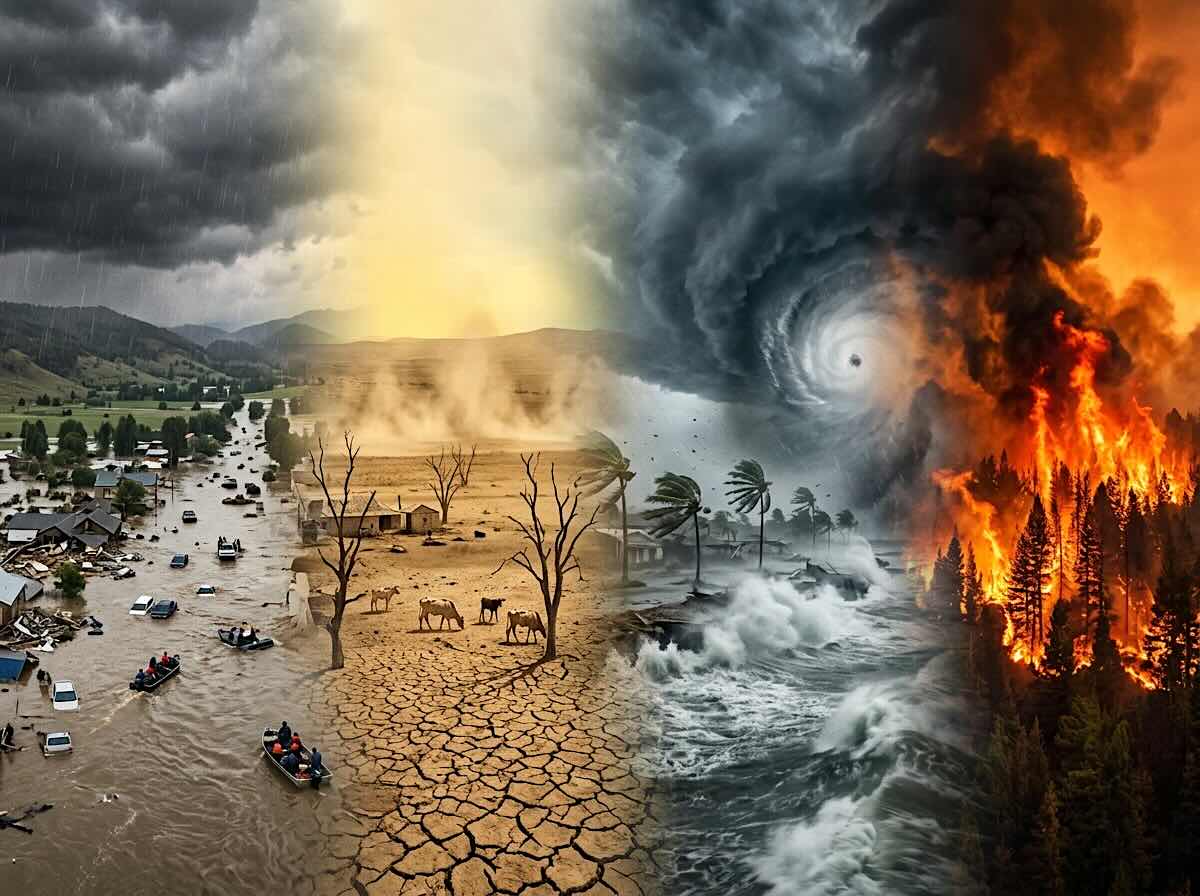
During this period, she claims that extreme weather has become “more common and disruptive,” citing extreme heat, floods, hurricanes, drought, and wildfires.
In this short post, It’s not possible to go into detail on why each of those weather events is not worsening due to climate change, but I will focus on the ones most relevant to Appalachia: extreme heat and flooding.
If you’d like to read about wildfires, hurricanes, and drought, you can read these Climate Realism posts about 2026 summer wildfires in North America, the impact of hurricane Helene on North Carolina, and drought in Georgia; for more general info about the U.S. as a whole, see Climate at a Glance: Hurricanes, Climate at a Glance: U.S. Wildfires, and Climate at a Glance: Drought
The Appalachian states have seen some of the lowest average warming in the country. Tennessee is estimated to have seen just a half-degree Fahrenheit warming in average temperature since 1900; West Virginia saw 1°F; Virginia 1.5°F; Kentucky 0.6°F.
Not one of these states has experienced an increase in “extreme heat” days. In fact, recent decades have seen less extreme heat than there was at the beginning of the twentieth century.
Take West Virginia, for example. In the 1910s-1930s, West Virginia saw many more days with temperatures of 95°F or higher. (See figure below)
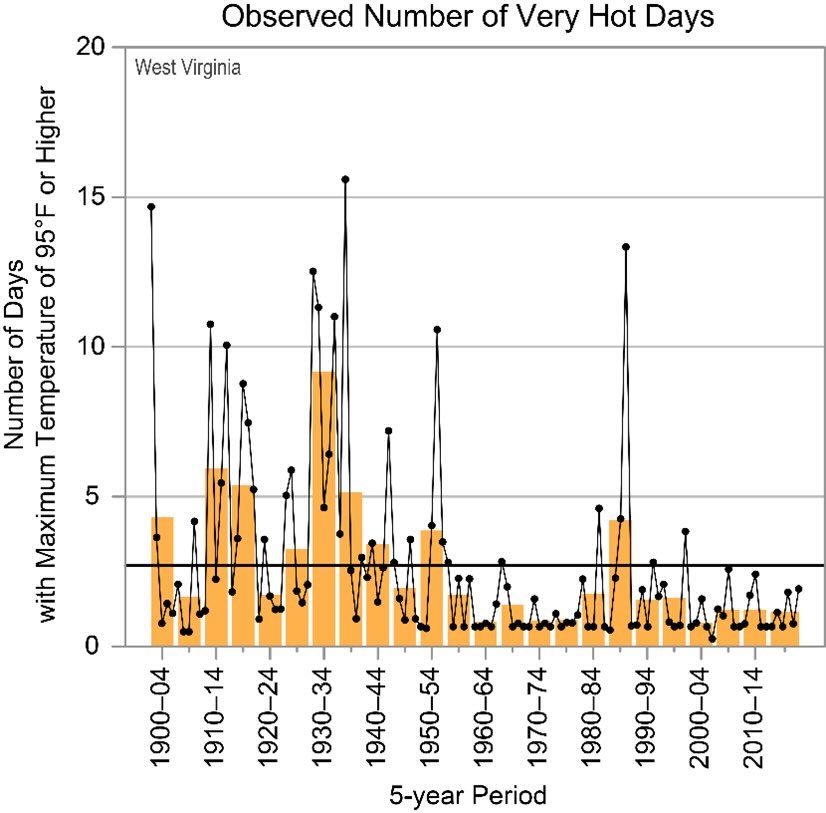
Even with this year’s heat factored in, it’s nowhere near the 1930s highs.
The same is true for the other Appalachian states.
As a result, increases in extreme heat cannot be driving rising feelings of isolation because they are not increasing in frequency or duration.
Likewise, flooding is not getting worse, at least not because extreme downpours are worsening, though aging infrastructure can make the impacts of natural flooding worse than they otherwise would be.
River gauge data from West Virginia, very prone to floods because of topography, show no trend in increased riverine flooding. The worst flood in the state’s history, which impacted multiple rivers and set records across the state, occurred in 1985.
The Conversation piece admits that the COVID-19 pandemic shut down American (and global) social life, and that social interaction was declining even before then, attributing this to climate change while saying absolutely nothing about other factors, such as the rise of social media and changing cultural practices.
Multiple studies have found strong links between increased social media use and feelings of isolation and loneliness among users, even though one would think they were more connected than ever.
This is not niche information, and a professional social worker would definitely be aware of this overwhelming evidence.
Weather is temporary, not the permanent state of the climate. It is natural and always changing, and has always impacted the way people interact. For every person who can’t attend a church function because a road is closed, another family might benefit from staying home, next to a fire on a blizzardy night.
Consider the impact on human mental health of winters in the far north where the sun sets and doesn’t return for weeks. That doesn’t mean that the Earth’s tilt and rotation around the sun is a problem for feelings of human isolation or depression.
The Conversation and PBS should be embarrassed for promoting this borderline pseudoscience. We know what is making the loneliness epidemic worse, and it’s not climate change or even the weather.
Top photo by Samuel Austin on Unsplash
Read more at Climate Realism