A recent Bloomberg story claims that climate change is behind rising food prices and that it’ll only get worse. Data and common sense say otherwise. Climate Realism’s H. Sterling Burnett takes them to task and writes,
“This is false. Data clearly show that world food production has dramatically increased as carbon dioxide (CO2) levels have increased and the Earth has modestly warmed. Growing conditions have improved as has plant health, and flawed climate models’ forecasts aside, there is no meteorological or biological reason for believing such conditions will worsen in the future.”
The Bloomberg story lists various factors, such as the COVID lockdown and the Iran War, that have caused periodic spikes in food prices. Sterling notes that it “goes off the rails” when it claims that “one-off weather shocks” are turning into regular events that can “decimate harvests and strain supply chains.”
“[A] less obvious force is also ratcheting up prices, but its effects risk lasting longer and being harder to predict,” claims Bloomberg. “Climate change is turning one-off weather shocks into more regular events that can decimate harvests and strain supply chains.
“As their effects compound, extreme heat and droughts threaten to make climate inflation an economic fixture,” the Bloomberg story continues. “Economists predict that the higher temperatures climb, the more bloated household costs like groceries may become.”
Sterling says, “Those paragraphs are replete with false claims about both worsening weather and worsening crop production.”
Is climate change causing more frequent or severe extreme weather, such as heatwaves? Data says no. Climate Realism reports that droughts, floods, and the number and temperatures of extremely hot days have not increased or become more severe. Sterling continues:
“In fact, the U.N. Intergovernmental Panel on Climate Change (IPCC) reports it has ‘low confidence’ that climate change has had a measurable impact on flooding, in the process admitting that climate change is as likely to have reduced flooding as it is to have made flooding events more common.
“The IPCC has also been unable to identify any clear global trend in worsening drought, much less any trend in worsening drought that can be scientifically attributed to human greenhouse gas emissions.”
And if human-caused climate change isn’t worsening farming conditions, how is it raising crop prices? It isn’t.
Climate Realism has refuted over 260 media reports claiming climate change harms crop yields and production. Using UN FAO data, they’ve shown that crop production and yields have set records during recent modest warming, largely due to increased CO2 that benefits plant productivity and health, and improved growing conditions. Sterling continues:
“Global warming lengthens growing seasons, reduces frost events, and makes more land suitable for crop production. Also, carbon dioxide is an aerial fertilizer for plant life. These factors have resulted in the largest decline in hunger, malnutrition, and starvation in human history.
“Whether one examines the production and yield of staple cereal grains, fruits and nuts, legumes, or less critical but still widely consumed crops like coffee and cocoa, the story is the same around the globe: increased yields and production
“Previous Climate Realism posts show agricultural productivity has increased dramatically, for example, in Africa, here, here, and here; in the Middle East, here and here; in Latin America, here, here, and here; in Asia, here, here, and here, and in North America, here, here, here, here, and here.”
Despite a declining farming population and less land devoted to agriculture, food production has increased, indicating rising productivity.
The growing abundance of food, partly due to climate change, has led the United Nations to report that the number of hungry people has declined by two billion since 1990. Sterling writes:
“So Bloomberg is wrong about climate change causing food shortages and thus higher prices now but what about its predictions, based on climate model projections, about the future.
“Bloomberg claims ‘[e]xtreme heat alone could raise global inflation by 0.3 percentage points to 1.2 percentage points a year starting in 2035, according to one study.’
“Even if one could trust climate models to accurately portray future climate conditions, which we can’t since they don’t portray past or present conditions accurately without significant ‘tuning,’ botany and agronomy suggests that what rising CO2 has done for crops up until now, should continue into the foreseeable future.”
Sterling notes that adding 140 parts per million of CO2 to the atmosphere has dramatically increased plant productivity and water use while decreasing hunger. Thousands of experiments confirm this, and research shows there’s 17% more food available per person than 30 years ago.
Put simply,
“There is no biological basis for believing any reasonably expected future levels of CO2 would reverse crop productivity or trends.”
Bloomberg relied on one alarming study based on unrealistic climate model projections and cited select “experts” who predict eco-doom to claim that human-caused climate change is harming food production. This is false.
Sterling points out:
“It’s time for Bloomberg to join the increasing number of media outlets that are reducing their alarming climate coverage, at least in part, in response to climate facts finally getting out and the public’s increasing skepticism or apathy regarding alarming climate claims, especially those that have been discredited multiple times in the past.”
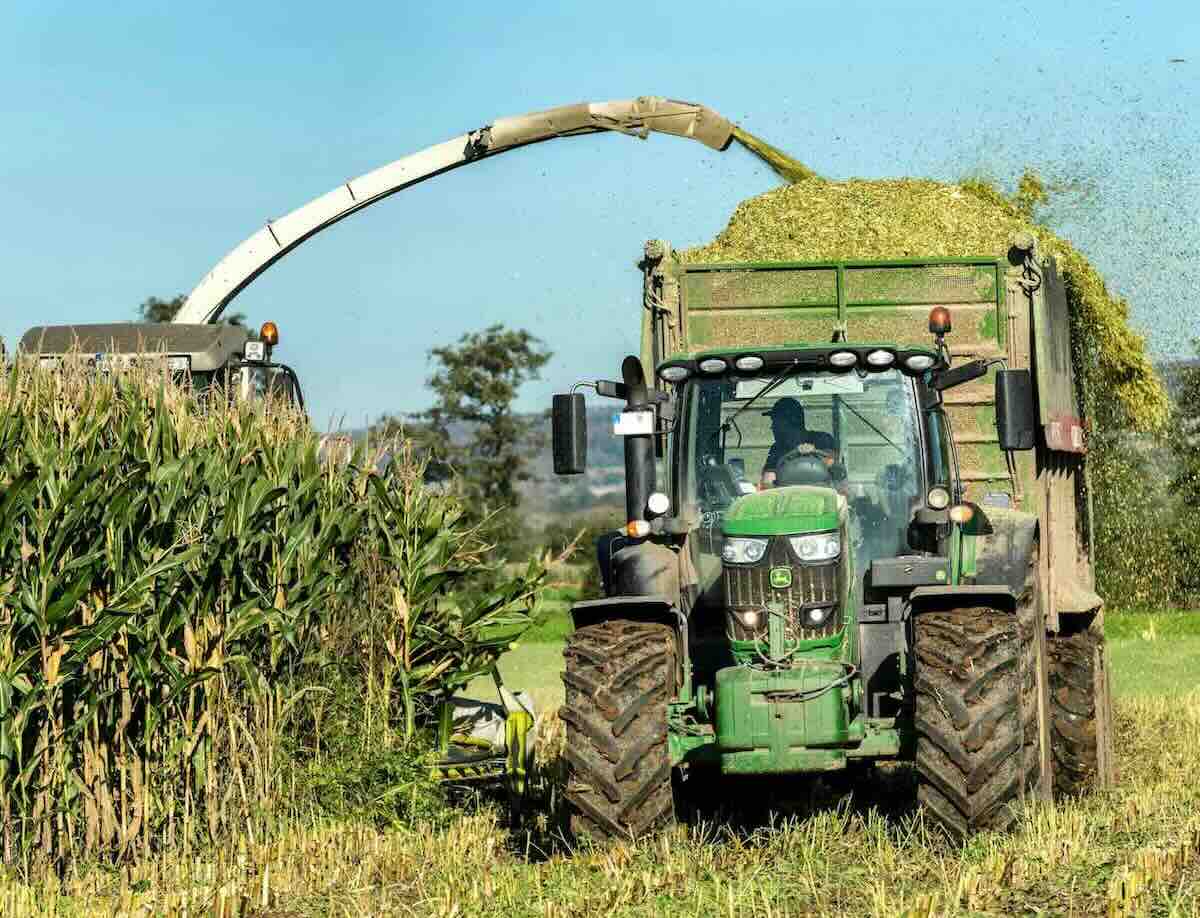
Top: Aerial shot of a harvester working a cornfield in rural Austin, MN, during the fall season. Photo by Tom Fisk via Pexels.