

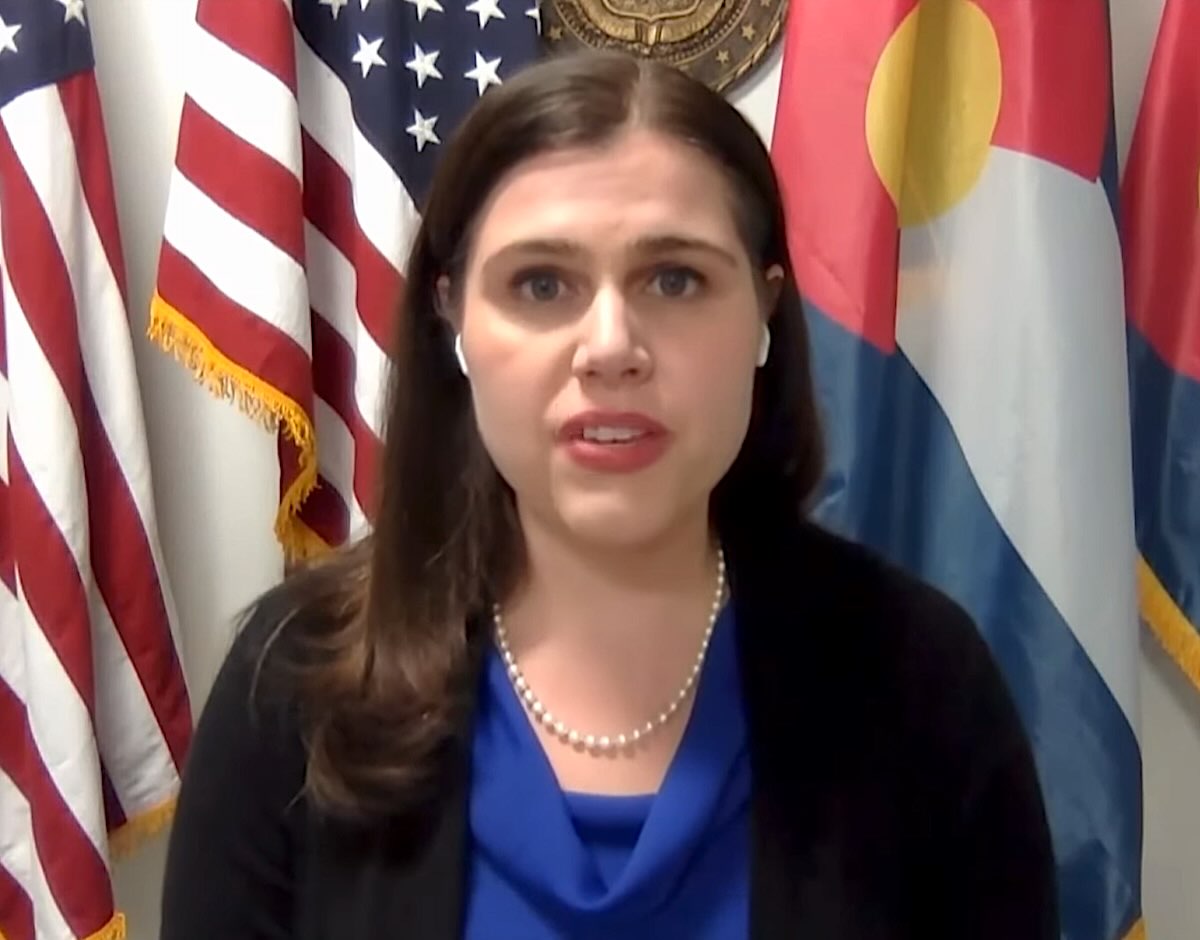
With less than a week before the June 30 Colorado primary, climate litigation has suddenly become a key issue in the race to become the state’s next attorney general. [some emphasis, links added]
All four Democrats running for office have now publicly backed Boulder’s climate lawsuit against American energy companies – but frontrunner and current Secretary of State Jena Griswold has gone further than the others.
Griswold is not only embracing Boulder’s case but also vowing to introduce her own litigation targeting American energy companies, if elected.
Climate litigation received little attention in the Democratic AG primary until earlier this month, when three candidates — Hetal Doshi, Michael Dougherty, and David Seligman — said during a Colorado Sun debate that they support Boulder’s lawsuit.
Griswold did not participate in the debate, but quickly clarified her position to POLITICO’s E&E News:
“The Democratic hopefuls include current Secretary of State Jena Griswold. She told POLITICO’s E&E News in an email that she supports the [Boulder] lawsuit and would ‘work to ensure the AG’s office has the resources to bring climate-related lawsuits without waiting on the governor’s administration.’” (emphasis added)
This is a major escalation.
Griswold isn’t just endorsing Boulder’s case; she is pledging to use the attorney general’s office to pursue additional climate litigation independently, even if the next governor declines to support it.
That could put her on a collision course with the leading Democratic gubernatorial candidates over who should drive Colorado’s energy policy.
U.S. Senator Michael Bennet has supported LNG exports, but his current energy agenda is more muddled after backing a windfall profits tax on large oil companies in 2022 and putting a statewide “cap-and-invest” program that would charge companies for emissions at the center of his gubernatorial platform.
Phil Weiser has previously declined to support Boulder outright – though comments from Boulder District Attorney Michael Dougherty during a recent debate hinted that his office has provided more support behind the scenes than has been disclosed.
Griswold’s comments raise several questions Colorado voters deserve to have answered:
- Will she pursue a new climate lawsuit even if the next governor opposes it?
- How much taxpayer money would she commit to this litigation?
- Would she continue pursuing these cases if SCOTUS rules against Boulder?
- How would more litigation against energy companies make life more affordable for Colorado families and businesses?
GOP Candidate Warns of Higher Costs
The leading Republican candidate in the attorney general’s race is already drawing a sharp contrast.
Michael Allen, a Colorado district attorney, told E&E News that Boulder’s lawsuit is:
“The wrong fight, in the wrong place, at the wrong time for working families… Boulder shouldn’t be trying to set national energy policy from a Colorado courtroom — and Colorado shouldn’t be dragged into costly, politically driven climate lawsuits that do nothing but drive up energy bills.”
That criticism gets to the core problem with climate litigation: these lawsuits are sold as a way to make energy companies “pay,” but their real-world impact would be higher consumer costs.
The people behind Boulder’s lawsuit have said as much.
David Bookbinder, an attorney who served for years as part of the legal team representing Boulder, has explained this theory plainly:
“Tort liability is an indirect carbon tax. You sue an oil company, an oil company is liable. The oil company then passes that liability on to the people who are buying its products. In some sense, it is the most efficient way. The people who buy those products are now going to be paying for the cost imposed by those products … [This is] somewhat of a convoluted way to achieve the goals of a carbon tax.”
Higher costs, in other words, are not an unintended consequence of these lawsuits. They are the point.
That matters in Colorado, where energy affordability is already a major concern for families, businesses, and manufacturers. Climate litigation may be marketed as a way to protect taxpayers, but the underlying theory is to raise the cost of producing and consuming energy through the courts rather than through legislation.
Bottom Line
Colorado’s Democratic attorney general primary has now put climate litigation squarely on the ballot.
All four candidates support Boulder’s lawsuit, but Griswold has gone further by suggesting she would use the attorney general’s office to pursue additional climate-related lawsuits against American energy companies — potentially without waiting for the next governor.
That leaves voters with a simple question: how would more lawsuits against energy companies lower costs when the legal theory behind those lawsuits is designed to raise them?
Top image of Jena Griswold via Next 9News/YouTube screencap.
Read more at EID Climate








Living in the newest left-wing cesspool and following practically everything California has done I am not surprised. The ads for the governor’s race from the Democrats (the current governor can’t run again due to term limits) don’t mention anything they will do to improve the state’s financial and competitive environment but is solely Trump, Trump, Trump. And the AG race is the same. None of them seem smart enough to understand the climate and the fact CO2 has nothing to do with any changes in the climate but just see the potential for DOLLARS to cover the fact that we are running deficits due to their overspending. The only thing constraining their taxation of “we the people” is a constitutional amendment called TABOR that requires “we the people” to approve increases in our taxes as well as require the government to refund us any amount of tax revenue that exceeds population growth and inflation. This gives you a big hint why they look for a jackpot from the companies that provide us with the energy we need to maintain our economies.