


Decades of careful grooming of incurious journalists designed to whip up a non-existent climate emergency have failed to halt a dramatic continuing collapse in mainstream media stories backing the net-zero fantasy. [some emphasis, links added]
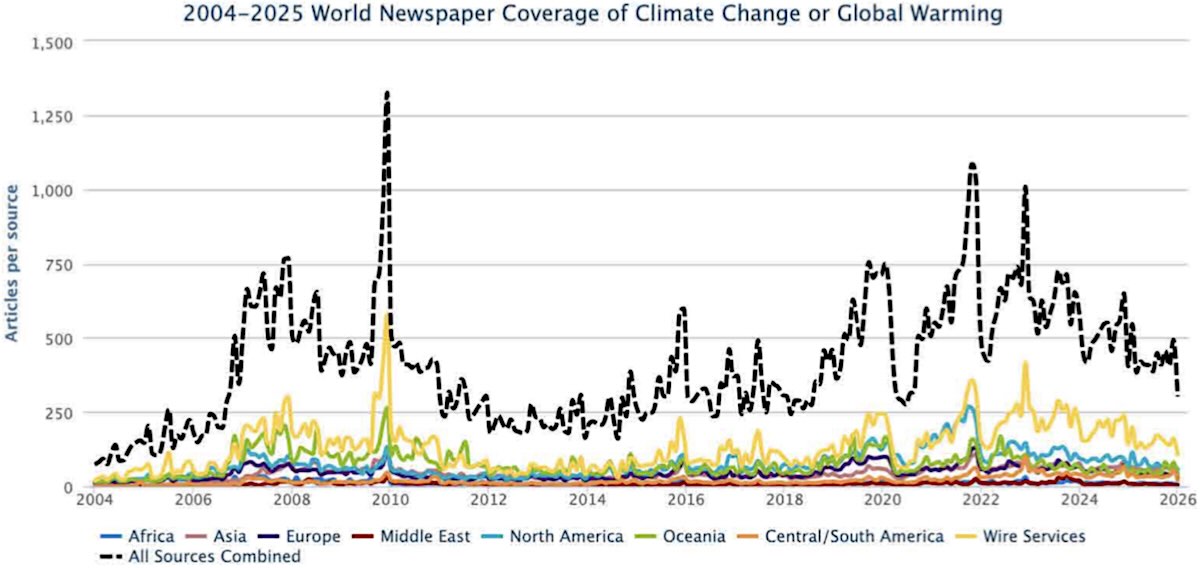
Last year saw a 14% global slump in climate-related stories compared to 2024, which was already 38% down on peak Greta hysteria in 2021.
Perhaps there is only so much that once-trusting consumers are prepared to read, let alone pay for, identical, narrative-driven drivel that is often so one-sided that it is an insult to the intelligence.
Exhibit 1: The BBC’s October 2023 classic – Climate change could make beer taste worse.
The greatest declines over 2025 were found in Africa, the Middle East, and North America. Interestingly, the failed Amazon COP30 meeting in November 2025 was followed the month after by coverage falling off a cliff in Latin America (-61%), Oceania (-52%), and the European Union (-41%).
A period of private grief seems to have given the long-suffering public a merciful break from the relentless cacophony of climate catastrophizing.
Annual report
News of the continuing decline in climate change and global warming coverage is contained in the latest annual report from the Media and Climate Change Observatory (MeCCO) at the University of Colorado Boulder.
To produce its latest findings, MeCCO tracked the volume of newspaper, wire services, radio, and TV climate stories across 59 countries and seven regions. The work is said to have used a consistent methodology since 2004.
The graph below shows clearly the spikes in the Greta hysteria around the start of the current decade, and the earlier Gore grift that followed the release of his ‘An Inconvenient Truth’ film.
University journalism courses often run climate modules, but prospects for aspiring students looking to make the world safe for net-zero fanatics do not look good.
The Guardian can only do so much, but in the UK, coverage was 34% down in the 12 months to November 2025.
In the USA, the sackings have started with a vengeance.
Last year, new managers at CBS News removed most of the climate crisis team. Recent reports suggest that everyone on the climate beat has now been binned. In February 2026, the Washington Post cut 14 climate writing positions, leaving only five journalists in place.
Last year was a bad time for the climate groomers that are largely funded by Green Blob billionaires seeking societal upheaval by depriving modern (and developing) industrial countries of vital hydrocarbons.

Groomed journalists working in narrative-driven mainstream media are seen as key to driving up fear of the invented climate crisis.
One of the first lessons taught to useful idiot fearmongers is that the opinion, often incorrectly referred to as a theory, that humans cause most, if not all, recent climate change is ‘settled’.
The incurious are not encouraged to ask if this is the first scientific opinion to be declared settled, or at least the first since the Roman Popes of old adjudicated ex cathedra on these matters.
Laughable
In the UK, the National Council for the Training of Journalists (NCTJ) is a respected industry-based charity that has operated since the 1950s. But its climate change training is laughable.
In what other investigative fields are journalists encouraged to rely on a claimed ‘consensus’, and encouraged not to disclose alternative views? What quicker way is there, it might be asked, to replace the writer with an AI tool?
Funded by the Google News Initiative (GNI), the NCTJ offers a free e-learning course on climate change reporting. As with all climate-science-grooming agitprop sessions, there is a warning about avoiding ‘false balance’.
In effect, this means denying publicity to sceptical scientists who investigate opinion by following the time-honoured process of scientific falsification.
Read rest at Clintel






AI hypothesis Addendum: This testable hypothesis proposes that the Roman Warm Period, Maya warming period, Medieval Warm Period, and the documented warming across North America from c.1–1350 CE represent connected phases of a contiguous, hemispheric-to-global warming event; the hypothesis specifies mechanisms, spatiotemporal structure, proxy expectations, and falsifiable predictions:
Reconciling Roman, Maya and Medieval Warming Transitions (c. 1–1350 CE): a Unified Hemispheric Framework
The Roman Warm Period (c. 1–500 CE), the Maya Warm Period (c. 250–900 CE), and the Medieval Warm Period (c. 900–1250 CE), together with contemporaneous regional warm/dry episodes, can be interpreted as episodic expressions of a single, multi‑century hemispheric‑to‑global tendency toward elevated temperatures across c. 1–1350 CE. Regional heterogeneity in timing and magnitude reflects local feedbacks and heat‑transport pathways; the underlying tendency was amplified and sustained by centennial external‑forcing windows (elevated solar activity combined with reduced cumulative explosive volcanic aerosol loading), long‑lived internal ocean‑atmosphere variability, gyre and boundary‑current reorganizations, episodic volcanic pulses, and substantial preindustrial land‑surface change.
Mechanisms (how a coherent large‑scale tendency emerges despite regional differences)
—External forcings establishing a persistent warm baseline: Centennial windows of relatively elevated solar irradiance (cosmogenic‑isotope derived total solar irradiance reconstructions) combined with lower centennial cumulative stratospheric aerosol loading create a positive hemispheric background that favors ocean heat accumulation; reduced frequency or magnitude of very large explosive eruptions during parts of c. 1–1350 CE lessened recurrent basin‑scale cooling and permitted decadal–centennial ocean heat uptake.
—Internal climate variability as amplifier and organizer: Prolonged phases of internal modes (for example, Atlantic multidecadal variability and multidecadal Pacific states) reorganized heat distribution, producing spatially coherent warm anomalies across the North Atlantic–European sector and amplifying terrestrial warmth in adjacent regions; persistent tendencies in El Niño–Southern Oscillation behavior and Pacific decadal variability propagated teleconnections with asynchronous but physically linked regional responses.
—Oceanic integration, gyre response, and propagation of heat: The ocean integrates surface forcings and redistributes heat via subtropical and subpolar gyres, western boundary currents, and thermohaline adjustments. Marine proxies (corals, sclerosponge, foraminifera, sediment cores) indicate decadal–centennial sea‑surface temperature and circulation variability in gyres and boundary currents across the North Atlantic, North Pacific, and South Pacific margins during c. 1–1350 CE. Gyre shifts and strengthened poleward heat transport plausibly transmitted and extended regional warm anomalies into Europe, Greenland, and Mesoamerica.
—Land‑surface feedbacks producing amplified terrestrial signals: Vegetation change (treeline advance), soil drying, reduced evapotranspiration, lowered albedo from deforestation or landscape burning, and glacier retreat amplified warming over land and modified regional circulation, explaining stronger terrestrial signals (for example, western North American drought and warmth; Mesoamerican aridity) relative to marine records.
—Compound small eruptions and long‑term volcanic landscape impacts: Clustered small to moderate eruptions produced episodic aerosol forcing superimposed on a warm baseline and caused long‑term biogeophysical impacts (tephra effects on soils, vegetation loss, fire) that modulated decadal variability without necessarily reversing a multi‑century warming tendency.
—Preindustrial anthropogenic land use as a reinforcing agent: Widespread preindustrial deforestation, agricultural expansion, and landscape burning (notably in Mesoamerica, parts of Europe and Asia) altered surface albedo and evapotranspiration sufficiently to reinforce local warming and drying; spatial correspondence between paleo‑ecological land‑use markers and amplified terrestrial warming supports a role for anthropogenic biogeophysical forcing in strengthening regional expressions.
Oceanic evidence supporting ocean integration and gyre involvement (summary)
• North Atlantic: Multiproxy records (foraminiferal SST, alkenone SST, sortable silt, ice‑rafted debris flux) indicate enhanced North Atlantic warmth and reorganized circulation associated with positive Atlantic multidecadal‑like states during parts of the Common Era, with strengthened subtropical gyre signals and increased poleward heat transport linking to European and Greenland warmth.
• North Pacific: Sediment cores and marine proxies from the western subtropical gyre, the Kuroshio extension, and eastern boundary margins show centennial shifts in sea‑surface temperature, surface stratification, and current strength consistent with sustained Pacific decadal variability influencing North America’s west coast.
• South Pacific and eastern tropical Pacific margins: Coastal and offshore cores indicate episodic sea‑surface temperature anomalies, altered upwelling intensity, and changes in subtropical gyre strength on multi‑decadal to centennial scales affecting coastal Mesoamerica and South America.
• Caribbean and eastern tropical Atlantic margin: Coral and sediment records show centennial‑scale sea‑surface temperature variability and episodic warming events that align with terrestrial drought/warmth in surrounding regions.
• Gyre‑margin coherence: Cross‑basin syntheses reveal that gyre and boundary‑current responses were regionally coherent on centennial timescales, providing plausible pathways for redistribution of accumulated ocean heat originating from reduced volcanic cooling and sustained external forcing.
Integration of the Roman, Maya, and the Medieval Warm Periods within
c. 1–1350 CE
• Roman Warm Period (c. 1–500 CE): plausibly an earlier positive phase within the broader c. 1–1350 CE tendency rather than an isolated phenomenon. Cosmogenic‑isotope based solar reconstructions indicate modestly elevated centennial solar activity in parts of this interval while ice‑core stratospheric aerosol optical depth reconstructions show no persistent, extremely high cumulative aerosol burden across the whole interval—conditions that permit modest ocean heat accumulation and regional warm expressions concentrated in the Mediterranean and Europe via North Atlantic heat‑transport pathways and local amplifying feedbacks.
• Maya Warm Period (c. 250–900 CE): terrestrial and archaeological records document pronounced warming and drying in Mesoamerica; targeted marine evidence from the Caribbean, western tropical Atlantic, and eastern tropical Pacific margins indicates episodic sea‑surface temperature anomalies, coastal current changes, and upwelling adjustments during centennial windows consistent with gyre and boundary‑current mediated heat transport. The Maya Warm Period fits as a central‑interval expression of the same hemispheric tendency, with strong terrestrial amplification from land‑use and hydrological feedbacks.
• Medieval Warm Period (c. 900–1250 CE): multiple proxy syntheses identify this as a robust multi‑century interval with comparatively elevated centennial solar activity and lower cumulative explosive volcanic aerosol loading relative to adjacent centuries, enabling substantial ocean heat accumulation and persistent hemispheric tendencies that produced widespread regional warm/dry expressions.
Predicted observable consequences (testable implications)
—Hemispheric mean and multiproxy coherence: Bias‑corrected multiproxy syntheses should show broadly coherent positive hemispheric mean anomalies over multiple centennial windows within c. 1–1350 CE (including the Roman, Maya, and Medieval Warm Periods), with terrestrial over‑representation addressed in uncertainty estimates.
—Marine proxy response across gyres and margins: Expanded coral, sclerosponge, foraminiferal, and sediment records in under‑sampled gyre margins should show weak to moderate sea‑surface temperature increases, shifts in stratification, and circulation changes broadly in phase with terrestrial warming once chronology and seasonal biases are resolved.
—Model reproducibility including gyre dynamics: Coupled model experiments that include plausible elevated solar forcing, reduced cumulative explosive volcanic aerosol loading, sustained phases of oceanic modes, gyre and boundary‑current adjustments, distributed small volcanic pulses, and spatially explicit preindustrial land‑use should reproduce an elevated hemispheric mean with regionally heterogeneous patterns consistent with observed terrestrial and marine signals.
—Land‑use covariation with amplified warming: Paleoecological indicators of land‑use change (charcoal, pollen, archaeological clearance) should spatially covary with amplified local warming and drying beyond what external forcing alone predicts.
Alternative explanations to be ruled out
• Purely independent, regionally confined drivers requiring implausibly synchronous, spatially disparate events to create the observed continental‑scale pattern.
• Pure internal variability producing a multi‑century hemispheric anomaly without consistent external forcing—this would require model demonstrations of centennial‑scale internal modes matching observed continental phasing and remains less likely given multi‑record evidence of external forcings and marine responses.
Research priorities to evaluate and falsify the hypothesis
• Densify marine proxy networks and improve chronology (corals, sclerosponge, foraminifera, alkenones, TEX86, marine laminates) in undersampled gyre margins and boundary currents (North Atlantic subtropical and subpolar margins, North Pacific subtropical gyre and Kuroshio extension, South Pacific margins, eastern tropical Pacific near Mesoamerica).
• Produce high‑resolution, well‑dated multiproxy syntheses that correct for terrestrial sampling bias in hemispheric estimates and explicitly include marine gyre‑margin records.
• Run coordinated model experiments incorporating updated solar and volcanic forcing reconstructions, long‑lived oceanic mode prescriptions, explicit gyre and boundary‑current dynamics, distributed small volcanic aerosol inputs, and spatially explicit preindustrial land‑use/biogeophysical forcings for the full c. 1–1350 CE interval.
• Intensify paleoland‑use studies (charcoal, pollen, archaeological clearance) to quantify timing and magnitude of anthropogenic forcing relative to climate signals.
Conclusion
Multiple lines of physical reasoning—centennial windows of elevated solar irradiance combined with reduced cumulative stratospheric aerosol loading, oceanic integration and redistribution of heat by subtropical and subpolar gyres and boundary currents, amplification by land‑surface feedbacks and preindustrial land‑use change, and episodic clustered volcanic pulses—collectively make it plausible that the Roman Warm Period (c. 1–500 CE), the Maya Warm Period (c. 250–900 CE), the Medieval Warm Period (c. 900–1250 CE), and numerous regional warm/dry episodes were expressions of a largely coherent hemispheric‑to‑global warming tendency across c. 1–1350 CE, with strong regional modulation; targeted marine sampling of gyre margins, bias‑aware multiproxy syntheses, and coordinated model experiments incorporating updated solar and ice‑core volcanic reconstructions can test and potentially falsify this hypothesis.
Selected references (primary reconstructions / representative studies)
Steinhilber, F., et al. (2009). Solar irradiance reconstruction from cosmogenic isotopes.
Sigl, M., et al. (2015; 2022). Ice‑core volcanic sulfate and stratospheric aerosol optical depth reconstructions for the Common Era.
Mann, M.E., et al. (2009). Global signatures and dynamical origins of the Little Ice Age and Medieval Climate Anomaly. Science.
Cobb, K.M., et al. (2003). El Niño/Southern Oscillation and tropical Pacific climate during the last millennium from corals. Science.
Oppo, D.W., et al. (2009). Oceanic variability during the past millennia from marine sediment records.
Crowley, T.J. (2000). Causes of climate change over the past 1000 years. Science.
Fjordstad et al. (2019). Earth System Dynamics.
Gray, S.T., et al. (2004). A tree‑ring based reconstruction of the North Atlantic Oscillation. Geophysical Research Letters.
Ruddiman, W.F. (2003). The anthropogenic greenhouse era began thousands of years ago. Quaternary Research.
Kaplan, J.O., et al. (2011). Climate and land‑use change impacts on the Holocene. The Holocene.
Zielinski, G.A., et al. (1996). Volcanic aerosol forcing reconstructions and climate impacts. Journal of Geophysical Research.
Bacon, C.R., et al. (2018). Tephra and landscape impacts from Long Valley volcanism.
AI hypothesis: This testable hypothesis proposes that the Roman Warm Period, Maya warming period, Medieval Warm Period, and the documented warming across North America from ~250–1350 CE represent connected phases of a contiguous, hemispheric-to-global warming event; the hypothesis should specify mechanisms, spatiotemporal structure, proxy expectations, and falsifiable predictions.
Reconciling Roman, Maya and Medieval Warming Transitions (c. 1–1350 CE): a Unified Hemispheric Framework
The Roman Warm Period (c. 1–500 CE), the Maya Warm Period (c. 250–900 CE), and the Medieval Warm Period (c. 900–1250 CE), together with contemporaneous regional warm/dry episodes, can be interpreted as episodic expressions of a single, multi‑century hemispheric‑to‑global tendency toward elevated temperatures across c. 1–1350 CE. Regional heterogeneity in timing and magnitude reflects local feedbacks and heat‑transport pathways; the underlying tendency was amplified and sustained by centennial external‑forcing windows (elevated solar activity combined with reduced cumulative explosive volcanic aerosol loading), long‑lived internal ocean‑atmosphere variability, gyre and boundary‑current reorganizations, episodic volcanic pulses, and substantial preindustrial land‑surface change.
Mechanisms (how a coherent large‑scale tendency emerges despite regional differences)
—External forcings establishing a persistent warm baseline: Centennial windows of relatively elevated solar irradiance (cosmogenic‑isotope derived total solar irradiance reconstructions) combined with lower centennial cumulative stratospheric aerosol loading create a positive hemispheric background that favors ocean heat accumulation; reduced frequency or magnitude of very large explosive eruptions during parts of c. 1–1350 CE lessened recurrent basin‑scale cooling and permitted decadal–centennial ocean heat uptake.
—Internal climate variability as amplifier and organizer: Prolonged phases of internal modes (for example, Atlantic multidecadal variability and multidecadal Pacific states) reorganized heat distribution, producing spatially coherent warm anomalies across the North Atlantic–European sector and amplifying terrestrial warmth in adjacent regions; persistent tendencies in El Niño–Southern Oscillation behavior and Pacific decadal variability propagated teleconnections with asynchronous but physically linked regional responses.
—Oceanic integration, gyre response, and propagation of heat: The ocean integrates surface forcings and redistributes heat via subtropical and subpolar gyres, western boundary currents, and thermohaline adjustments. Marine proxies (corals, sclerosponge, foraminifera, sediment cores) indicate decadal–centennial sea‑surface temperature and circulation variability in gyres and boundary currents across the North Atlantic, North Pacific, and South Pacific margins during c. 1–1350 CE. Gyre shifts and strengthened poleward heat transport plausibly transmitted and extended regional warm anomalies into Europe, Greenland, and Mesoamerica.
—Land‑surface feedbacks producing amplified terrestrial signals: Vegetation change (treeline advance), soil drying, reduced evapotranspiration, lowered albedo from deforestation or landscape burning, and glacier retreat amplified warming over land and modified regional circulation, explaining stronger terrestrial signals (for example, western North American drought and warmth; Mesoamerican aridity) relative to marine records.
—Compound small eruptions and long‑term volcanic landscape impacts: Clustered small to moderate eruptions produced episodic aerosol forcing superimposed on a warm baseline and caused long‑term biogeophysical impacts (tephra effects on soils, vegetation loss, fire) that modulated decadal variability without necessarily reversing a multi‑century warming tendency.
—Preindustrial anthropogenic land use as a reinforcing agent: Widespread preindustrial deforestation, agricultural expansion, and landscape burning (notably in Mesoamerica, parts of Europe and Asia) altered surface albedo and evapotranspiration sufficiently to reinforce local warming and drying; spatial correspondence between paleo‑ecological land‑use markers and amplified terrestrial warming supports a role for anthropogenic biogeophysical forcing in strengthening regional expressions.
Oceanic evidence supporting ocean integration and gyre involvement (summary)
• North Atlantic: Multiproxy records (foraminiferal SST, alkenone SST, sortable silt, ice‑rafted debris flux) indicate enhanced North Atlantic warmth and reorganized circulation associated with positive Atlantic multidecadal‑like states during parts of the Common Era, with strengthened subtropical gyre signals and increased poleward heat transport linking to European and Greenland warmth.
• North Pacific: Sediment cores and marine proxies from the western subtropical gyre, the Kuroshio extension, and eastern boundary margins show centennial shifts in sea‑surface temperature, surface stratification, and current strength consistent with sustained Pacific decadal variability influencing North America’s west coast.
• South Pacific and eastern tropical Pacific margins: Coastal and offshore cores indicate episodic sea‑surface temperature anomalies, altered upwelling intensity, and changes in subtropical gyre strength on multi‑decadal to centennial scales affecting coastal Mesoamerica and South America.
• Caribbean and eastern tropical Atlantic margin: Coral and sediment records show centennial‑scale sea‑surface temperature variability and episodic warming events that align with terrestrial drought/warmth in surrounding regions.
• Gyre‑margin coherence: Cross‑basin syntheses reveal that gyre and boundary‑current responses were regionally coherent on centennial timescales, providing plausible pathways for redistribution of accumulated ocean heat originating from reduced volcanic cooling and sustained external forcing.
Integration of the Roman, Maya, and the Medieval Warm Periods within c. 1–1350 CE
• Roman Warm Period (c. 1–500 CE): plausibly an earlier positive phase within the broader c. 1–1350 CE tendency rather than an isolated phenomenon. Cosmogenic‑isotope based solar reconstructions indicate modestly elevated centennial solar activity in parts of this interval while ice‑core stratospheric aerosol optical depth reconstructions show no persistent, extremely high cumulative aerosol burden across the whole interval—conditions that permit modest ocean heat accumulation and regional warm expressions concentrated in the Mediterranean and Europe via North Atlantic heat‑transport pathways and local amplifying feedbacks.
• Maya Warm Period (c. 250–900 CE): terrestrial and archaeological records document pronounced warming and drying in Mesoamerica; targeted marine evidence from the Caribbean, western tropical Atlantic, and eastern tropical Pacific margins indicates episodic sea‑surface temperature anomalies, coastal current changes, and upwelling adjustments during centennial windows consistent with gyre and boundary‑current mediated heat transport. The Maya Warm Period fits as a central‑interval expression of the same hemispheric tendency, with strong terrestrial amplification from land‑use and hydrological feedbacks.
• Medieval Warm Period (c. 900–1250 CE): multiple proxy syntheses identify this as a robust multi‑century interval with comparatively elevated centennial solar activity and lower cumulative explosive volcanic aerosol loading relative to adjacent centuries, enabling substantial ocean heat accumulation and persistent hemispheric tendencies that produced widespread regional warm/dry expressions.
Predicted observable consequences (testable implications)
—Hemispheric mean and multiproxy coherence: Bias‑corrected multiproxy syntheses should show broadly coherent positive hemispheric mean anomalies over multiple centennial windows within c. 1–1350 CE (including the Roman, Maya, and Medieval Warm Periods), with terrestrial over‑representation addressed in uncertainty estimates.
—Marine proxy response across gyres and margins: Expanded coral, sclerosponge, foraminiferal, and sediment records in under‑sampled gyre margins should show weak to moderate sea‑surface temperature increases, shifts in stratification, and circulation changes broadly in phase with terrestrial warming once chronology and seasonal biases are resolved.
—Model reproducibility including gyre dynamics: Coupled model experiments that include plausible elevated solar forcing, reduced cumulative explosive volcanic aerosol loading, sustained phases of oceanic modes, gyre and boundary‑current adjustments, distributed small volcanic pulses, and spatially explicit preindustrial land‑use should reproduce an elevated hemispheric mean with regionally heterogeneous patterns consistent with observed terrestrial and marine signals.
—Land‑use covariation with amplified warming: Paleoecological indicators of land‑use change (charcoal, pollen, archaeological clearance) should spatially covary with amplified local warming and drying beyond what external forcing alone predicts.
Alternative explanations to be ruled out
• Purely independent, regionally confined drivers requiring implausibly synchronous, spatially disparate events to create the observed continental‑scale pattern.
• Pure internal variability producing a multi‑century hemispheric anomaly without consistent external forcing—this would require model demonstrations of centennial‑scale internal modes matching observed continental phasing and remains less likely given multi‑record evidence of external forcings and marine responses.
Research priorities to evaluate and falsify the hypothesis
• Densify marine proxy networks and improve chronology (corals, sclerosponge, foraminifera, alkenones, TEX86, marine laminates) in undersampled gyre margins and boundary currents (North Atlantic subtropical and subpolar margins, North Pacific subtropical gyre and Kuroshio extension, South Pacific margins, eastern tropical Pacific near Mesoamerica).
• Produce high‑resolution, well‑dated multiproxy syntheses that correct for terrestrial sampling bias in hemispheric estimates and explicitly include marine gyre‑margin records.
• Run coordinated model experiments incorporating updated solar and volcanic forcing reconstructions, long‑lived oceanic mode prescriptions, explicit gyre and boundary‑current dynamics, distributed small volcanic aerosol inputs, and spatially explicit preindustrial land‑use/biogeophysical forcings for the full c. 1–1350 CE interval.
• Intensify paleoland‑use studies (charcoal, pollen, archaeological clearance) to quantify timing and magnitude of anthropogenic forcing relative to climate signals.
Conclusion
Multiple lines of physical reasoning—centennial windows of elevated solar irradiance combined with reduced cumulative stratospheric aerosol loading, oceanic integration and redistribution of heat by subtropical and subpolar gyres and boundary currents, amplification by land‑surface feedbacks and preindustrial land‑use change, and episodic clustered volcanic pulses—collectively make it plausible that the Roman Warm Period (c. 1–500 CE), the Maya Warm Period (c. 250–900 CE), the Medieval Warm Period (c. 900–1250 CE), and numerous regional warm/dry episodes were expressions of a largely coherent hemispheric‑to‑global warming tendency across c. 1–1350 CE, with strong regional modulation; targeted marine sampling of gyre margins, bias‑aware multiproxy syntheses, and coordinated model experiments incorporating updated solar and ice‑core volcanic reconstructions can test and potentially falsify this hypothesis.
Selected references (primary reconstructions / representative studies)
Steinhilber, F., et al. (2009). Solar irradiance reconstruction from cosmogenic isotopes.
Sigl, M., et al. (2015; 2022). Ice‑core volcanic sulfate and stratospheric aerosol optical depth reconstructions for the Common Era.
Mann, M.E., et al. (2009). Global signatures and dynamical origins of the Little Ice Age and Medieval Climate Anomaly. Science.
Cobb, K.M., et al. (2003). El Niño/Southern Oscillation and tropical Pacific climate during the last millennium from corals. Science.
Oppo, D.W., et al. (2009). Oceanic variability during the past millennia from marine sediment records.
Crowley, T.J. (2000). Causes of climate change over the past 1000 years. Science.
Fjordstad et al. (2019). Earth System Dynamics.
Gray, S.T., et al. (2004). A tree‑ring based reconstruction of the North Atlantic Oscillation. Geophysical Research Letters.
Ruddiman, W.F. (2003). The anthropogenic greenhouse era began thousands of years ago. Quaternary Research.
Kaplan, J.O., et al. (2011). Climate and land‑use change impacts on the Holocene. The Holocene.
Zielinski, G.A., et al. (1996). Volcanic aerosol forcing reconstructions and climate impacts. Journal of Geophysical Research.
Bacon, C.R., et al. (2018). Tephra and landscape impacts from Long Valley volcanism.
Public interest has slipped because the media is dishonest about climate—the public is catching on.
A testable hypothesis proposing that the Maya warming period, the Medieval Warm Period, and the documented warming across North America from ~250–1350 CE represent connected phases of a contiguous, hemispheric-to-global warming event; the hypothesis should specify mechanisms, spatiotemporal structure, proxy expectations, and falsifiable predictions.
250-1350 CE—A Hemispheric‑to‑Global Warming Framework for the Maya Warm Period and Medieval Warm Period
Statement
The Maya Warm Period, the Medieval Warm Period (MWP), and contemporaneous regional warm/dry episodes (e.g., western North America ~10th–14th c.) were largely expressions of a single, multi‑century, hemisph eric‑to‑global warming episode. Regional heterogeneity in timing and magnitude reflects local feedbacks and heat‑transport pathways, while the underlying signal was amplified and sustained by a combination of external forcings, long‑lived internal ocean‑atmosphere variability, oceanic gyre and boundary‑current reorganizations, and substantial preindustrial land‑surface change.
Mechanisms (how a coherent large‑scale signal emerges despite regional differences)
—External forcings establishing a persistent warm baseline: Reconstructed solar irradiance and volcanic aerosol histories indicate intervals of relatively higher centennial solar forcing together with reduced cumulative explosive volcanic aerosol loading compared with adjacent centuries, producing a positive hemispheric background that raised baseline temperatures and favored ocean heat accumulation. Reduced frequency and magnitude of large explosive eruptions during parts of the interval lessened recurrent basin‑scale cooling, permitting decadal–centennial ocean heat uptake and persistence of a warm baseline.
—Internal climate variability as amplifier and organizer: Prolonged phases of modes such as the Atlantic Multidecadal Oscillation (AMO) and multidecadal Pacific states (PDO/IPO‑like) reorganized heat distribution, producing spatially coherent warm anomalies across the North Atlantic–European sector and amplifying terrestrial warmth in adjacent regions (Greenland, parts of Europe, eastern North America). Persistent ENSO tendencies and Pacific decadal variability propagated teleconnections with asynchronous but physically linked regional responses.
—Oceanic integration, gyre response, and propagation of heat:The ocean integrates surface forcings and redistributes heat via gyres, western boundary currents, and thermohaline adjustments. Evidence from sediment cores, corals, sclerosponge records, and foraminifera indicates decadal–centennial SST and circulation variability in subtropical and subpolar gyres and boundary currents across the North Atlantic, North Pacific, and South Pacific margins during the first and second millennia CE. Gyre shifts and strengthening of poleward heat transport (e.g., North Atlantic subtropical gyre/AMOC influence) plausibly transmitted and extended regional warm anomalies (AMO‑related) into Europe and Greenland, while Pacific gyre and eastern boundary current changes affected eastern Pacific SSTs and upwelling adjacent to Mesoamerica. These marine processes would produce remote teleconnections that link oceanic and terrestrial responses across basins.
—Land‑surface feedbacks producing amplified terrestrial signals: Vegetation change (treeline advance), soil drying, reduced evapotranspiration, lowered albedo from deforestation or burned landscapes, and glacier retreat amplified warming over land and modified regional circulation patterns, explaining stronger terrestrial signals (e.g., western North American drought and warmth, Mesoamerican aridity) relative to marine records.
—Compound small eruptions and long‑term volcanic landscape impacts: Clustered small–moderate eruptions produced episodic aerosol forcing superimposed on a warm baseline and caused long‑term biogeophysical impacts (tephra effects on soils, vegetation loss, fire outbreaks) that modulated decadal variability but did not eliminate the multi‑century warming tendency. Regional volcanic series (e.g., Long Valley activity ~900–1350 CE) likely produced localized landscape impacts and intermittent aerosol forcing that punctuated the broader warm epoch.
—Preindustrial anthropogenic land use as a reinforcing agent: Widespread preindustrial deforestation, agricultural expansion, and landscape burning (notably in Mesoamerica, parts of Europe and Asia) altered surface albedo, evapotranspiration, and regional carbon fluxes sufficiently to reinforce local warming and drying. Spatial correspondence between paleo‑ecological land‑use markers and amplified terrestrial warming supports a role for anthropogenic biogeophysical forcing in strengthening regional expressions of the larger climate anomaly.
Ocean integration and gyre involvement (summary of relevant marine signals)
• North Atlantic: Multiproxy records (foraminiferal SST, alkenone SST, sortable silt, IRD flux) indicate enhanced North Atlantic warmth and reorganized circulation associated with a positive AMO‑like state during parts of the MWP, with strengthened subtropical gyre signals and increased poleward heat transport that link to European and Greenland warmth.
• North Pacific: Sediment cores and marine proxies from the western subtropical gyre, Kuroshio extension, and eastern boundary current margins show centennial shifts in SST, surface stratification, and current strength consistent with sustained Pacific decadal variability influencing North American west‑coast climate.
• South Pacific and eastern tropical Pacific margins: Coastal and offshore cores indicate episodic SST anomalies, altered upwelling intensity, and changes in subtropical gyre strength on multi‑decadal to centennial scales; these would affect coastal environments adjacent to Mesoamerica and South America and could relay heat via equatorial and subtropical pathways.
• Caribbean and eastern tropical Atlantic/Caribbean margin: Coral and sediment records show centennial‑scale SST variability and episodic warming events that align with terrestrial drought/warmth in surrounding regions.
• Gyre‑margin coherence: Cross‑basin syntheses reveal that gyre and boundary‑current responses were regionally coherent on centennial timescales, providing plausible pathways for redistribution of accumulated ocean heat originating from reduced volcanic cooling and sustained external forcing.
Predicted observable consequences (testable implications)
—Hemispheric mean and multiproxy coherence: Bias‑corrected multiproxy syntheses should show a broadly coherent positive hemispheric mean temperature anomaly over roughly 900–1350 CE, with terrestrial over‑representation accounted for in uncertainty estimates.
—Marine proxy response across gyres and margins: Expanded coral, sclerosponge, foraminiferal, and sediment records in under‑sampled gyre margins should show weak–moderate SST increases, shifts in stratification, and circulation changes consistent in phase with terrestrial warming once chronology and seasonal biases are resolved.
—Model reproducibility including gyre dynamics: Coupled model experiments that include plausible elevated solar forcing, reduced cumulative explosive volcanic aerosol loading, long‑lived AMO/ENSO/PDO phases, gyre and boundary‑current adjustments, distributed small volcanic pulses, and spatially explicit preindustrial land‑use/biogeophysical forcings should reproduce an elevated hemispheric mean with regionally heterogeneous patterns consistent with observed terrestrial and marine signals.
—Land‑use covariation with amplified warming: Paleoecological indicators of land‑use change (charcoal, pollen, archaeological clearance) should spatially covary with amplified local warming/drying beyond what external climate forcing alone predicts.
Regional extent, transport pathways, and the Maya portion
—AMO and North Atlantic influence: A strong AMO‑like state during the MWP plausibly drove contiguous warm anomalies from Europe into Greenland and parts of North America via enhanced northward heat transport; atmospheric teleconnections would distribute associated climatic effects downstream.
—Maya Warm Period and adjacent marine signals Terrestrial and archaeological records document pronounced warming/drying in the Maya region; targeted marine evidence from the Caribbean, western tropical Atlantic, and eastern tropical Pacific margins is sparser but indicates episodic SST anomalies, coastal current changes, and upwelling adjustments during centennial windows. Localized gyre and boundary‑current responses, rather than a uniform basin‑scale warming of the entire South Pacific gyre, are the most plausible oceanic mechanisms for transferring heat into marine regions adjacent to Mesoamerica. Even spatially patchy or coastal‑confined marine warming would strongly support oceanic involvement and strengthen the case that the Maya Warm Period was linked to larger basin and hemispheric processes.
Alternative explanations to be ruled out
• Purely independent, regionally confined drivers requiring implausibly synchronous, spatially disparate events to create the observed continental‑scale pattern.
• Pure internal variability producing a multi‑century hemispheric anomaly without consistent external forcing—this would require model demonstrations of centennial‑scale internal modes matching observed continental phasing and remains less likely given multi‑record evidence of external forcings and marine responses.
Research priorities to evaluate and falsify the hypothesis
• Densify marine proxy networks and improve chronology (corals, sclerosponge, foraminifera, alkenones, TEX86, marine laminates) in undersampled gyre margins and boundary currents (North Atlantic subtropical and subpolar margins, North Pacific subtropical gyre and Kuroshio extension, South Pacific margins, eastern tropical Pacific near Mesoamerica). • Produce high‑resolution, well‑dated multiproxy syntheses that correct for terrestrial sampling bias in hemispheric estimates and explicitly include marine gyre‑margin records. • Run coordinated model experiments that incorporate updated solar and volcanic forcing reconstructions, long‑lived oceanic mode prescriptions, explicit gyre and boundary‑current dynamics, distributed small volcanic aerosol inputs, and spatially explicit preindustrial land‑use/biogeophysical forcings. • Intensify paleoland‑use studies (charcoal, pollen, archaeological clearance) to quantify timing and magnitude of anthropogenic forcing relative to climate signals.
Conclusion
Multiple lines of physical reasoning—external forcing setting a warmer baseline, oceanic integration via gyres and boundary currents redistributing heat, amplification by land‑surface feedbacks, episodic volcanic pulses, and reinforcing preindustrial land‑use—collectively make it plausible that the Maya Warm Period, the MWP/MCA, and many regional warm/dry episodes were facets of a largely coherent hemispheric‑to‑global warming episode with strong regional modulation; targeted marine sampling of gyre margins, bias‑aware multiproxy syntheses, and coordinated model experiments can test and potentially falsify this hypothesis.
Selected references
Crowley, T.J. (2000). Causes of climate change over the past 1000 years. Science.
Fjordstad et al. (2019). Earth System Dynamics.
Gray, S.T., et al. (2004). A tree‑ring based reconstruction of the North Atlantic Oscillation. Geophysical Research Letters.
Mann, M.E., et al. (2009). Global signatures and dynamical origins of the Little Ice Age and Medieval Climate Anomaly. Science.
Cobb, K.M., et al. (2003). El Niño/Southern Oscillation and tropical Pacific climate during the last millennium from corals. Science.
Oppo, D.W., et al. (2009). Oceanic variability during the past millennia from marine sediment records. Paleoceanography.
Ruddiman, W.F. (2003). The anthropogenic greenhouse era began thousands of years ago. Quaternary Research.
Kaplan, J.O., et al. (2011). Climate and land‑use change impacts on the Holocene. The Holocene.
Zielinski, G.A., et al. (1996). Volcanic aerosol forcing reconstructions and climate impacts. Journal of Geophysical Research.
Bacon, C.R., et al. (2018). Tephra and landscape impacts from Long Valley volcanism.