


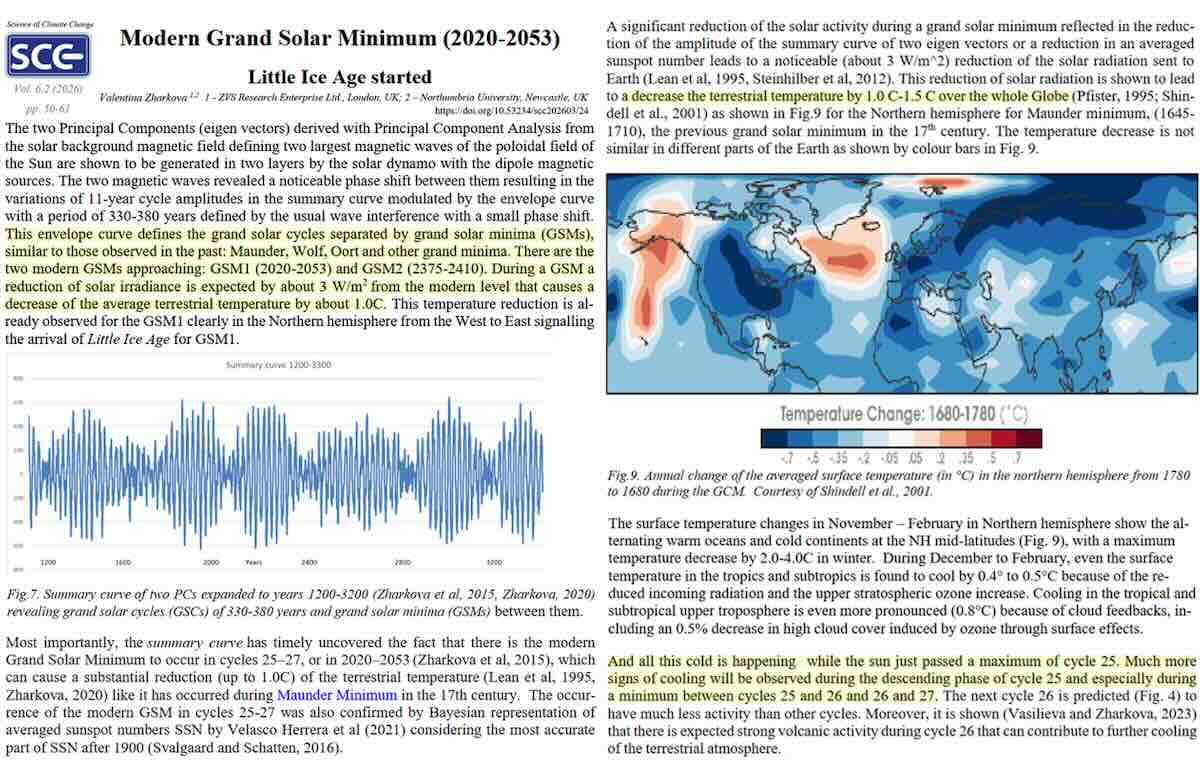
Century-scale solar activity patterns mark the onset of the next Little Ice Age cooling period. [some emphasis, links added]
Newly published research utilizing historical solar magnetic field phase analysis documents the impact of solar activity on Earth’s temperature.
Cold “Little Ice Age” periods can be reliably linked to Grand Solar Minima (GSM).
For example, during the Maunder Minimum (late 1600s to early 1700s), solar irradiance is thought to have declined by about 3 W/m², and consequently, the Northern Hemisphere cooled by approximately 1°C.
Based on pattern analysis, it may be assumed that the onset of the next GSM has arrived, and global cooling will occur over the next few decades.
“During a GSM, a reduction of solar irradiance is expected by about 3 W/m² from the modern level that causes a decrease of the average terrestrial temperature by about 1.0C.
“In summary, it can be concluded that the modern grand solar minimum (2020-2053) predicted 10 years ago by Zharkova et al (2015) has arrived and will progress as expected until [mid-century]. There is the cold weather with huge frosts and snows recorded in January- February 2026 in the whole Northern Hemisphere from the West to the East and from the North to the equator. The little ice age associated with the modern grand solar minimum is here…”
Top: Tall ships frozen in the icy Thames during the Maunder Minimum, when declining solar activity plunged Europe into the depths of the Little Ice Age for hundreds of years. AI image.
Read more at No Tricks Zone



Better to be prepared then to suffer the consequences of energy poverty like Germany and the UK are experiencing.
solar rising reaching the top of the atmosphere has remained virtually constant since the late 1970s based on NASA satellites
any other conclusion is not based on data
Zarkhova’s info is a forecast, so your statement is both true and false. True in that it has been relatively constant (it has varied to a certain degree). But it may yet turn out to be false or true depending on whether or not her forecast has been accurate. If she’s right, it will drop.
This is a time to take a “wait and see” approach rather than giving a foregone conclusion.