

Ed Miliband’s new net zero targets are not credible, carmakers have warned. [some emphasis, links added]
The Society of Motor Manufacturers and Traders (SMMT) said the Energy Secretary’s latest so-called carbon budget implied electric vehicle (EV) sales need to triple in just three years.
This was “highly unlikely” on current trends, the industry lobby group said, even though demand has risen significantly.
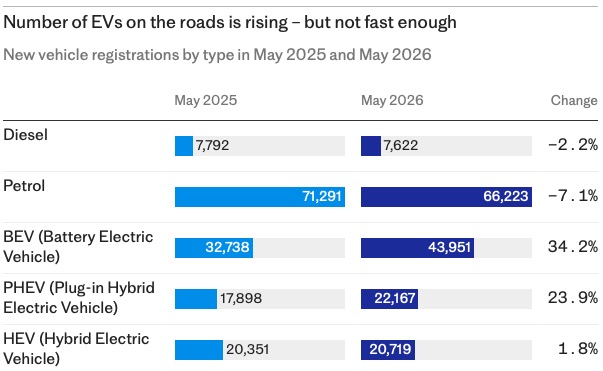
New figures published on Thursday showed that 24pc of new car sales were electric in the first five months of this year. However, the proportion remains well below the government target of 33pc by 2026.
Mr. Miliband’s latest carbon budget is based on modelling that assumes 95pc of auto sales will be electric by 2030.
The SMMT said that “if such targets are to be credible, then equally ambitious fiscal and investment support would be essential”.
Mike Hawes, the SMMT’s chief executive, said the figure was not realistic given current demand.
He said:
“The EV transition is progressing, but consumer uptake still lags behind even today’s targets, let alone the ambition set out in the latest carbon budget.
“While industry shares the long-term ambition, the pathway to net zero must be credible. It cannot come at the cost of lost competitiveness and deindustrialization.
“A review of the transition is now urgent to ensure we have a sustainable path to road transport decarbonization.”
The seventh carbon budget, backed by Mr. Miliband on Tuesday, sets a target to reduce Britain’s total emissions by 87pc, compared with 1990 levels, by 2040. It is based on modelling by the independent Climate Change Committee (CCC).
The Government said the SMMT was “wrong” to claim that the new carbon budget would impose a higher target for EV sales and that alternative ways of meeting it were possible.
A spokesman added: “We value the Climate Change Committee’s independent advice, but that does not mean we have to replicate their pathway.”
However, the overall budget is legally binding, meaning the emission savings would have to be found elsewhere if EV sales do not accelerate.
That could potentially include a bigger rollout of heat pumps, stricter curbs on flying or eating meat, a faster transition to green energy, or greater use of technologies such as carbon capture and storage.
Read rest at The Telegraph








What is the point of Net Zero?
Control. It’s all about control of the citizens.
‘the Climate Change Committee’s independent advice’ – they are not independent. They have personal vested interests in pushing the NZ agenda.