

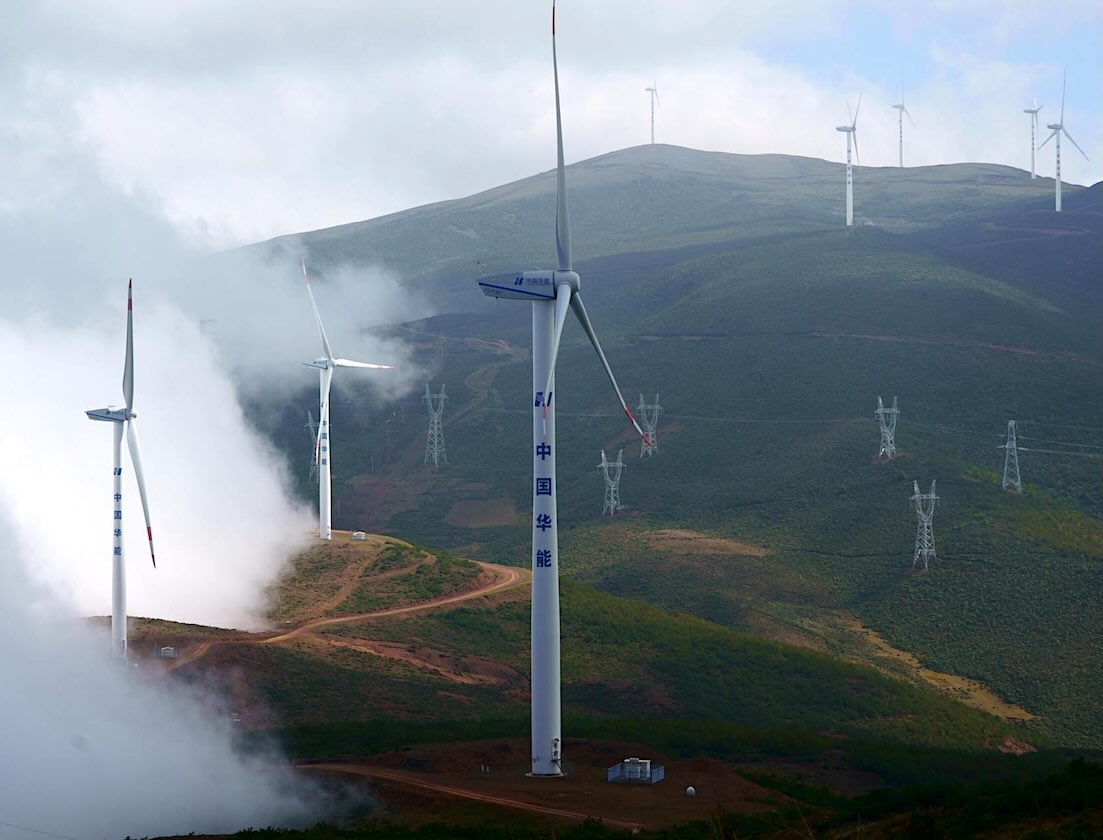
Two articles from the New York Times in the past couple of days describe the widening divergence between the approaches taken by the U.S. and China on the subject of wind energy. I apologize that these pieces are behind the Times’s paywall, but remember that I subscribe there so that you don’t have to. [some emphasis, links added]
On Monday (May 4), the article was about the status of wind energy development in the U.S., with the headline “More Than 150 Wind Projects Stall as Pentagon Delays Reviews.” Tuesday’s (May 5) piece covered the same subject in China, with the headline “China’s Big Bet on Wind Power Is Paying Off.”
These articles once again illustrate the extent to which the U.S. and its people are uniquely blessed in the world. Our biggest blessing is that we have been bequeathed by our forebears with the freest economy in the world, and with structural obstacles that make it very difficult for politicians to undo that.
But almost as big a blessing is the total incompetence of our geopolitical adversaries.
The May 4 piece about the U.S. reports on the latest gambit by the Trump administration to shut down wind power development. The asserted basis is national security, and particularly the alleged interference of wind turbines with military radars and flight paths.
Excerpt:
“The Trump administration is blocking more than 150 onshore wind farms across the United States by delaying military reviews that were once considered routine, according to a leading industry trade group. . . . [T]he administration has held up a large number of onshore wind projects under development on private land, citing national security concerns. These wind farms typically have to undergo a review by the Pentagon before being built to ensure that their turbines won’t interfere with military radar or flight paths. In the past, those reviews have been fairly straightforward, but they have ground to a halt in recent weeks, and the Pentagon has canceled some meetings with developers. “The Department of War is currently making it almost impossible to build a new wind project in the United States,” said Jason Grumet, chief executive of the American Clean Power Association, which represents renewable energy companies.”
I do not know the extent to which the asserted basis for restricting wind power development is real versus pretextual. On the other hand, I would not be surprised at all to learn that wind turbines have at least some negative effects on military radars and flight paths.
An evaluation of the extent of a real national security concern is something uniquely within the President’s responsibilities, with the courts having little power to second-guess.
Meanwhile, these 100+ wind turbine projects, if they were undertaken in time to qualify for tax credits but have now been terminated for newer projects, could cost taxpayers hundreds of billions of dollars over the next couple of decades, for nothing of any value.
The administration has done us all a huge favor by preventing these projects from proceeding.
Needless to say, the Times and Mr. Grumet of the ACPA don’t see it that way:
“The stalled projects together would have about 30 gigawatts of electric generating capacity if they were built, Mr. Grumet said. One gigawatt can provide enough electricity for more than 300,000 homes, although wind turbines can’t produce power at all hours.”
Somehow, the Times and Mr. Grumet don’t see it as a significant problem that wind turbines work only about 30-35% of the time. You may have a different view of your own home or business.
Then we come to yesterday’s piece about how China’s big bet on wind power is, supposedly, “paying off.” How do we know that?
Excerpt:
“Across China, hilltops are dotted with wind turbines, and long rows of them span many miles in western deserts. Ultrahigh-voltage power lines carry electricity thousands of miles to the energy-hungry factories along China’s coast. Last year, China installed three times as much wind power capacity as the rest of the world combined, even as its turbine exports jumped. The global industry’s center of gravity has shifted decisively: All of the world’s six largest wind turbine manufacturers are Chinese, displacing once-dominant European firms and companies like General Electric. The war has made China’s investments in wind look prescient. Its Asian neighbors, long reliant on Middle Eastern oil and gas, are struggling to secure fuel supplies. Meanwhile, China, with its massive reserves and modern electric grid, is better positioned to weather the energy crisis.”
OK, they have wind turbines all over the place. There are several pictures accompanying the article depicting huge and hideous wind farms in China. Here is one of them [via Pexels]:
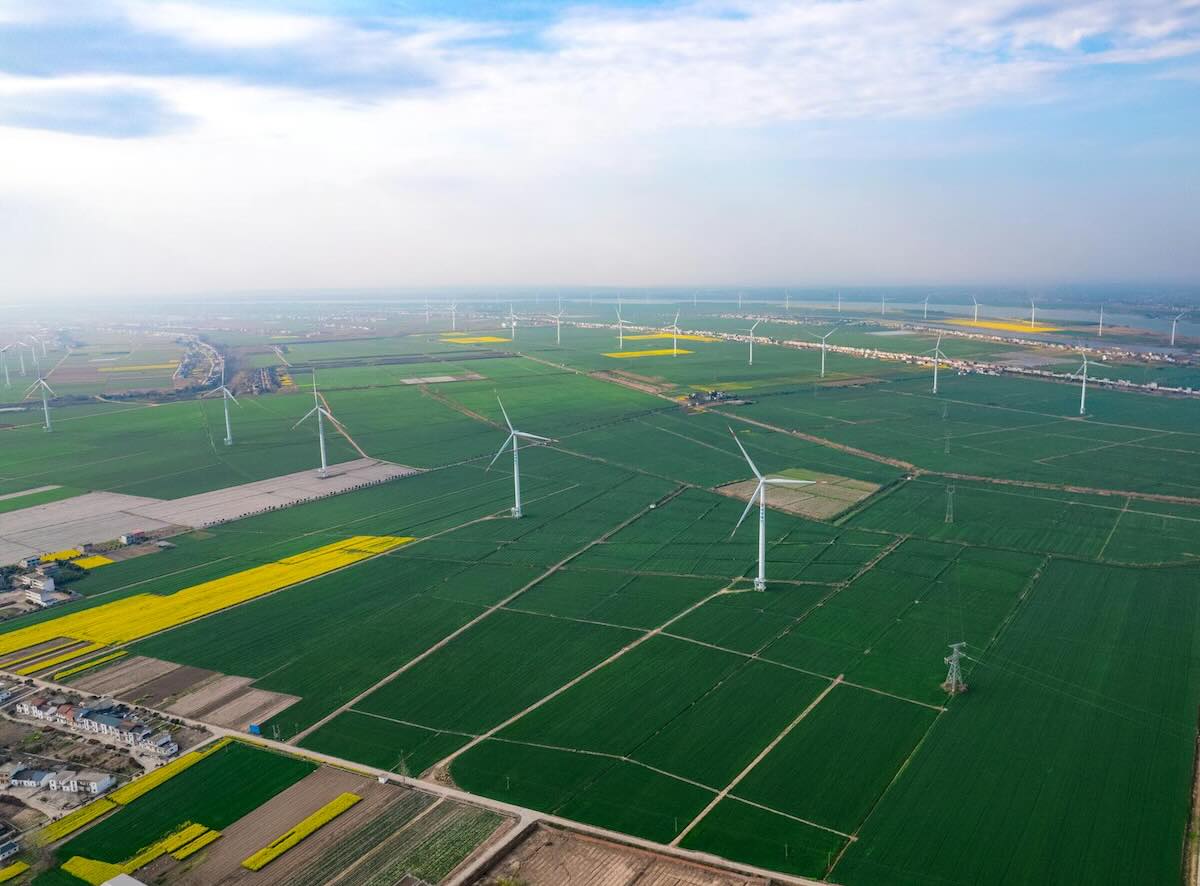
But how do you know that these wind farms are “paying off”? Sorry, but there is no such thing as “massive reserves” of wind power. The wind blows when it feels like blowing.
So are all these wind turbines creating wealth or destroying it? In a market economy like ours, you get the answer to that question from profitability.
If a project makes a profit after paying for factor inputs at prices determined by markets, then you have an excellent indication that the project is creating wealth.
If the project loses money or requires subsidies to get built or to continue to operate, then you know that it is destroying wealth.
So, how about the China wind projects? From the Times:
“An industrial policy of subsidies and import restrictions laid the foundations for China to become almost as dominant in wind turbines as in solar panels. … Chinese manufacturers, led by Envision Energy, are also gaining ground in India. Buoyed by tax incentives and government support, the country vies with the United States as the world’s second-largest wind market, after China. … China’s state-owned banks keep the renminbi weak against the euro, making Chinese wind turbines less expensive abroad.”
So the industry has grown massive based on “tax incentives,” “government support” [i.e., subsidies], “import restrictions,” and currency manipulation.
In other words, they have no way to measure whether they are creating or destroying wealth. However, since the “incentives” and subsidies are apparently necessary for the industry to survive, the odds that the industry is creating wealth are nil.
This article does not mention anything about China’s parallel and massive expansion of its coal power plant fleet over the past two decades, nor does it consider the question of why all those coal power plants are needed, even though all this wind power capacity has been built.

China is building two full overlapping and duplicative electricity generation systems, one of which works all the time and the other of which does not. Somebody has to pay for both of them.
You can hide who’s paying by concealing the cost in subsidies and tax incentives, but that does not change the fact that somebody is paying. So how does this add up to the wind turbines “paying off”?
The article does provide the answer to why China might be spending billions on this uneconomic endeavor. Xi wants it!
“Energy is a strategic issue in development — our pioneering development of wind power and solar technology has proved to be forward-looking,” Xi Jinping, China’s top leader, said in late March. … In a speech in July, Mr. Xi urged China to “promote the orderly and well-regulated expansion of offshore wind power.”
It looks like Xi is no better at doing basic arithmetic or physics than the morons who are in charge of climate policy here in New York. And in China, nobody dares to speak up and contradict Xi, no matter how obviously wrong he may be.
As I said, the U.S. is blessed by the total incompetence of its geopolitical adversaries.
The article takes note of the fact that nobody in China is pushing back against the wind power expansion, despite obvious downsides:
“The push has faced little public resistance because of strong government backing. Even though local residents complain, they have little power to stop projects from moving forward. ‘The noise from these turbines is quite loud,’ said Wang Cuifen, who lives on a small farm outside Yancheng, near the base of towering turbines in a tidal zone. ‘They run nonstop from around 4 p.m. to 4 a.m., and it affects our rest.'”
There’s nothing like a government that does not need to respond to complaints from the population. In the view of the New York Times, this is a good thing.
So, dear readers, you can place your bets on whether it is the U.S. or China that is making the right bet on the future of wind energy. I bet that within about a decade, China will be taking hundreds of billions of dollars, if not trillions of dollars, in write-offs on its wind energy investments.
Or, given that this is China and no loss of face for the leaders is ever allowed, it will be propping the industry up with ever-increasing subsidies as its economy gets eaten away from within.
Read more at Manhattan Contrarian






2026
Chinese wind farms are currently profitable,
generating significant revenue
by selling electricity to grid companies
at a massive scale.
they are mainly owned by the government
but the wind turbines that they buy
are usually from private investors
this article does not recognize the current profitability
of wind farms in china and its prediction
“trillions of dollars, in write-offs on its wind energy
investments” should not be taken seriously
the manhattan contrarian
is an unreliable website
(has made wrong predictions
about the collapse
f the chinese economy
for many years)
Either you or the Chinese are lying. Which is it? They fully subsidize their wind turbine industry which doesn’t make it profitable. And as the column said they are essentially running duo grids to maintain a stable grid. But of course your hatred of Thomas Richard is so great you can’t read anything from him with an open mind.
You may want to check or revisit your Microeconomics theory fundamentals regarding market “failures”. Social optimal quantity or output (and therefore associated social marginal costs) may not be equal to “at market prices” implied private quantities and costs. This may well be the case here, given that the cost of running a partly duplicate grid is understood to be compensated by the social, external benefit provided in terms of energy resilience in geopolitical situations like the present. Those governmental or public subsidies act as Pigouvian subsidies incentivising a strategic policy which makes sense when going beyond shortsighted present value, private market-only considerations. I won’t delve into other considerations at the moment, to keep the focus. And, no —I am not Chinese, neither lying.😅
the manhattan contrarian ( francis menton ) has been claiming for three years that the chinese economy is going to collapse
so far he’s been wrong for three years
the chinese wind farms owned by the government have become marginally profitable
the government owned wind and wind farms don’t care about profits and they’re certainly not going to write off trillions of dollars as claimed by the manhattan contrarian
and chinese turbine manufacturers that are privately owned have become marginally profitable. the shareholders do care about profits which have been missing for many years and even now are just marginal
Chinese state-owned farms benefit from turbine costs that are up to 50% cheaper than Western counterparts, along with lower financing costs from state banks.
China’s direct fiscal subsidies for renewable energy are estimated to be approximately 0.04% to 0.05% of its GDP.
While the entire clean energy sector (including manufacturing and power generation) accounted for 11.4% of China’s GDP in 2025, the specific fiscal subsidy scale for renewables is estimated at roughly $7–8 billion.
statistics coming from china are likely to be unreliable so the marginal profits in these industries could just be a fantasy
As the world’s leading wind energy producer for 15 consecutive years, China continues to set records in both installed capacity and power output. As of early 2026, China operates approximately 700,000 wind turbines. This figure represents nearly half of the world’s total operating wind capacity, satellite observations have been used to confirm and map China’s wind turbine infrastructure.
Wind energy provided about 16% of China’s electricity in late 2025 and early 2026.