


The Associated Press (AP) claims in “Climate change is outpacing evolution. Scientists are using DNA to catch up” that climate change is moving so fast that species cannot adapt quickly enough, forcing scientists to intervene genetically. [some emphasis, links added]
This is ridiculous and false.
The dramatic comparison between evolutionary timescales and modern warming is rhetorically powerful but scientifically shallow, and it ignores how evolution, ecological adaptation, and climate variability actually work.
The article opens with the declarative line, “Evolution works over millennia. Climate change is moving far faster.” That framing sets up the entire scare narrative. It suggests an unprecedented mismatch between biology and climate that will inevitably result in ecosystem collapse.
But the time comparison AP made is completely irrelevant.
Species do not adapt only through slow, geological-scale evolutionary shifts. They respond through migration, phenotypic plasticity, genetic variability already present within populations, hybridization, and ecological reorganization.
The AP article describes a naturally occurring hybrid eelgrass in Mission Bay that “outperformed its parent species” under murkier conditions. That is evolution and adaptation in action, not failure.
The climate has never been static. During the Holocene alone, temperatures have fluctuated, as seen in the graph below from Climate at a Glance:
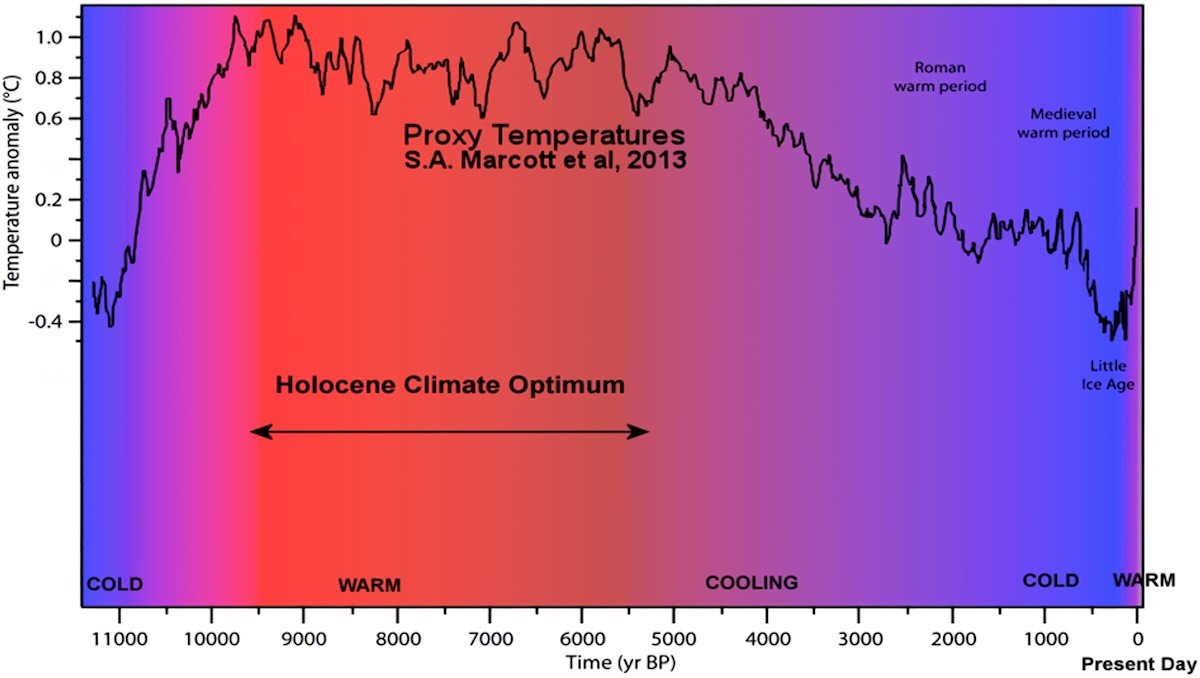
Drought regimes have shifted, sea levels have risen thousands of years before industrial emissions, and ecosystems reorganized accordingly. Coral reefs expanded and contracted. Forest boundaries migrated. Species ranges shifted north and south.
None of that required human-directed genomics.
The AP article also leans heavily on marine heatwaves and wildfires, suggesting they are pushing ecosystems “beyond their limits.” Yet wildfire regimes in California, for example, are influenced heavily by poor forest management, fuel loads, and land-use policy.
The article even acknowledges that logging eliminated roughly 95 percent of old-growth redwoods, drastically reducing genetic diversity. That is a land-management issue first and foremost, not a minor temperature change problem.
Similarly, coastal development and sediment runoff are cited as stressors in Mission Bay. Urbanization muddies water, reduces light penetration, and alters habitat. Those impacts are local and mechanical. They are not evidence that “climate change is outpacing evolution.”
The evolutionary timescale comparison also ignores rates. Modern warming since the late nineteenth century is on the order of about 1 degree Celsius globally. That change has occurred over roughly 150 years, not instantaneously.
During past deglaciations, regional temperatures shifted far more dramatically over centuries, yet ecosystems reorganized rather than universally collapsing.
Moreover, extinction narratives are frequently exaggerated. The article references a 2019 report suggesting one million species face extinction. That widely cited figure is a projection based on habitat modeling and scenario assumptions. It is not an observed count of species vanishing due to temperature rise.
The genomic work described in the piece is interesting and potentially useful. Sequencing corals, eelgrass, and redwoods to understand genetic resilience is legitimate science. But presenting it as a necessary emergency response to an evolutionary crisis is unjustifiably alarming.
There is no climate crisis, shifting habitats, or changing weather at unprecedented rates, so there is no climate change requiring adaptation.
Even the scientists quoted in the article admit limits. “Conservation genomics alone cannot solve climate change,” one expert notes. Another acknowledges that engineering tolerance in one species “is not an ecosystem.” Those caveats undercut the apocalyptic framing of the headline.
The deeper problem is the spinning of a false narrative implying a biological catastrophe is underway. By declaring that climate change is “outpacing evolution,” the article implies that life on Earth is fundamentally unable to cope with gradual warming.
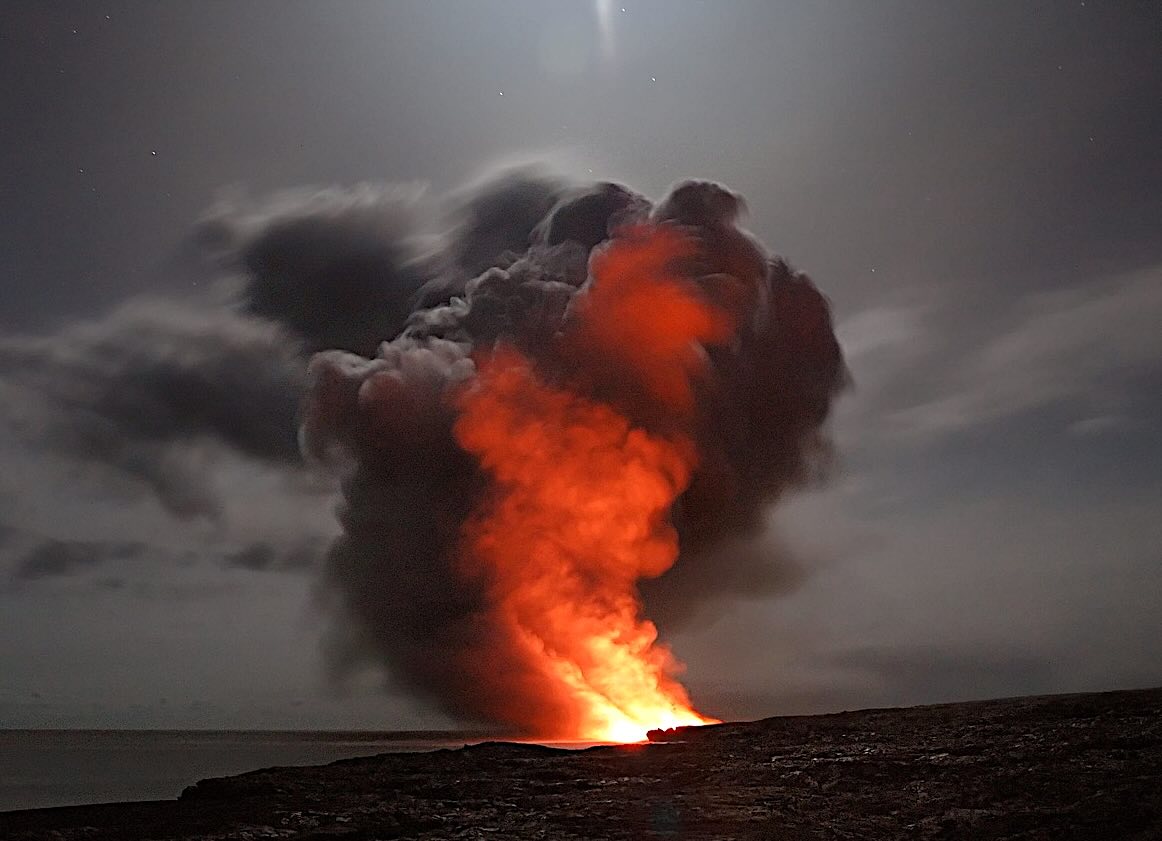
Yet species have endured ice ages, volcanic winters, megadroughts, and abrupt regional shifts long before fossil fuels existed.
Adaptation is not limited to modest changes over millennia that require radical new mutations. It includes range shifts, behavioral changes, hybrid vigor, and ecological turnover. The eelgrass example highlighted by AP demonstrates precisely that natural adaptive capacity.
Climate change presents challenges. So do habitat destruction, pollution, invasive species, and overharvesting. Conflating all environmental pressures into a single narrative of evolutionary collapse oversimplifies complex ecological dynamics.
Climate change is not a binary cliff presenting tipping points for species or ecosystems. Human habitat change has a far greater and more direct impact on species and ecological niches than gradual climate change and on a much shorter timescale.
The Associated Press has taken an emerging field of conservation genomics and wrapped it in an existential storyline that exaggerates the speed and uniqueness of current climate trends. That is false science reporting.
Unfortunately, it is what we have come to expect from the Associated Press when it writes about climate change, a low-quality narrative largely bereft of facts and context.
Read more at Climate Realism







Hypothesis Draft 7
file:///Users/davinci/Desktop/Hypothesis/Reconciling%20Roman,%20Maya%20and%20Medieval%20Warming%20Transitions%20(c.%201–1350%20CE)-%20a%20Unified%20Hemispheric%20Framework.html
Addendum to AI hypothesis:
Reconciling Roman, Maya and Medieval Warming Transitions (c. 1–1350 CE): a Unified Hemispheric Framework
The Roman Warm Period (c. 1–500 CE), the Maya Warm Period (c. 250–900 CE), and the Medieval Warm Period (c. 900–1250 CE), together with contemporaneous regional warm/dry episodes, can be interpreted as episodic expressions of a single, multi‑century hemispheric‑to‑global tendency toward elevated temperatures across c. 1–1350 CE. Regional heterogeneity in timing and magnitude reflects local feedbacks and heat‑transport pathways; the underlying tendency was amplified and sustained by centennial external‑forcing windows (elevated solar activity combined with reduced cumulative explosive volcanic aerosol loading), long‑lived internal ocean‑atmosphere variability, gyre and boundary‑current reorganizations, episodic volcanic pulses, and substantial preindustrial land‑surface change.
Mechanisms (how a coherent large‑scale tendency emerges despite regional differences)
—External forcings establishing a persistent warm baseline: Centennial windows of relatively elevated solar irradiance (cosmogenic‑isotope derived total solar irradiance reconstructions) combined with lower centennial cumulative stratospheric aerosol loading create a positive hemispheric background that favors ocean heat accumulation; reduced frequency or magnitude of very large explosive eruptions during parts of c. 1–1350 CE lessened recurrent basin‑scale cooling and permitted decadal–centennial ocean heat uptake.
—Internal climate variability as amplifier and organizer: Prolonged phases of internal modes (for example, Atlantic multidecadal variability and multidecadal Pacific states) reorganized heat distribution, producing spatially coherent warm anomalies across the North Atlantic–European sector and amplifying terrestrial warmth in adjacent regions; persistent tendencies in El Niño–Southern Oscillation behavior and Pacific decadal variability propagated teleconnections with asynchronous but physically linked regional responses.
—Oceanic integration, gyre response, and propagation of heat: The ocean integrates surface forcings and redistributes heat via subtropical and subpolar gyres, western boundary currents, and thermohaline adjustments. Marine proxies (corals, sclerosponge, foraminifera, sediment cores) indicate decadal–centennial sea‑surface temperature and circulation variability in gyres and boundary currents across the North Atlantic, North Pacific, and South Pacific margins during c. 1–1350 CE. Gyre shifts and strengthened poleward heat transport plausibly transmitted and extended regional warm anomalies into Europe, Greenland, and Mesoamerica.
—Land‑surface feedbacks producing amplified terrestrial signals: Vegetation change (treeline advance), soil drying, reduced evapotranspiration, lowered albedo from deforestation or landscape burning, and glacier retreat amplified warming over land and modified regional circulation, explaining stronger terrestrial signals (for example, western North American drought and warmth; Mesoamerican aridity) relative to marine records.
—Compound small eruptions and long‑term volcanic landscape impacts: Clustered small to moderate eruptions produced episodic aerosol forcing superimposed on a warm baseline and caused long‑term biogeophysical impacts (tephra effects on soils, vegetation loss, fire) that modulated decadal variability without necessarily reversing a multi‑century warming tendency.
—Preindustrial anthropogenic land use as a reinforcing agent: Widespread preindustrial deforestation, agricultural expansion, and landscape burning (notably in Mesoamerica, parts of Europe and Asia) altered surface albedo and evapotranspiration sufficiently to reinforce local warming and drying; spatial correspondence between paleo‑ecological land‑use markers and amplified terrestrial warming supports a role for anthropogenic biogeophysical forcing in strengthening regional expressions.
Oceanic evidence supporting ocean integration and gyre involvement (summary)
• North Atlantic: Multiproxy records (foraminiferal SST, alkenone SST, sortable silt, ice‑rafted debris flux) indicate enhanced North Atlantic warmth and reorganized circulation associated with positive Atlantic multidecadal‑like states during parts of the Common Era, with strengthened subtropical gyre signals and increased poleward heat transport linking to European and Greenland warmth.
• North Pacific: Sediment cores and marine proxies from the western subtropical gyre, the Kuroshio extension, and eastern boundary margins show centennial shifts in sea‑surface temperature, surface stratification, and current strength consistent with sustained Pacific decadal variability influencing North America’s west coast.
• South Pacific and eastern tropical Pacific margins: Coastal and offshore cores indicate episodic sea‑surface temperature anomalies, altered upwelling intensity, and changes in subtropical gyre strength on multi‑decadal to centennial scales affecting coastal Mesoamerica and South America.
• Caribbean and eastern tropical Atlantic margin: Coral and sediment records show centennial‑scale sea‑surface temperature variability and episodic warming events that align with terrestrial drought/warmth in surrounding regions.
• Gyre‑margin coherence: Cross‑basin syntheses reveal that gyre and boundary‑current responses were regionally coherent on centennial timescales, providing plausible pathways for redistribution of accumulated ocean heat originating from reduced volcanic cooling and sustained external forcing.
Integration of the Roman, Maya, and the Medieval Warm Periods within c. 1–1350 CE
• Roman Warm Period (c. 1–500 CE): plausibly an earlier positive phase within the broader c. 1–1350 CE tendency rather than an isolated phenomenon. Cosmogenic‑isotope based solar reconstructions indicate modestly elevated centennial solar activity in parts of this interval while ice‑core stratospheric aerosol optical depth reconstructions show no persistent, extremely high cumulative aerosol burden across the whole interval—conditions that permit modest ocean heat accumulation and regional warm expressions concentrated in the Mediterranean and Europe via North Atlantic heat‑transport pathways and local amplifying feedbacks.
• Maya Warm Period (c. 250–900 CE): terrestrial and archaeological records document pronounced warming and drying in Mesoamerica; targeted marine evidence from the Caribbean, western tropical Atlantic, and eastern tropical Pacific margins indicates episodic sea‑surface temperature anomalies, coastal current changes, and upwelling adjustments during centennial windows consistent with gyre and boundary‑current mediated heat transport. The Maya Warm Period fits as a central‑interval expression of the same hemispheric tendency, with strong terrestrial amplification from land‑use and hydrological feedbacks.
• Medieval Warm Period (c. 900–1250 CE): multiple proxy syntheses identify this as a robust multi‑century interval with comparatively elevated centennial solar activity and lower cumulative explosive volcanic aerosol loading relative to adjacent centuries, enabling substantial ocean heat accumulation and persistent hemispheric tendencies that produced widespread regional warm/dry expressions.
Predicted observable consequences (testable implications)
—Hemispheric mean and multiproxy coherence: Bias‑corrected multiproxy syntheses should show broadly coherent positive hemispheric mean anomalies over multiple centennial windows within c. 1–1350 CE (including the Roman, Maya, and Medieval Warm Periods), with terrestrial over‑representation addressed in uncertainty estimates.
—Marine proxy response across gyres and margins: Expanded coral, sclerosponge, foraminiferal, and sediment records in under‑sampled gyre margins should show weak to moderate sea‑surface temperature increases, shifts in stratification, and circulation changes broadly in phase with terrestrial warming once chronology and seasonal biases are resolved.
—Model reproducibility including gyre dynamics: Coupled model experiments that include plausible elevated solar forcing, reduced cumulative explosive volcanic aerosol loading, sustained phases of oceanic modes, gyre and boundary‑current adjustments, distributed small volcanic pulses, and spatially explicit preindustrial land‑use should reproduce an elevated hemispheric mean with regionally heterogeneous patterns consistent with observed terrestrial and marine signals.
—Land‑use covariation with amplified warming: Paleoecological indicators of land‑use change (charcoal, pollen, archaeological clearance) should spatially covary with amplified local warming and drying beyond what external forcing alone predicts.
Alternative explanations to be ruled out
• Purely independent, regionally confined drivers requiring implausibly synchronous, spatially disparate events to create the observed continental‑scale pattern.
• Pure internal variability producing a multi‑century hemispheric anomaly without consistent external forcing—this would require model demonstrations of centennial‑scale internal modes matching observed continental phasing and remains less likely given multi‑record evidence of external forcings and marine responses.
Research priorities to evaluate and falsify the hypothesis
• Densify marine proxy networks and improve chronology (corals, sclerosponge, foraminifera, alkenones, TEX86, marine laminates) in undersampled gyre margins and boundary currents (North Atlantic subtropical and subpolar margins, North Pacific subtropical gyre and Kuroshio extension, South Pacific margins, eastern tropical Pacific near Mesoamerica).
• Produce high‑resolution, well‑dated multiproxy syntheses that correct for terrestrial sampling bias in hemispheric estimates and explicitly include marine gyre‑margin records.
• Run coordinated model experiments incorporating updated solar and volcanic forcing reconstructions, long‑lived oceanic mode prescriptions, explicit gyre and boundary‑current dynamics, distributed small volcanic aerosol inputs, and spatially explicit preindustrial land‑use/biogeophysical forcings for the full c. 1–1350 CE interval.
• Intensify paleoland‑use studies (charcoal, pollen, archaeological clearance) to quantify timing and magnitude of anthropogenic forcing relative to climate signals.
Conclusion
Multiple lines of physical reasoning—centennial windows of elevated solar irradiance combined with reduced cumulative stratospheric aerosol loading, oceanic integration and redistribution of heat by subtropical and subpolar gyres and boundary currents, amplification by land‑surface feedbacks and preindustrial land‑use change, and episodic clustered volcanic pulses—collectively make it plausible that the Roman Warm Period (c. 1–500 CE), the Maya Warm Period (c. 250–900 CE), the Medieval Warm Period (c. 900–1250 CE), and numerous regional warm/dry episodes were expressions of a largely coherent hemispheric‑to‑global warming tendency across c. 1–1350 CE, with strong regional modulation; targeted marine sampling of gyre margins, bias‑aware multiproxy syntheses, and coordinated model experiments incorporating updated solar and ice‑core volcanic reconstructions can test and potentially falsify this hypothesis.
Selected references (primary reconstructions / representative studies)
Steinhilber, F., et al. (2009). Solar irradiance reconstruction from cosmogenic isotopes.
Sigl, M., et al. (2015; 2022). Ice‑core volcanic sulfate and stratospheric aerosol optical depth reconstructions for the Common Era.
Mann, M.E., et al. (2009). Global signatures and dynamical origins of the Little Ice Age and Medieval Warm Period.
Cobb, K.M., et al. (2003). El Niño–Southern Oscillation and tropical Pacific climate during the last millennium from corals.
Oppo, D.W., et al. (2009). Oceanic variability during the past millennia from marine sediment records.
Ruddiman, W.F. (2003). The anthropogenic greenhouse era began thousands of years ago.
Kaplan, J.O., et al. (2011). Climate and land‑use change impacts on the Holocene. The Holocene.
Zielinski, G.A., et al. (1996). Volcanic aerosol forcing reconstructions and climate impacts. Journal of Geophysical Research.
Bacon, C.R., et al. (2018). Tephra and landscape impacts from Long Valley volcanism.
Crowley, T.J. (2000). Causes of climate change over the past 1000 years. Science.
Sorry for redundant posts, I wasn’t getting a connection earlier.
Climate change Isn’t ‘outpacing evolution’, it IS evolution.
The following hypothesis could rock science if said evidence is taken to its conclusion in a peer reviewed paper:
A testable hypothesis proposing that the Maya warming period, the Medieval Warm Period, and the documented warming across North America from ~250–1350 CE represent connected phases of a contiguous, hemispheric-to-global warming event; the hypothesis should specify mechanisms, spatiotemporal structure, proxy expectations, and falsifiable predictions.
Hypothesis:
250-1350 CE—A Hemispheric‑to‑Global Warming Framework for the Maya Warm Period and Medieval Warm Period
Statement
The Maya Warm Period, the Medieval Warm Period (MWP), and contemporaneous regional warm/dry episodes (e.g., western North America ~10th–14th c.) were largely expressions of a single, multi‑century, hemisph eric‑to‑global warming episode. Regional heterogeneity in timing and magnitude reflects local feedbacks and heat‑transport pathways, while the underlying signal was amplified and sustained by a combination of external forcings, long‑lived internal ocean‑atmosphere variability, oceanic gyre and boundary‑current reorganizations, and substantial preindustrial land‑surface change.
Mechanisms (how a coherent large‑scale signal emerges despite regional differences)
—External forcings establishing a persistent warm baseline: Reconstructed solar irradiance and volcanic aerosol histories indicate intervals of relatively higher centennial solar forcing together with reduced cumulative explosive volcanic aerosol loading compared with adjacent centuries, producing a positive hemispheric background that raised baseline temperatures and favored ocean heat accumulation. Reduced frequency and magnitude of large explosive eruptions during parts of the interval lessened recurrent basin‑scale cooling, permitting decadal–centennial ocean heat uptake and persistence of a warm baseline.
—Internal climate variability as amplifier and organizer: Prolonged phases of modes such as the Atlantic Multidecadal Oscillation (AMO) and multidecadal Pacific states (PDO/IPO‑like) reorganized heat distribution, producing spatially coherent warm anomalies across the North Atlantic–European sector and amplifying terrestrial warmth in adjacent regions (Greenland, parts of Europe, eastern North America). Persistent ENSO tendencies and Pacific decadal variability propagated teleconnections with asynchronous but physically linked regional responses.
—Oceanic integration, gyre response, and propagation of heat:The ocean integrates surface forcings and redistributes heat via gyres, western boundary currents, and thermohaline adjustments. Evidence from sediment cores, corals, sclerosponge records, and foraminifera indicates decadal–centennial SST and circulation variability in subtropical and subpolar gyres and boundary currents across the North Atlantic, North Pacific, and South Pacific margins during the first and second millennia CE. Gyre shifts and strengthening of poleward heat transport (e.g., North Atlantic subtropical gyre/AMOC influence) plausibly transmitted and extended regional warm anomalies (AMO‑related) into Europe and Greenland, while Pacific gyre and eastern boundary current changes affected eastern Pacific SSTs and upwelling adjacent to Mesoamerica. These marine processes would produce remote teleconnections that link oceanic and terrestrial responses across basins.
—Land‑surface feedbacks producing amplified terrestrial signals: Vegetation change (treeline advance), soil drying, reduced evapotranspiration, lowered albedo from deforestation or burned landscapes, and glacier retreat amplified warming over land and modified regional circulation patterns, explaining stronger terrestrial signals (e.g., western North American drought and warmth, Mesoamerican aridity) relative to marine records.
—Compound small eruptions and long‑term volcanic landscape impacts: Clustered small–moderate eruptions produced episodic aerosol forcing superimposed on a warm baseline and caused long‑term biogeophysical impacts (tephra effects on soils, vegetation loss, fire outbreaks) that modulated decadal variability but did not eliminate the multi‑century warming tendency. Regional volcanic series (e.g., Long Valley activity ~900–1350 CE) likely produced localized landscape impacts and intermittent aerosol forcing that punctuated the broader warm epoch.
—Preindustrial anthropogenic land use as a reinforcing agent: Widespread preindustrial deforestation, agricultural expansion, and landscape burning (notably in Mesoamerica, parts of Europe and Asia) altered surface albedo, evapotranspiration, and regional carbon fluxes sufficiently to reinforce local warming and drying. Spatial correspondence between paleo‑ecological land‑use markers and amplified terrestrial warming supports a role for anthropogenic biogeophysical forcing in strengthening regional expressions of the larger climate anomaly.
Ocean integration and gyre involvement (summary of relevant marine signals)
• North Atlantic: Multiproxy records (foraminiferal SST, alkenone SST, sortable silt, IRD flux) indicate enhanced North Atlantic warmth and reorganized circulation associated with a positive AMO‑like state during parts of the MWP, with strengthened subtropical gyre signals and increased poleward heat transport that link to European and Greenland warmth.
• North Pacific: Sediment cores and marine proxies from the western subtropical gyre, Kuroshio extension, and eastern boundary current margins show centennial shifts in SST, surface stratification, and current strength consistent with sustained Pacific decadal variability influencing North American west‑coast climate.
• South Pacific and eastern tropical Pacific margins: Coastal and offshore cores indicate episodic SST anomalies, altered upwelling intensity, and changes in subtropical gyre strength on multi‑decadal to centennial scales; these would affect coastal environments adjacent to Mesoamerica and South America and could relay heat via equatorial and subtropical pathways.
• Caribbean and eastern tropical Atlantic/Caribbean margin: Coral and sediment records show centennial‑scale SST variability and episodic warming events that align with terrestrial drought/warmth in surrounding regions.
• Gyre‑margin coherence: Cross‑basin syntheses reveal that gyre and boundary‑current responses were regionally coherent on centennial timescales, providing plausible pathways for redistribution of accumulated ocean heat originating from reduced volcanic cooling and sustained external forcing.
Predicted observable consequences (testable implications)
—Hemispheric mean and multiproxy coherence: Bias‑corrected multiproxy syntheses should show a broadly coherent positive hemispheric mean temperature anomaly over roughly 900–1350 CE, with terrestrial over‑representation accounted for in uncertainty estimates.
—Marine proxy response across gyres and margins: Expanded coral, sclerosponge, foraminiferal, and sediment records in under‑sampled gyre margins should show weak–moderate SST increases, shifts in stratification, and circulation changes consistent in phase with terrestrial warming once chronology and seasonal biases are resolved.
—Model reproducibility including gyre dynamics: Coupled model experiments that include plausible elevated solar forcing, reduced cumulative explosive volcanic aerosol loading, long‑lived AMO/ENSO/PDO phases, gyre and boundary‑current adjustments, distributed small volcanic pulses, and spatially explicit preindustrial land‑use/biogeophysical forcings should reproduce an elevated hemispheric mean with regionally heterogeneous patterns consistent with observed terrestrial and marine signals.
—Land‑use covariation with amplified warming: Paleoecological indicators of land‑use change (charcoal, pollen, archaeological clearance) should spatially covary with amplified local warming/drying beyond what external climate forcing alone predicts.
Regional extent, transport pathways, and the Maya portion
—AMO and North Atlantic influence: A strong AMO‑like state during the MWP plausibly drove contiguous warm anomalies from Europe into Greenland and parts of North America via enhanced northward heat transport; atmospheric teleconnections would distribute associated climatic effects downstream.
—Maya Warm Period and adjacent marine signals Terrestrial and archaeological records document pronounced warming/drying in the Maya region; targeted marine evidence from the Caribbean, western tropical Atlantic, and eastern tropical Pacific margins is sparser but indicates episodic SST anomalies, coastal current changes, and upwelling adjustments during centennial windows. Localized gyre and boundary‑current responses, rather than a uniform basin‑scale warming of the entire South Pacific gyre, are the most plausible oceanic mechanisms for transferring heat into marine regions adjacent to Mesoamerica. Even spatially patchy or coastal‑confined marine warming would strongly support oceanic involvement and strengthen the case that the Maya Warm Period was linked to larger basin and hemispheric processes.
Alternative explanations to be ruled out
• Purely independent, regionally confined drivers requiring implausibly synchronous, spatially disparate events to create the observed continental‑scale pattern.
• Pure internal variability producing a multi‑century hemispheric anomaly without consistent external forcing—this would require model demonstrations of centennial‑scale internal modes matching observed continental phasing and remains less likely given multi‑record evidence of external forcings and marine responses.
Research priorities to evaluate and falsify the hypothesis
• Densify marine proxy networks and improve chronology (corals, sclerosponge, foraminifera, alkenones, TEX86, marine laminates) in undersampled gyre margins and boundary currents (North Atlantic subtropical and subpolar margins, North Pacific subtropical gyre and Kuroshio extension, South Pacific margins, eastern tropical Pacific near Mesoamerica). • Produce high‑resolution, well‑dated multiproxy syntheses that correct for terrestrial sampling bias in hemispheric estimates and explicitly include marine gyre‑margin records. • Run coordinated model experiments that incorporate updated solar and volcanic forcing reconstructions, long‑lived oceanic mode prescriptions, explicit gyre and boundary‑current dynamics, distributed small volcanic aerosol inputs, and spatially explicit preindustrial land‑use/biogeophysical forcings. • Intensify paleoland‑use studies (charcoal, pollen, archaeological clearance) to quantify timing and magnitude of anthropogenic forcing relative to climate signals.
Conclusion
Multiple lines of physical reasoning—external forcing setting a warmer baseline, oceanic integration via gyres and boundary currents redistributing heat, amplification by land‑surface feedbacks, episodic volcanic pulses, and reinforcing preindustrial land‑use—collectively make it plausible that the Maya Warm Period, the MWP/MCA, and many regional warm/dry episodes were facets of a largely coherent hemispheric‑to‑global warming episode with strong regional modulation; targeted marine sampling of gyre margins, bias‑aware multiproxy syntheses, and coordinated model experiments can test and potentially falsify this hypothesis.
Selected references
Crowley, T.J. (2000). Causes of climate change over the past 1000 years. Science.
Fjordstad et al. (2019). Earth System Dynamics.
Gray, S.T., et al. (2004). A tree‑ring based reconstruction of the North Atlantic Oscillation. Geophysical Research Letters.
Mann, M.E., et al. (2009). Global signatures and dynamical origins of the Little Ice Age and Medieval Climate Anomaly. Science.
Cobb, K.M., et al. (2003). El Niño/Southern Oscillation and tropical Pacific climate during the last millennium from corals. Science.
Oppo, D.W., et al. (2009). Oceanic variability during the past millennia from marine sediment records. Paleoceanography.
Ruddiman, W.F. (2003). The anthropogenic greenhouse era began thousands of years ago. Quaternary Research.
Kaplan, J.O., et al. (2011). Climate and land‑use change impacts on the Holocene. The Holocene.
Zielinski, G.A., et al. (1996). Volcanic aerosol forcing reconstructions and climate impacts. Journal of Geophysical Research.
Bacon, C.R., et al. (2018). Tephra and landscape impacts from Long Valley volcanism.