

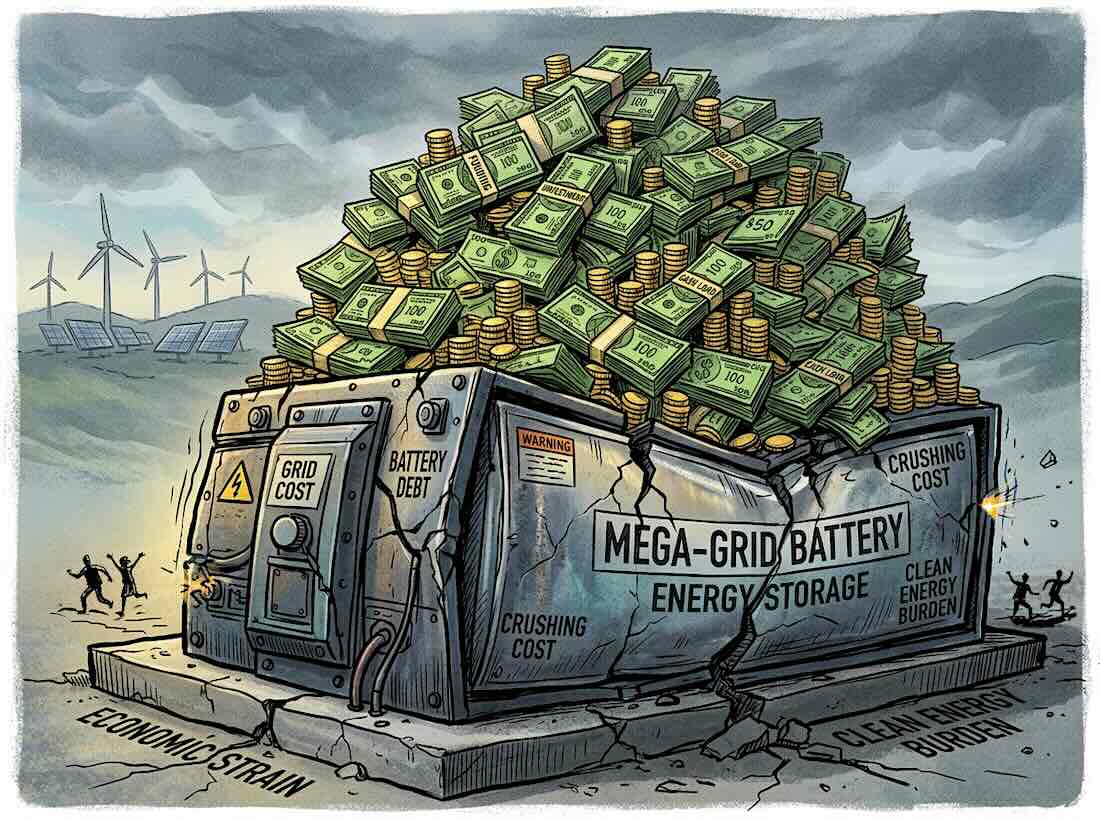
Renewable energy proponents often claim that the problem of intermittent generation from wind and solar power can be addressed with batteries. [some emphasis, links added]
In an opinion piece on Friday, for example, a Reuters columnist heaped praise on batteries as the technology that would bring about “net zero” — the amount of energy consumed being offset by the amount of renewable energy generated.
“In little more than three decades, batteries have moved from an afterthought in energy systems to one of the defining technologies of the transition away from fossil fuels,” Global Energy Transition columnist Gavin Maguire wrote.
Maguire makes no mention of the fact that the globe has exponentially increased the volume of fossil fuels it consumes – a decades-long trend that shows no reversal – nor does he mention that the amount of energy stored in batteries is measured in minutes.
Researchers at the National Center for Energy Analytics set out to find out if it’s possible to power the grid with wind, solar, and batteries.
Their report, released Thursday, casts considerable doubt on renewable energy proponents’ promise that batteries can resolve the problems of intermittency with wind and solar.
“This study demonstrates that a wind-solar-battery policy to meet electricity demand is physically implausible, cost-prohibitive, and unjustifiable based on goals to reduce CO2 emissions,” the report concludes.
Staggering Costs
Jonathan Lesser, senior fellow with the NCEA, and Mitch Rolling, director of research at Always On Energy Research, used the PJM Interconnection system, the nation’s largest grid operator, to evaluate the cost and feasibility of a system powered by wind, solar, and batteries.
The operator supplies electricity to 67 million people living in 13 states and the District of Columbia.
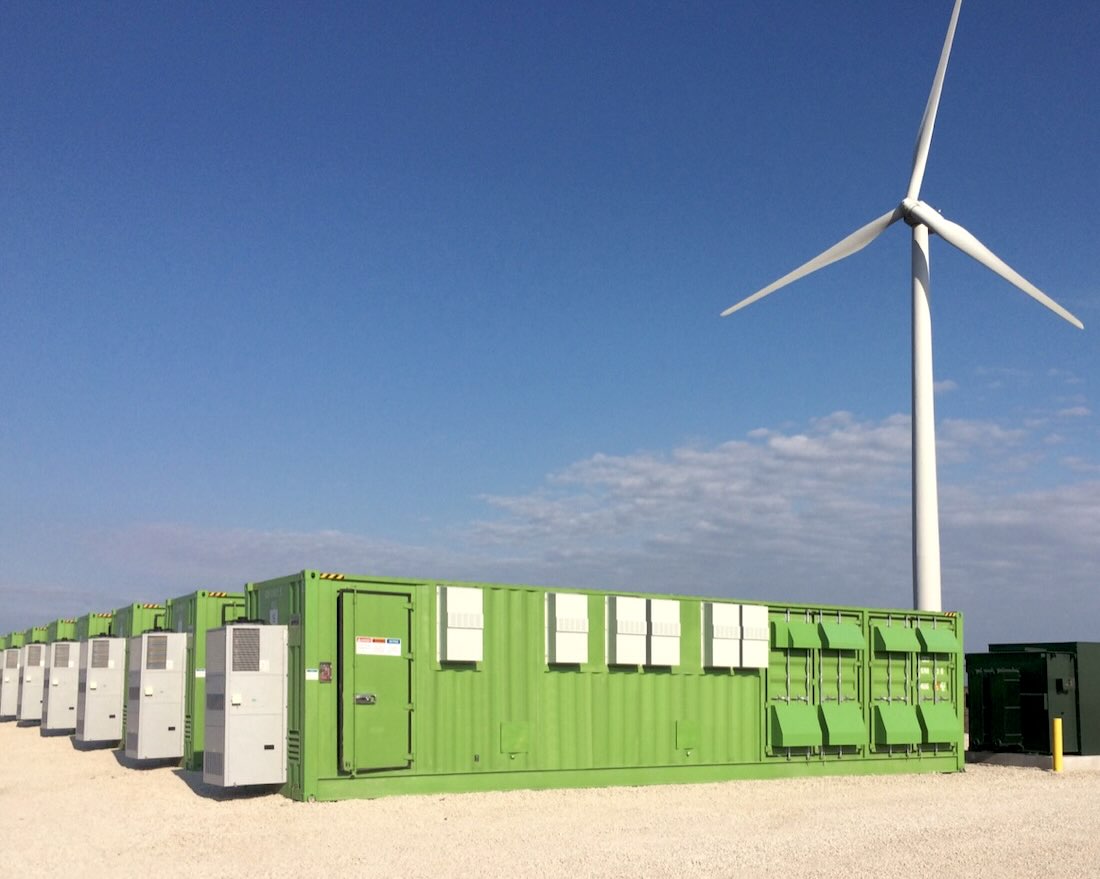
The researchers looked at three different scenarios.
One evaluated the PJM grid running on wind, solar, batteries, and existing nuclear power plants. Under this scenario, all coal and natural gas generation is retired.
In the second scenario, batteries are used along with new and existing gas-powered generators, as well as new nuclear power plants.
In the last scenario, battery storage is added to replace gas-fired generators during peak demand.
To compensate for the intermittency of wind and solar under the renewable-only scenario, the analysis found, PJM would need to add roughly 10 times the total generation capacity by 2045 than would be needed under the natural gas and nuclear scenario.
That extra capacity would not only serve daily and seasonal variations in supply and demand [but also accommodate days with] little to no wind or sunshine.
The study also found that to pay for this ideal net-zero grid with no new nuclear facilities, ratepayers served by PJM would need to fork over $4 trillion over the next 20 years.
That figure accounts for savings on fossil fuels.
Low Benefit for Cost
The authors note that the rationale for such a grid is that it will reduce carbon emissions that contribute to global warming. The study estimated that the annual costs of avoided emissions come to $771 per ton.
Recent estimates of the social cost of carbon – the economic damages caused by emitting carbon dioxide (CO2) into the atmosphere – range from $180 per ton in 2025 to $320 per ton in 2045
Even in terms of emissions reduction, the renewable-only scenario costs more than the benefits produced, the researchers conclude.
In the other two scenarios, the costs to ratepayers are still quite high.
In the natural gas and nuclear scenario, PJM customers would need to pay $668 billion over the next 20 years; under the [battery storage scenario, which would] replace gas-fired generators during peak demand, PJM customers would need to pay $768 billion over 20 years.
Read rest at Just The News







Since when are there benefits to Carbon Capture?
CO2 has been shown to have no measurable affect on global warming.
This post points up the failure of the Australian planning agency to take account of the cost of battery storage.
https://rafechampion.substack.com/p/australian-power-planning-debacle
That comes to $130 Billion for one night and we have to be prepared for two or three in a row.
And think about replacing the batteries every ten years or so.
For comparison, the Federal Government spent $240 Billion on health goods and services in 2021-22, and $180 Billion on welfare.
I don’t know if the figure includes the required over-installation of wind turbines and/or solar panels to recharge those batteries after the stored energy has been depleted to make up for the shortage of power generated by those wind turbines and solar panels.
No, and it does not include the cost of thousands of miles of high tension wires to connect the dispersed wind and solar facilities to the grid. They are living in a different universe.
https://rafechampion.substack.com/p/energy-policy-where-parallel-universes
The Social Cost of Carbon is arguably the most maleable metric in the global climate change discussion. The SCC is model projected possible future, while the Social Benefits of Carbon are real, current and measurable.
The game is about to change here and more people will be informed of the benefit of both warming and more plant food in the air.
https://rafechampion.substack.com/p/enough-of-the-decarbonisation-cult