

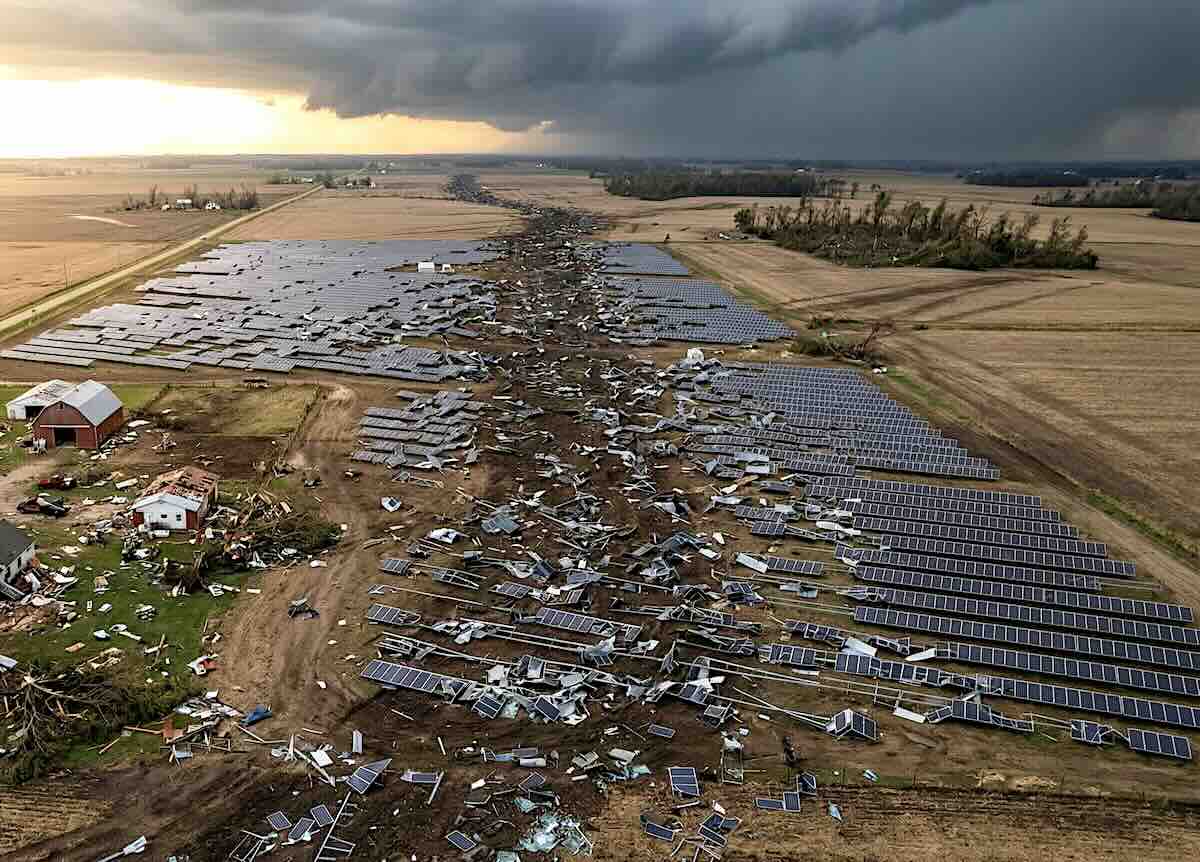
On Tuesday, March 10th, an EF-1 tornado destroyed the Dunns Bridge Solar I and II facilities owned by the Northern Indiana Public Service Company (NIPSCO). [some emphasis, links added]
The facilities, located outside of Wheatfield, Indiana, had 2.4 million solar panels, totaling 700 megawatts (MW) of power capacity, and reportedly cost $1 billion to construct—a little over $1,400 per kilowatt (kW).
NIPSCO issued the following statement in the aftermath:
“On the evening of March 10, while actively monitoring severe weather and responding to storm‑related outages across our service area, NIPSCO became aware of damage to its Dunns Bridge I and Dunns Bridge II solar facilities in Starke and Jasper counties. Our team was tracking the storm in real time and moved in to assess conditions and respond as soon as it was safe to do so. Debris from the damage could have been displaced, and we are working to safely secure the area, assess the damage and proactively communicate with the community.
“We recognize there may be questions and concerns about potential environmental impacts related to the damage at the solar farm. Solar panel leaching concerns have been thoroughly evaluated in industry-leading research, which shows that the risk is extremely low. Overall, the available evidence demonstrates that both crystalline silicon and thin-film PV (i.e., photovoltaic) modules do not pose a meaningful risk of environmental or human exposure from leaching, even when damaged.”
The Chief Deputy of Jasper County Sheriff’s Department, Brandon Napier, noted, “Just the path of the tornado that came through, we have several large solar fields to the east of the town here, it went right through the solar field and just ripped a lot of them out.”
While the solar panels were damaged by the tornado, we are not aware of any reports of damage at the nearby R.M. Schahfer Generating Station, a 950 MW coal facility that NIPSCO was planning to retire at the end of 2025.
However, it is still running thanks to a 202(C) order issued by the U.S. Department of Energy requiring the plant to continue operations. Click on the map below to explore the custom Google Map we made this week of the facilities.
This week, we wanted to take the opportunity to explore more about NIPSCO and share some data with our readers, especially given our recent research in the state.
This article will explore the cost of the destroyed solar facility compared to the nearby R.M. Schahfer Plant, and explore how energy costs have changed in the NIPSCO service territory in response to changes in the company’s generation fleet, using some cool data from S&P Global.
It’s kind of a meandering exploration, but one of the things we value most about Substack and our readers is our ability to explore new ideas and see the feedback you all give. Thanks for being part of it.
Implications of the Destruction
According to S&P Global, the Dunns Bridge solar projects were built to “support Northern Indiana Public Service’s goal of becoming coal-free by 2028, reducing carbon emissions by more than 90 percent by 2030, compared to a 2005 baseline, according to the utility.”
The situation begs several questions:
- If climate change is going to make the weather more extreme, how does it make any sense to shut down coal plants and build energy generation facilities, like solar, that are destroyed by extreme weather?
- Are the company’s coal-free and emissions reduction goals increasing the company’s exposure to costs associated with weather events, and why should ratepayers be saddled with these additional costs?
- Was there any damage to the R.M. Schahfer coal plant or the onsite battery storage facility at Dunns Bridge?
- What type of insurance policy is in place for the solar facility, and what deductible would the company be required to pay, if any?
- What liability, if any, does the company have for the cleanup of the site and surrounding areas?
- How is any of this in the best interests of ratepayers?
We reached out to NIPSCO via their “24-hour” media hotline, asking for this information, but they did not respond to our inquiry at the time of publication, and we sincerely doubt they will.
However, these are questions the company should have to answer in front of the Indiana Utility Regulatory Commission on March 24th at its scheduled hearing on energy affordability.
They can dodge our questions, but they had better come clean to the regulators.
Read rest at Energy Bad Boys








Solar farms belong in the Sunny Southwest and not anywhere North of the Sunbelt
Solar doesn’t belong anywhere if it’s to provide electricity to the grid since every night it provides zero electricity which means there was a power plant that was either idling or providing very little electricity to the grid. So the owner of that plant was losing money when the solar farm was providing that power.
Keep in mind that this was an EF1 tornado, the weakest to be classified as a tornado. My wife’s family is from rural Nebraska. They and neighbors have experience with these storms. Normally if an EF1 hits a house it will not destroy it but there will be some damage. I expect a power plant to fair better though I would expect some damage. Solar farms on the other hand are very fragile.
Greene of course completely ignored that in his response to me. What I would expect may likely happen was some damage to the coal piles located outside the plant but the plant would be designed to handle the kinds of winds from an EF1 tornado. And a nuclear plant would be designed to withstand any level of of tornado and/or hurricane.
the tornado hit solar farm and it broke
but the tornado did not hit the coal plant,
so it didn’t break
that’s the whole story
Do you think that if the tornado hit the coal plant it would be destroyed?
the article implies a coal power plant is safe from a tornado
no proof of that
and i disagree with that
Yes, a tornado can cause significant damage to a coal power plant, affecting its structural integrity, operational systems, and supply chains. While these facilities are built with industrial-grade materials, they are not immune to the extreme forces of high-intensity tornadoes.
While there are no records of a tornado completely destroying a coal power plant, several facilities have sustained significant damage from direct hits or near misses.
Where is my shocked face that even an EF1 tornado can cause that much destruction? We had a hail storm in eastern Colorado that destroyed a solar field, leaving behind toxic waste. And just north of where I live Excel Energy just installed a solar field that is a mile long and nearly a 1/2 mile wide. We get hail storms all up and down the Front Range of Colorado so this field will be lucky to avoid significant damage at some point in the next few years.