

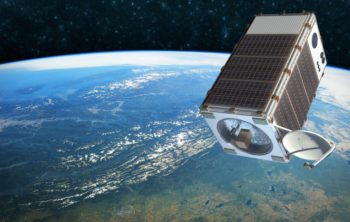
 The Environmental Defense Fund (EDF) this week announced plans to launch a $40 million methane-detecting satellite that EDF President Fred Krupp touts “would be the first capable of monitoring worldwide all oil and gas facilities with precision.”
From EDF’s blog post announcing the project:
“MethaneSAT is designed to measure areas of interest with a level of precision not previously available. It will use a wide, 200-kilometer view path at intervals of seven days or less, making it feasible to regularly monitor roughly fifty major oil and gas regions accounting for over 80% of global production. MethaneSAT will also be capable of measuring emissions from feedlots, landfills, and other man-made methane sources.”
Not surprisingly, the project’s rollout received widespread media coverage featuring little scrutiny and many important factors left unreported.
That noted, here are four things you need to know about this project and the extensive media coverage it’s received, as well as EDF’s past methane research and methane emissions in general.
#1. Satellite Studies Have Significant Limitations
In what amounted to a full endorsement of EDF’s project, The New York Times (NYT) reported on Thursday, “To address the problem of finding leaks around the world, a recent report from the National Academy of Sciences called for methane monitoring from space, where international access is not a problem.”
What the NYT fails to mention is the fact that the National Academy of Sciences (NAS) report actually recommended regulators use a combination of facility-level (bottom-up), aircraft and tower measurements (top-down), and satellite measurements in order to improve the accuracy of methane emission inventories.
Why? Because satellite measurements have significant limitations, as the NAS report discussed in detail.
From the NAS report (emphasis added):
“[S]atellite-based retrievals will never be able to be as accurate or precise as ground-based in-situ instruments, as the measurements are always affected by other confounding factors such as aerosols, which can never be fully eliminated with passive remote sensing (see Chapter 4).
If proven successful, future active remote sensing using Lidar (Light Detection and Ranging), such as the Methane Remote Sensing Lidar Mission Merlin (Pierangelo et al., 2016), might alleviate these caveats and enable year-round measurements from pole to pole. Active measurements are unlikely to achieve true global coverage, however.”
“Current satellite instruments have been shown to have persistent biases in space and time.”
“… For the reasons mentioned above, accurate ground-based and spatially contiguous satellite observations should be seen as complementary to other approaches, with the combined systems overcoming weaknesses in the individual elements.”
“Satellites can provide a complementary view of regional methane abundances from their vantage point in space. However, remotely sensed data are not as accurate as in-situ measurements, which can be calibrated against standards (see Chapter 3).
In fact, current satellite instruments such as SCIAMACHY have been shown to have persistent biases in space and time (e.g. Bergamaschi et al., 2013; Houweling et al., 2014) that need to be accounted for if satellite data are to be assimilated into atmospheric inverse models.”
Granted, EDF is claiming its satellite project will feature far more advanced technology than past satellite projects. However…
#2. The Technology EDF Touts Hasn’t Been Fully Developed Yet
The previously linked media reports on EDF’s announcement almost breathlessly tout technology that would seemingly address the satellite limitations listed above and usher in a new age of absolute certainty on the methane emission data front. EDF doesn’t hold back on the hyperbole, either.
Krupp told the Washington Post that the new satellite will be “designed to do one thing way better than anyone’s done it,” while project head Tom Ingersoll said the satellite “would use infrared spectrometers and track methane’s signature wavelengths and reflection of small packets of light, or photons.”
High-tech stuff, no question. But it is important to emphasize that, by EDF’s own admission, some of the technology discussed in the media hasn’t been fully developed yet.
As the New York Times reported, “The environmental group is also working with Steven C. Wofsy, a professor of atmospheric and environmental science at Harvard, and his colleagues to address the daunting technology challenge of creating an infrared spectrometer that can detect methane plumes on the Earth’s surface.”
The Washington Post reported, “[EDF] has reached out to Ingersoll and others in the commercial space business to create a device that will be able to measure methane emissions on a 125-mile wide swath with a pixel resolution of less than five-eighths of a mile.”
In other words — this is a work in progress.
Along with the fact that the actual launch date of the satellite is likely two years away (EDF says it won’t actually “lift off until 2020 at the earliest”), it is clear that the hype generated by this project may be a bit premature based on the long road ahead on the technology-development front.
The project, which will rely entirely on financial contributions from a “coalition of philanthropists,” has also yet to be fully funded.
#3. Past EDF Studies Have Found Low Methane Leakage Rates
EDF continues to tout in the media that its well-publicized $20 million series of methane studies that preceded this project “shows that emissions are significantly higher than previously estimated.”
But what is actually important — and woefully underreported — is the fact that each of those EDF studies found low methane rates well below the 3.2 percent threshold for natural gas to maintain its climate benefits.
Five of those studies are featured in the following EID graphic illustrating the most prominent research showing low leakage rates from U.S. natural gas systems.
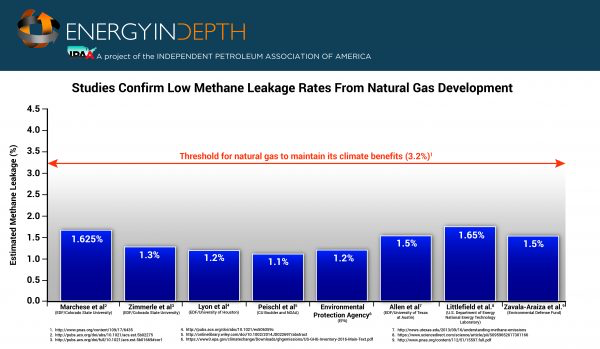
Here is what the above-listed EDF studies found.
- Allen et al. (Leakage rate: 1.5 percent): This landmark 2013 EDF/University of Texas study was the first to measure actual emissions, and it found emissions “nearly 50 times lower than previously estimated by the Environmental Protection Agency,” confirming beyond a shadow of a doubt natural gas’ climate benefits over coal. Activists have attempted to discredit this study by claiming the use of a potentially malfunctioning measuring device by the researchers led to an underestimate of emissions, but that claim was recently debunked by an independent EPA audit. UT and EDF followed up with two more studies, which also found very low methane leakage rates. These studies concluded that methane emissions from the upstream portion of the supply chain are only 0.38 percent of production. That’s about 10 percent lower than what they found in their 2013 study.
- Lyon et al. (Leakage rate: 1.2 percent): Using “top-down” measurements from aircraft over the Barnett Shale in Texas, this 2015 EDF/University of Houston study found very low leakage rates, despite the fact it was a “top-down” study with the significant limitation of being unable to attribute methane detected to other potential sources, such as agriculture and natural seeps.
- Marchese et al. (Leakage rate: 1.6 percent): This 2015 EDF/Colorado State University study took direct measurements from 114 gathering stations and 16 processing plants across 13 states. Using these measurements, along with EPA data from other segments of the natural gas supply chain, the study found an overall leakage rate that EDF’s Mark Brownstein noted is “well below what most scientists say is advantageous for the climate.”
- Zavala-Araiza et al. (Leakage rate: 1.5 percent): This 2015 EDF study analyzes data from 12 previous EDF Barnett Shale papers and finds low methane emissions despite being, as the report puts it, “biased toward high-emitters.” Notably, a recent NOAA study reveals the “super-emitters” data Zavala-Araiza et al. relied on used air measurements likely collected during episodic maintenance events, which skewed emissions higher than they typically would be. As a result, these “peak” emissions data were inappropriately used to calculate a normal emissions profile.
- Zimmerle et al. (Leakage rate: 1.3 percent): This 2015 EDF/Colorado State University study finds low overall natural gas system methane leakage rates based on 2,292 onsite measurements from transmission and storage facilities along with additional emissions data from 677 facilities and activity data from 922 facilities.
Each of these EDF studies found leakage rates in the range of 1.2 and 1.6 percent, which is notable considering they were generally regarded to be the most comprehensive studies of their kind at the time they were released.
Each is also in line with U.S. Environmental Protection Agency (EPA) estimates and well below the 3.2 percent threshold for natural gas to maintain its climate benefits.
#4. Best Available Data Show U.S. Oil and Gas Methane Emissions Represent Small Portion of Global Total
EDF estimates that global oil and gas methane emissions are roughly 75 million metric tons annually and notes that “the International Energy Agency estimates the industry can feasibly reduce its worldwide emissions by 75 percent – and that up to two-thirds of those reductions can be achieved at zero net cost.”
That said, the International Energy Agency (IEA) also notes that the most cost-effective methane mitigation opportunities exist outside the U.S., as this following IEA graphic shows.
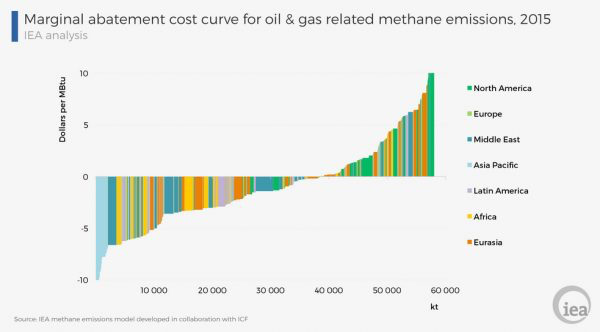
The reason is simple: according to almost every reputable third-party account, U.S. emissions of methane (CH4) from oil and natural gas development have been declining in recent years, thanks in large part to technological innovation.
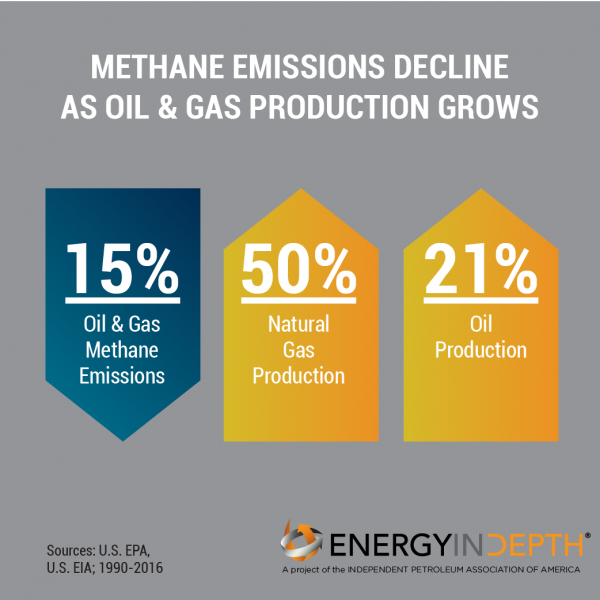
From 1990 to 2016, methane emissions from petroleum and natural gas systems declined by 31.5 million metric tons of carbon dioxide (CO2) equivalent or nearly 15 percent.
Over that same period, natural gas production increased by 50 percent, while oil production increased by 21 percent.
This methane mitigation success is reflected not only in EDF’s studies but also EPA and the Global Carbon Project data (which was referenced in the aforementioned highly regarded NAS study), which show U.S. oil and natural gas methane emissions account for only 1.4 percent of all methane emissions worldwide.
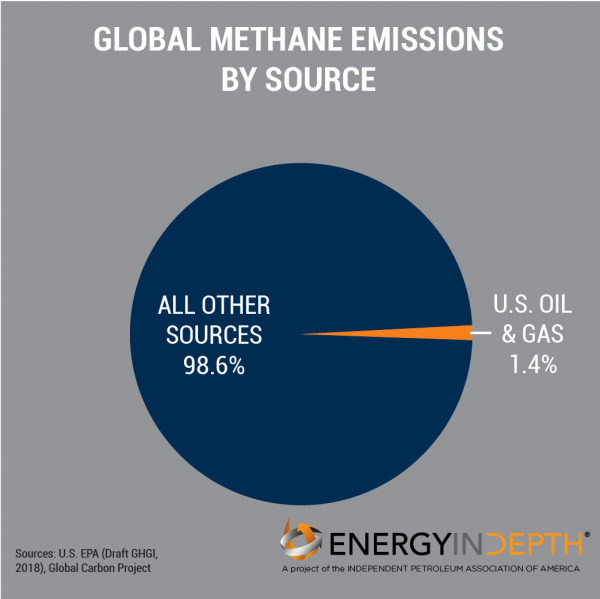
U.S. oil and gas system methane emissions also represent just 10.5 percent of the world’s total oil and gas methane emissions, even though we are the largest oil and natural gas producer in the world.
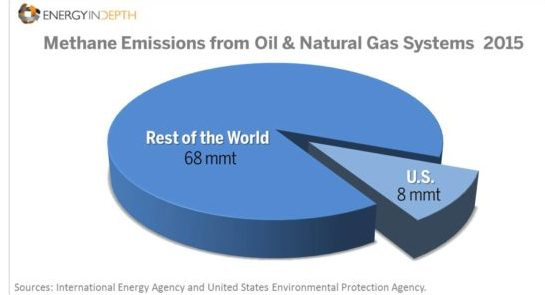
In other words, even if claims by EDF and virtually every other environmental group that U.S. oil and gas methane emissions are underestimated — they are almost certainly not a significant percentage of global emissions.
But despite the fact that the U.S. oil and natural gas industry is leading on the methane mitigation front, EDF plans to focus the early stages of its satellite study on the U.S.
One would think that if the effort were truly about reducing greenhouse gas emissions and mitigating climate change in an urgent fashion that efforts would focus on regions of the world where methane emissions are not only believed to be more prominent but also more cost-effective to reduce.
Conclusion
EDF has a relatively solid reputation compared to other environmental groups, which is based largely on its comparatively pragmatic stance on fracking and natural gas, as well as its willingness to work with industry on methane research.
But the fact remains that EDF is an environmental non-government organization, meaning its methane satellite project should be met with the same skepticism that industry-produced work would be by the media.
Whether or not that will actually happen remains to be seen.
Read more at EID Climate



“Four Things To Know About EDF’s New Methane-Detecting Satellite”
I understand they calibrate the EDF’s sensors daily when passing over over Sacramento…. he he
Wait. What about #5, #6, #7, #8,…..??? They may be able to locate large concentrations of herbivores…..or maybe locate active undersea volcanoes…. or large concentrations of “ship”(see Sacramento above), or large landfills, or large areas of untreated sewage to update San Francisco’s public Defecation Map, or locate baked bean church suppers or maybe track Al Gore’s movements.
Maybe.
If environmentalists want to stifle gas leaks, they’re looking in the wrong place. Old rusty pipes and valves should be top of their hit list, not new ones.
Also, the EDF’s eye in the sky won’t do much good in places like OPEC member countries. Try marching EPA into Iran and Iraq.
I can still remember back when they launched the Earth Resources,Technology Satellite(ERTS)back in the 1970’s and so i guess it went the way of Skylab and the other satellites it was suppost monitor our natural resources
let’s hope they follow the same development track as the James Webb Space Telescope, the satellite which is in it’s fourth decade of building and may leave it’s earthbound stand sometime next decade…
So now dose the Enviromental Defense Fund(EDF)want to regulate methane as a so called Greenhouse Gas so they can have it regulated the way they want to do with CO2 the trouble with these Eco-Wackos is they want to control our lives and dictate how we live just another group of Eco-Nazis/Watermelons
Where is the proof that methane has any effect, warming or otherwise, upon the earth’s climate just like carbon dioxide is alleged to be having? There has never been one single scientific proof that so-called “greenhouse gases” warm the atmosphere or the land.
They don’t have any proof and never will.
Thermal Infrared Spectrography says so.
This ” eye in the sky ” is merely the beginning of
their quest and goal to shut down
All gas and oil production worldwide.
It has nothing to do with climate.
It has everything to do with establishing
One world totalitarian government.