

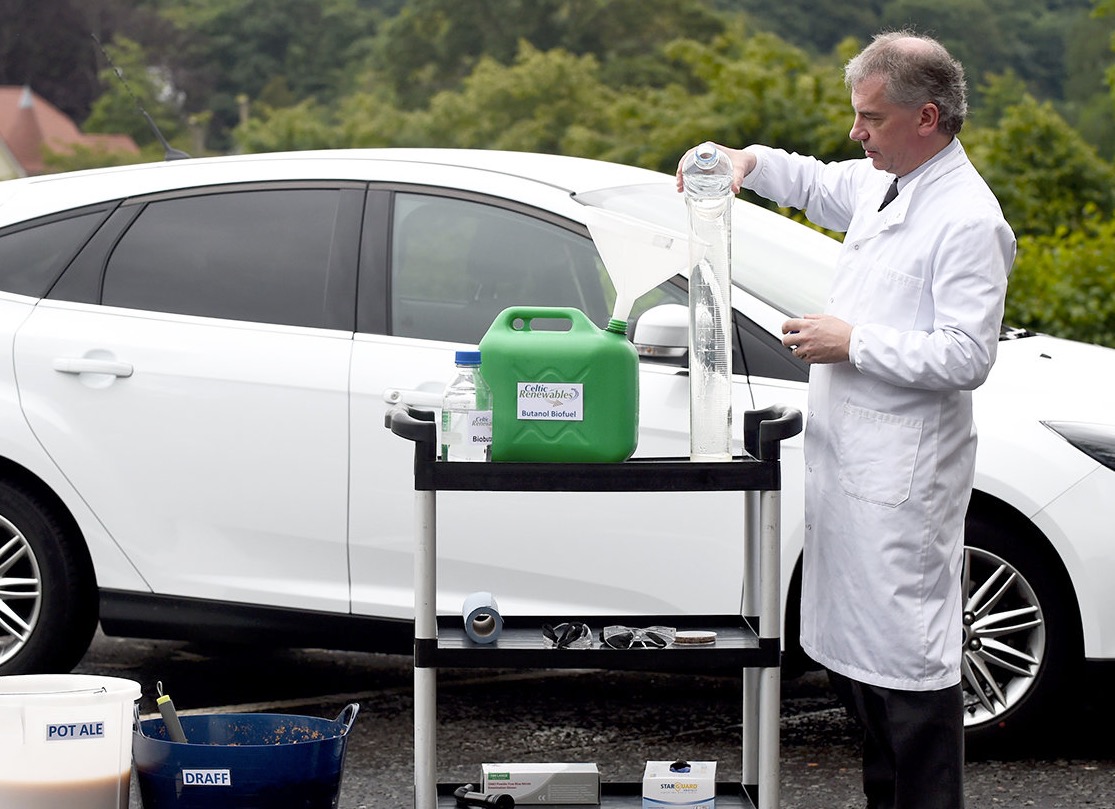
The Environmental Protection Agency is about to allow a new renewable fuel to be sold at the pump, which could revolutionize the fuel business while eliminating the use of corn ethanol in gasoline. [some emphasis, links added]
For some, the prospect of no longer having to use ethanol under the EPA’s renewable fuel mandate is reason enough to support the new super fuel.
“We started to look at what would be an alternative, rather than just say ‘no, no, no, we don’t like ethanol,’” said John McKnight, senior vice president for environmental policy with the National Marine Manufacturers Association.
His trade group opposes moving to higher levels of ethanol under the EPA’s Renewable Fuel Standard (RFS) because the fuel damages marine engines, powering everything from 75-foot yachts to fishing boats and jet skis.
Some of McKnight’s members include engine makers Volvo, Honda, Kawasaki, Caterpillar, Cummins, and Mercury.
“Is there something that’s out there that’s better?” was the question McKnight asked about 10 years ago.
The answer was “biobutanol,” the name given to the renewable form of isobutanol.
His group, with help from the Department of Energy and the Coast Guard, studied the fuel’s benefits for nearly a decade while biofuel company Gevo and oil giant BP developed the fuel.
The Coast Guard’s research division advised a few years ago that the branch closely “monitor the commercial production capability of biobutanol” as it enters the market and, once available, begin adding it as a requirement when buying new engines.
BP, in a partnership with global chemical giant DuPont, is preparing to introduce the fuel commercially, with production ramping up in the coming months.
The EPA is expected to approve an application to sell BP’s biobutanol as a 16-percent gasoline blend.
In its proposal to approve the fuel, the EPA called it an “attractive option” to meet the RFS because of its superior qualities compared to conventional corn ethanol, including its higher energy density.
But there is also the prospect of the fuel taking off on a large scale. Because of that, the EPA put a notice in the Federal Register seeking public comment. The agency is reviewing the comments now.
Ethanol and biobutanol are alcohol fuels derived from fermenting corn. But biobutanol is not corrosive like ethanol and behaves more like conventional gasoline.
That means cars, boats, and other machines that require gasoline can use it at high levels without experiencing problems.
The Energy Department lists four main benefits of the fuel. It has a “higher energy content” than most gasoline alternatives such as ethanol. It has lower Reid Vapor Pressure than ethanol, which means lower fuel volatility and emissions.
It also provides for “Increased energy security” because it can be produced “domestically from a variety of feedstocks while creating U.S. jobs.” Finally, it reduces carbon dioxide emissions.
McKnight, who is pushing the new fuel, said increasing the year-round use of 15-percent ethanol blends from the current 10 percent, as President Trump recently endorsed, is particularly damaging to marine engines.
McKnight helped conduct several tests on the effects of 15 percent ethanol blends on the engines in collaboration with the Department of Energy’s Argonne National Laboratory.
“We have pictures. They just blew up,” he said. “I mean, they could not run through a normal durability cycle on E15.”
Argonne and the Energy Department’s National Renewable Energy Laboratory started a multi-year effort with Gevo last year to test the octane benefits the fuel provides when blended in gasoline.
Tom Wallner, head of the transportation research center at Argonne, said the lab has conducted several research projects on the fuel and found it’s “ideally suited” to blend with gasoline. They tested biobutanol for automotive and off-road use.
But more than marine manufacturers are eyeing the fuel. The military, airlines, the oil industry and other sectors are all waiting to see what the fuel can do once it is ready to compete with ethanol.
Bringing a new fuel into the market is a “long-term game,” one that could be a big win for both the oil industry and ethanol producers, said Jan Koninckx, CEO of Butamax, the biobutanol producer that is the 50-50 joint venture between BP and DuPont.
Biobutanol, sometimes called a “drop-in” fuel because it can easily be put into the nation’s fuel supply without any harmful effects, has none of the drawbacks of conventional corn-based ethanol, Koninckx said.
A top reason to use the fuel is that it is less corrosive than ethanol.
“It is easier to deal with and is offering the ethanol industry a diversification option … to make a fuel product that is easier to use,” Koninckx said.
For example, ethanol cannot be shipped in steel pipelines, because it causes them to corrode. Only plastic pipelines can be used, which is not practical for long distances. So it is currently transported by rail and barges.
But biobutanol can be shipped with gasoline and diesel fuel through conventional steel pipes.
The fuel also packs more power than ethanol, giving it an energy profile that more closely resembles gasoline. Ethanol is less energy dense, making cars less fuel efficient when it is added to gasoline.
Koninckx says biobutanol has the potential to replace ethanol, making a 16-percent biobutanol blend the new national fuel. However, he says his company isn’t looking to do that.
Biobutanol is the “next step” biofuel, he said, and will be offered as an “upgrade” to existing corn-ethanol facilities.
The fuel can help oil refiners, because biobutanol generates more renewable identification number credits, or RINs, under the EPA’s RFS program since it is considered an advanced biofuel, he said.
The bigger credit would help smaller, independent oil refiners meet the fuel mandate because they must buy the credits to comply with the RFS since they don’t have the infrastructure to blend biofuels.
Mike McAdams, president and CEO of the Advanced Biofuels Association, which represents BP and other biobutanol producers such as the company Gevo, said the new fuel would help lower the price of RINs.
“I’m kind of surprised EPA hadn’t pushed for that, because they are looking for more RINs to drive the price down,” McAdams said.
“The significant thing from my view is, in the last 18 months it’s been very hard to get new fuels approved and new pathways approved under this administration,” McAdams said. “We would be delighted to see any movement at all on new fuels and pathways under this administration.”
Read rest at Washington Examiner








The ethanol blend not only damages marine engines, but small engines and according to my mechanic is the reason one of my cars needs its carburetor rebuilt once a year. It appears biobutanol is a much needed alternative.
However, it doesn’t make sense to use any bio-fuel. Many advocates on both sides of the climate change debate say that as much carbon dioxide is emitted producing these fuels as they displace. In addition, with the entire climate change movement being a fraud, there is no reason to try to reduce emissions.