


WTAE ABC, Pittsburgh, published a story titled, “Climate change affecting global coffee production, study finds.” The study is false, perpetrated by a climate activist group called Climate Central, and uncritically echoed by WTAE meteorologist Jill Szwed. [some emphasis, links added]
Had Szwed or WTAE fact-checked Climate Central’s claims against real-world data, they would have found coffee production has increased dramatically around the world amid the modest recent warming, including in each of the countries cited in WTAE’s story.
“A study from Climate Central revealed that climate change is making coffee production more challenging and expensive, affecting the flavor and availability of coffee worldwide,” writes Szwed. “Climate Central analyzed daily temperatures over the last five years in 25 coffee-growing countries, including Brazil, Vietnam, Colombia, Ethiopia, and Indonesia.
“Temperatures exceeding 86 degrees Fahrenheit negatively affect the growth of Arabica and Robusta coffee plants,” Szwed continued. “On average, countries in the ‘bean belt’ experienced nearly two extra months of harmful heat.”
Szwed is referencing the same study that Climate Realism debunked just two weeks ago. If additional heat is hampering coffee production in Brazil, Colombia, Ethiopia, Indonesia, and Vietnam, or globally, it isn’t reflected in actual coffee production data.
Here Are The Facts
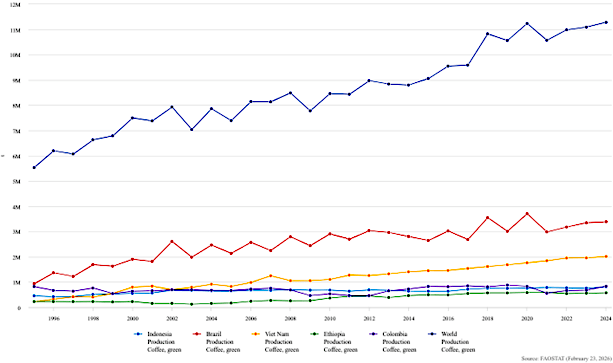
FAO Data show that during the twenty-first century, the period that has supposedly been the warmest in recent history, coffee production has increased substantially, globally, and in each of the five countries WTAE highlighted in its story: Brazil, Colombia, Ethiopia, Indonesia, and Vietnam.
From 1995 to 2024, the most recent year for which data is available:
- Global coffee production has more than doubled, increasing by more than 104 percent, with the most recent record for production coming in 2024.
- Coffee production in Brazil has escalated by more than 264 percent.
- Coffee production in Colombia has grown by a relatively modest two percent.
- Coffee production in Ethiopia has been boosted by approximately 156 percent.
- Coffee production in Indonesia expanded by 76.4 percent, and
- Coffee production in Vietnam increased an astounding 824 percent. (see the graph, below)
In multiple earlier posts debunking previous false news reports warning of climate change compromising coffee production, Climate Realism showed that production of both robusta and arabica beans, as well as other varieties of coffee, is growing here, here, and here, for example.
Coffee trees, which are flowering plants, like other trees, cereal grains, grasses, and legumes, are benefiting from higher atmospheric carbon dioxide (CO2) levels.
In fact, CO2 enrichment studies in Latin America show that elevated CO2 increased photosynthesis by 40% and increased the efficiency of plants’ water use by approximately 60%.
Higher CO2 eventually caused a 7-14% increase in plant height and a 12-14% increase in yield. Another study showed that there were significant increases in all leaf area and biomass markers in response to increased CO2.
Research and production data both indicate that we are already reaping the rewards of increased productivity rates in arabica, robusta, and other coffee varieties, thanks to the recent rise in atmospheric CO2.

This reality is reflected in the plantations across the globe. Production in South America and Southeast Asia has shown increases in yield during the past two decades [graph, above].
As far as flavor profile goes, a coffee’s taste is subjective. But if coffee tastes worse than before, it’s hard to explain why daily coffee consumption recently reached a 20-year high, with consumption in the U.S. surging more than 40 percent since 2004 alone.
And there are more varieties, flavors, and styles of coffee on the market now than at any time in history. Coffee drinkers’ choices are no longer only black or with cream and sugar, but rather range from Ethiopian cold brew, to Kona Chocolate Macadamia Nut, to caramel, mocha latte, etc.
The geographic sources, flavors, and styles of coffee are virtually endless at this stage, suggesting coffee is better tasting and more attractive to beverage enthusiasts now than ever before.

The Climate Central study has been around for a few weeks, meaning it was hardly breaking news. WTAE’s audience would have been better served by the outlet and Szwed had they taken the time to see if its research had been vetted by others and its claims checked out.
Had they done so, they could have easily found Climate Realism’s previous post rebutting Climate Central’s claims and, by doing so, saved themselves the embarrassment of reporting as fact the false claims about coffee’s decline due to climate change.
After a simple fact check, WTAE could have simply ignored the story entirely or, with a little investigative journalistic effort, exposed Climate Central’s study for the inaccurate, politically motivated work it is.
That would have been a worthy journalistic endeavor – bringing truth, not climate alarm, to their audience, especially those who enjoy coffee with their news.
Read more at Climate Realism


So it sounds like the only thing accurate in the article is the headline! Apparently a climate changing due to higher CO2 concentrating is beneficial to growing things. Who knew!?