While “traditional” climate lawsuits continue to face a string of dismissals and a pending U.S. Supreme Court review, the same activists and plaintiffs’ attorneys are scrambling to repackage the same claims into new legal frameworks. [some emphasis, links added]
But Michigan Attorney General Dana Nessel’s sweeping antitrust climate lawsuit against the U.S. oil-and-gas industry has already drawn a blunt assessment from legal experts: it’s “facing a meaningful risk of dismissal” – just like the growing list of similar climate cases that have been thrown out in courts across the country.
The Michigan complaint attempts to repackage decades of lawful industry behavior – investment decisions, public statements, and participation in industry trade associations – as evidence of a coordinated conspiracy to suppress competing energy technologies.
That’s a major stretch. And one that’s been tried with no success in the past (flashback to Puerto Rico).
It’s been roughly two months since Nessel filed her major lawsuit. Let’s examine what energy and legal experts are saying about the case.
A “Meaningful Risk of Dismissal” – for Good Reason
At its core, the lawsuit leans heavily on broad industry trends and parallel conduct, not concrete proof of collusion.
As Gary Mouw, an antitrust specialist at Varnum Law in Grand Rapids, notes:
“The complaint relies on trade association participation, similar messaging and investment choices, and shared views of the market to suggest a conspiratorial agreement in restraint of trade…However, those activities are common, often beneficial, and sometimes protected.” (emphasis added)
The lawsuit also targets conduct that courts have repeatedly protected under the First Amendment.
As Robert H. Bork Jr. of the Antitrust Education Project warns in the Washington Examiner:
“Given the great deference courts usually give to a First Amendment defense, this charge is not likely to stick… It is unlikely that speeches, videos, and op-eds by a trade association advocating industry positions will be judged as an antitrust violation.”
Built Around a Hypothetical Energy Market
The lawsuit also hinges on a flawed premise that electric vehicles would already dominate the market if not for alleged interference by energy companies.
But reality tells a different story.

Automakers themselves have been clear that consumer demand – not conspiracy – is the determining factor. Ford Motor’s CEO Jim Farley emphasized this further on a recent earnings call:
“I think the customer has spoken… That’s the punchline.”
High costs, infrastructure gaps, and performance tradeoffs remain real barriers. As Detroit News columnist Nolan Finley smartly argues:
“[Nessel] hopes to convince the court there is not an EV in every garage, solar panels on every roof and windmills atop every beanie because greedy corporations have teamed up to deny the people what they really want. It’s hogwash, of course.
“The auto industry committed $1.2 trillion to developing electric vehicles and trying to create demand for them. Oil execs didn’t undermine that massive investment, the marketplace did.” (emphasis added)
Cherry-Picked “Evidence” of Deception
Even more problematic is how the complaint attempts to build its case around alleged deception by fossil fuel companies.
A closer look shows many of the claims cited in the complaint rely on selectively edited quotes stripped of context to fit a predetermined narrative.
As detailed by Michigan Capitol Confidential, the full record paints a different picture.
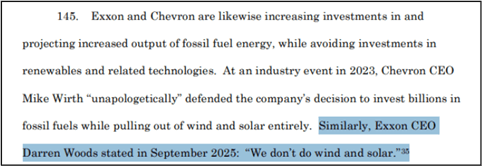
The actual quote is far more nuanced:
“We don’t do wind and solar, we have no issues with wind and solar, but we don’t have capability in that space… But we do have capability of transforming molecules and there are enormous opportunities in that space to use hydrogen and carbon molecules to meet the growing demand.”
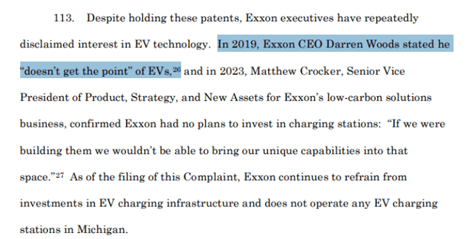
What Woods actually said:
“What the point is of having electric vehicles that will end up being charged by power generated from coal?”
The full quotes acknowledge business realities, ongoing research, and the persistence of fossil fuels as a source for power generation – hardly a smoking gun.
Noerr-Pennington Shield Undercuts Nessel Theories
Perhaps the most consequential flaw is that the lawsuit runs headlong into the Noerr-Pennington doctrine, which protects the right to petition the government (including lobbying, advocacy, and participation in trade associations) from antitrust liability.
That’s a major problem for AG Nessel’s case.
Much of what the complaint tries to portray as collusion – coordinated messaging, policy advocacy, and industry group activity – falls squarely within conduct courts have long treated as protected.

Under Nessel’s theory, an industry’s collective position on policy and technology development could suddenly be treated as illegal conduct if they disadvantage a competing technology.
But unfortunately for Nessel, that’s not how antitrust law works.
Consider that if this approach were accepted, it wouldn’t stop with oil and gas. Any industry group – from climate advocates to manufacturers to the ACLU – could face liability simply for promoting its policy preferences. As Bork further notes:
“The American Clean Power Association, which also represents big and often highly profitable energy companies, could be sanctioned for advocating policies that “restrict” the nation’s reliance on fossil fuels. Similar suits could be waged against every trade association.”
Bottom Line
Nessel’s lawsuit isn’t breaking new ground so much as retracing a path that’s already led to repeated legal dead ends.
By attempting to stretch antitrust law to cover speech, advocacy, and long-term investment strategy, the case “faces a meaningful risk of dismissal,” and ultimately, the same outcome that has doomed similar climate lawsuits across the country.
And with its reliance on speculative market assumptions and cherry-picked evidence, critics say this latest effort looks less like a viable legal claim and more like another attempt to use the courts to achieve policy goals that lawmakers – and consumers – haven’t embraced.
Read more at EID Climate