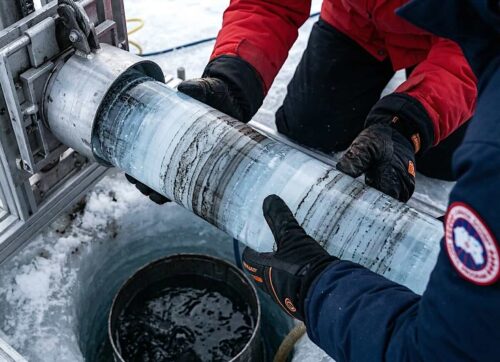
A large portion of the Greenland ice sheet that is today over 500 meters thick did not exist during the Early to Mid-Holocene. [some emphasis, links added]
Prudhoe Dome (PD), a 2,500 km² section of northwestern Greenland’s ice sheet (GIS), is today 500 to 600 m thick (Walcott-George et al., 2026).
Approximately 6,000-8,000 years ago, or when atmospheric CO2 was said to be ~260 ppm, the PD had deglaciated completely, exposing the soil to sunlight.
The primary mechanism for the PD deglaciation was the estimated 3 to 7°C warmer than present regional temperatures.
This warming and the consequent ice cap minima were said to be “Arctic-wide”.
Starting ~4,000 years ago, the GIS gradually began thickening until it recently reached its modern glaciated state, with glaciation peaking in the 1800s.

Top: Greenland today (left) versus a reconstructed Early to Mid-Holocene landscape, when warmer temperatures left large areas ice-free.
Read more at No Tricks Zone