


The world currently has 8.2 billion people and a global economy approaching $120 trillion. The world also routinely experiences extreme weather events like tropical cyclones, floods, and tornadoes.1 [some emphasis, links added]
Given these facts, how much economic loss should we expect annually from extreme weather events in the context of the global economy?
For 2025, the catastrophe modeling firm Verisk provided their estimate2 — $152 billion in insured losses and $395 billion overall (i.e., insured plus uninsured, and including non-weather-related losses).
Insured losses make up ~38% of the overall 2025 total, with the table below showing a regional breakdown for Average Annual Loss (AAL), and 1% and 0.4% loss estimates.

These loss estimates are not fixed. They change as the world changes — more people, more wealth, more exposure means more potential for loss.
The table below from Verisk shows how annual insured loss estimates have changed from 2020 to 2025.

Have a look at the white column on the left, which reflects their estimated Average Annual Loss for each year from 2020 to 2025.
The AAL shows that expected losses increase by 50% from 2022 to 2025, from $100 billion to $152 billion, and have almost doubled from 2020.
Similarly, the levels of extreme losses have increased rapidly as well, with a loss with an estimated 1% chance in 2025 at $425 billion, representing an increase of $151 billion since 2020.
What is driving this remarkable increase in loss potential?
Climate change, obviously.
Right?
Wrong.
Verisk explains that increasing loss exposure is being driven by construction and inflation:3
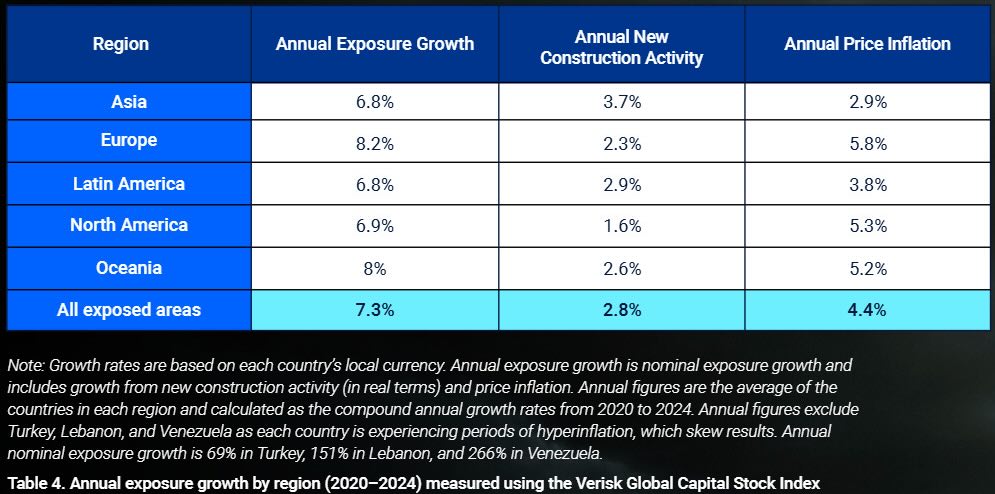
“Insured losses—and the modeled AAL—increase over time in part because of growth in exposure to natural catastrophes. Over the past five years (2020–2024), global property exposure in Verisk-modeled countries grew about 7% per year on average (Table 4 [above]), driven by both new construction and construction price increases. Since 2020, fast-rising global inflation significantly increased exposure values, which in turn helped spur increases in insured natural catastrophe losses. While construction price inflation has slowed recently, exposure growth continues to contribute to rising insured losses.”
Global loss estimates for 2025 have been reported in recent weeks by several reinsurance companies, allowing an update of my global time series of weather-related catastrophe losses through 2025.4
Munich Re, a global reinsurance company, has explained that they consider their time series of losses to be reliable since 1990. In my analyses, I use their data (along with GDP estimates from the World Bank) and update the analysis of Pielke (2019) through 2025 in the figure below.5
The time series shown below shows total weather-related catastrophe losses as a percentage of global GDP (constant 2025 PPP dollars) for 1990 through 2025.6
The data is freshly updated with the 2025 loss estimates from Munich Re, which estimates total weather-related losses for 2025 of $212 billion, of which $106.5 billion was insured.7

Last year’s losses as a percentage of GDP were ~0.18%, which were below both the long-term annual average of 0.22%, as well as the long-term linear trend (dashed red line), which, since 1990, has fallen from ~0.25% to ~0.20% per year.8
In terms of absolute numbers, Munich Re’s estimates of $212 billion (total) and $106.5 billion (insured) are far below the Verisk 2025 AAL estimates of $152 billion (total) and $395 billion (total), which include non-weather-related losses.
That means that weather-related losses for 2025 were well below expected annual loss totals in both absolute numbers and with respect to GDP, adding to a longer-term trend of no increase in weather-related catastrophe losses as a proportion of GDP.
The Honest Broker is written by climate expert Roger Pielke Jr and is reader-supported. If you value what you have read here, please consider subscribing and supporting the work that goes into it.
Read rest at The Honest Broker



The data are very interesting, but unrelated to the slight warming of the global average temperature in the past 50 years. Improved weather prediction significantly reduces economic and human losses from severe events, with studies indicating that better forecasts can prevent roughly 15% of infrastructure damage and save thousands of lives annually.
Long-term trends confirm that the 25-year average US GDP growth has slowed significantly compared to earlier historical periods