


The 2025 annual report recently issued by the National Centers for Environmental Information, a division of NOAA, claims that 2025 was the third hottest year in recorded history. [Full report]
“NOAA ranks 2025 as the third-warmest year in its global temperature record, which dates back to 1850.”
Should we believe this? Well, not if we understand the scientific method, because whoever came up with this report doesn’t.
First of all, in science, we don’t mix apples and oranges. In 1850, there were very few weather stations taking daily temperature readings, as demonstrated by this world map.

Broad weather observation networks were just getting organized in the mid-19th century. Systematic weather station networks didn’t cover the globe in 1850 — very few stations existed outside major cities and observatories, and even in the U.S., the network was nascent.
Europe had scattered scientific observatories taking measurements (thermometers, barometers, etc.), but there was no standardized, coordinated global network like we have today.
Most temperature collection was done in Europe and the eastern United States. There were just a few in South America, Africa, Asia, and Australia. There was also no system for measuring the temperature of the oceans, which cover about 70% of the Earth’s surface.
So how in the world could they have come up with a valid average temperature of the Earth in 1850? This means that we have no idea how much the Earth’s temperature has risen since then.
Obviously, there was a lot of guesswork involved here. Yet these temperature increases are spelled out to the hundredths of a degree. How can that be? This is from NOAA’s website:
“The year 2025 ranked as the third-warmest year since global records began in 1850, finishing 1.17°C (2.11°F) above the 20th-century average of 13.9°C (57.0°F). This value narrowly missed the second-place currently held by 2023 (by 0.02°C / 0.04°F) and trailed the all-time record set in 2024 by 0.12°C (0.22°F).”
Secondly, these are surface temperatures they are talking about. Satellite temperature measurement avoids a serious problem with surface measurement: the Urban Heat Island (UHI) effect.
Thermometers used in ground-based weather stations are often located in cities as well as in airports and other paved areas, where concrete, after absorbing radiation from the sun, raises the temperature.
A century ago, most weather stations were located in grassy, unpaved, rural areas.
The influence of human activities such as traffic, concrete, and air conditioner exhaust vents could make a difference of a few degrees, skewing the results. Cities developed around weather stations that had originally been located in semi-remote areas.
A team of volunteers, headed by meteorologist Anthony Watts, checked US weather stations to identify those with such problems. When he confronted NOAA about the problems at these weather stations, they refused to fix them, countering that they were compensating for the problem by making “adjustments”.
But how would they know how much of an adjustment to make at each station? This is a sloppy measurement and certainly not science.
About three percent of the Earth’s land area is affected by the UHI effect. The average temperatures of the Earth’s great cities, such as New York, have risen significantly in the past century.
Global warming IS happening in cities. But the temperatures of most smaller cities and towns have remained flat or even dipped lower during the same time period. So NOAA can tell us that temperatures have risen, but that means nothing.
Another very serious problem with NOAA is that they’ve been caught changing recorded temperatures, lowering the older ones and raising recent ones to make it appear that it’s getting warmer.
Many climate scientists have been surprised and shocked to see later editions of graphs published by NOAA and NASA that were changed from their previous editions.
These agencies don’t deny that they’ve cooked the data. With a flurry of doublespeak, they admit that they’ve made “adjustments” to it.
In the year 2000, NASA charts showed about 0.5°C. of warming before 2000. But in 2023, the very same charts showed nearly 1.5°C of warming for the same time period.
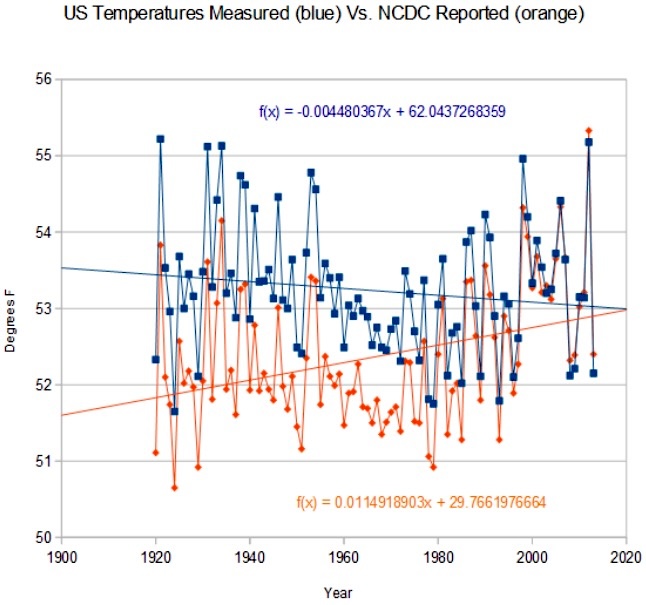
Temperature data were also fudged by the Climate Research Unit (CRU) in Britain, Australia, and New Zealand. This blatant fraud being committed right before our eyes goes against every principle of science.
In the year 1911, a massive heat wave killed tens of thousands of people in Europe and the United States. This is verified by newspaper reports from 1911. In France alone, 41,000 people died.
In Nashua, New Hampshire, the temperature reached 106° F, and in Maine, the temperature reached 112°F. Thousands died in New England. Yet strangely, NASA’s graph shows 1911 as a cold year.
1910, 1911, and 1912 were all exceptionally hot years. Rapid melting of glaciers was reported. A collision with an iceberg that had calved off a glacier sank the Titanic on April 12, 1912, at a latitude close to that of New York City.
A May 5, 1912, article in the New York Times reads,
“An unprecedentedly warm Winter in the entire Arctic is believed to be the cause of the vast number of icebergs in the north Atlantic Ocean during the present season, and for the low latitudes which many of them have reached… Last year, according to officials at the Hydrographic Office, the thermometer reached 94 degrees in midsummer at Irigtut, on the west coast of Greenland.”
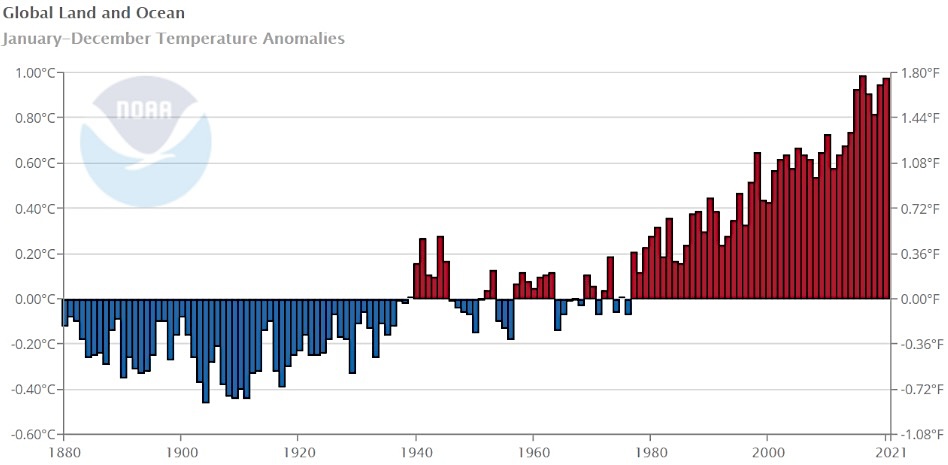
Yet, this graph by NOAA shows 1912 to be an exceptionally cold year, demonstrating the extent to which temperature records have been falsified. How is that possible?
When the “U.S. Heat Waves” graph shown below is superimposed on the climate record starting in 1900, it comes out looking like the correct graph below. Notice how much more severe the heat waves were in the 1930s, the warmest decade of the 20th century.
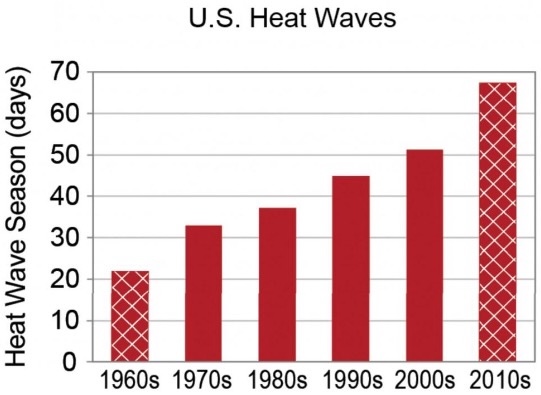
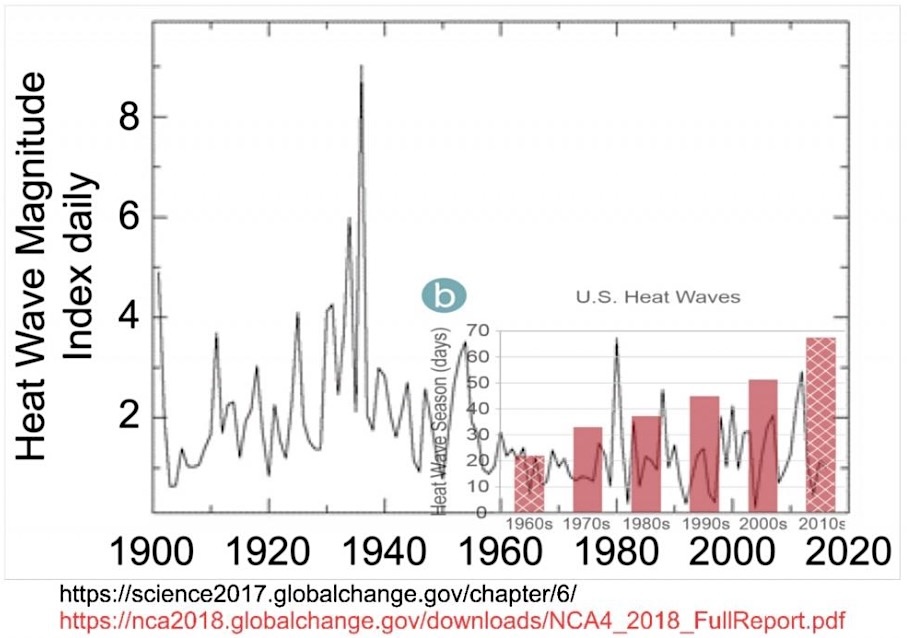
1960 was selected as the starting point for the upper graph to make it look like heat waves were getting worse, because 1960 was the coldest year. You can see how they simply wiped out the temperature history previous to 1960.
During the 1960s, the Earth was cooling while the percentage of carbon dioxide (CO2) was rising at the same time. How can that be if CO2 causes temperatures to increase?
Surface weather stations are still not evenly distributed around the globe. There are far fewer weather stations in the southern hemisphere, the polar regions, and on oceans.
Regarding the “20th-century average of 13.9°C (57.0°F),” cited in this report, there was no consistent method for measuring ocean temperatures during the entire 20th century.
The ARGO system for ocean temperature measurement wasn’t implemented until 2000. Before that, ocean temperatures were guessed at.

The ocean makes up ~70% of Earth’s surface. Yet, they’re giving us these temperature increases in tenths of a degree? Come on, now.
In computing Earth’s average temperature, many temperatures in those regions are still simply guessed at. Land-based weather stations cover less than 25% of the Earth.
Thus, statements that we just had the “warmest year on record”, when the average temperature has been recorded as a few hundredths of a degree higher than the previous estimate, are meaningless.
They indicate that temperatures were flat.
Even though there were only about 1,000 weather stations used to provide data for the computer models, this number was reduced in the 1960s. Then, in the 1990s, that number was further decreased.
The main concern is which stations were retired. In Canada, a large country, most of the Arctic stations were removed, with the only one remaining in Eureka. Each station is supposed to represent a radius of 1,200 km (745 miles).
Since NOAA and NASA have demonstrated their utter disregard for careful measurement and have been repeatedly caught lying, it is utterly impossible to believe anything they say or put in print.
Hundreds of fascinating facts about the climate change scam can be found in Lynne Balzer’s richly illustrated book, “Exposing the Great Climate Change Lie”, available on Amazon. A second, expanded version of this book is due to be published on Amazon within the next month.





I understand not wanting to accept data from NOAA or any data before 1975. The only alternative is UAH satellite data since 1979.
UAH; 2025 was the 2nd warmest year (behind 2024) in the 47-year satellite record. 2nd warmest is not that much different than third warmest. There is no evidence that any decade in the past 10,000 years was warmer than the prior decade. I’m talking about estimates of the global average temperature based on an average of local proxies.
This article served no purpose
If the article serves no purpose then I’d add that your reply serves even less than none.
The article served many purposes including the highlighting of the adjustments to the temperature records. Which continues