On February 17, 2026, an avalanche struck north of Lake Tahoe, California, killing nine people amid a heavy, multi-day snowstorm in the area. The media falsely blamed climate change for the event. [some emphasis, links added]
Heavy snow is common in the mountains above Lake Tahoe during the winter, as are avalanches. Sadly, deaths from avalanches are all too common as well.
Multiple media outlets jumped on the “climate change caused the deadly avalanche” bandwagon.
For example, Scientific American’s headline about the avalanche was titled, “Lake Tahoe avalanche explained by warm weather. “ In making a false causal connection between climate change and the avalanche, Scientific American wrote, “Many scientists expect rising temperatures from climate change to increase dangerous avalanches…”
“Avalanche risks remain high in California after deaths of skiers,” was the title of The Guardian’s story on the sad event, blaming the deaths on the “climate crisis.”
While NPR’s article about the avalanche asked, “Did climate change factor into the Lake Tahoe avalanche?, stating, “[a]s the climate warms, scientists are trying to better understand avalanche risks.”
The media response to California’s recent deadly avalanche is laid out plainly: weather was rebranded as a climate crisis to support a narrative; yet, no such connection between climate change and the recent avalanche exists.
Scientific American, The Guardian, NPR, and other media outlets, in a unified rapid response, framed the tragedy through the lens of global warming.
The claim, implicit or explicit, is that rising temperatures and so-called “snow droughts” made the avalanche more likely.
That framing is false, representing the media’s attempt to follow the example of flawed attribution studies that Climate Realism has debunked multiple times.
Avalanches are weather-driven events governed by snowpack structure, storm timing, temperature swings, and terrain. The media have presented no evidence of a long-term trend of increasing incidences of avalanches because no such trend exists.
Absent such a trend, the Lake Tahoe avalanche can’t be honestly attributed to climate change.
The mainstream media lurch back and forth between differing claims about the prevalence and amount of snowfall the world can expect under global warming: from claims of snow disappearing to worsening snowstorms.
For years, we have been told snowfall is disappearing, that warming winters mean the end of ski seasons, and that snow will soon be a relic. Yet heavy snow years continue to occur.

The Sierra Nevada experienced record-breaking snowfall in the winter of 2016–2017, a season documented by the National Oceanic and Atmospheric Administration’s (NOAA) station data. Snow in the Sierra Nevada is not an anomaly. It is the norm.
NOAA’s long-term 1991–2020 climate normals for Truckee, California — available through NOAA’s U.S. Climate Normals dataset — show average January and February high temperatures in the low 40s Fahrenheit and lows well below freezing. That is prime snow conditions, period. Calling February snowfall delayed by a few weeks a “snow drought” ignores both climatology and history.
California gets snow every year. Some years, storms arrive early. Some years, they arrive late. That variability is precisely why climate is defined using 30-year baselines rather than single months.
Avalanches in the area are not a new phenomenon. For example, the March 31, 1982, Alpine Meadows avalanche near Lake Tahoe killed seven people, more than 40 years of climate change ago, when the average global temperature was cooler.
That event is further documented in historical reporting from the era and summarized in newspaper archival coverage, and the San Francisco Gate even made the comparison between the current avalanche and the 1982 event.
Avalanches require a very specific set of ingredients that have nothing to do with climate. According to the National Weather Service (NWS) and Powder Magazine, here are the key ingredients for a snow avalanche:
- Snowpack (Slab): A cohesive layer of snow, often called a slab, must exist.
- Steep Slope (Terrain): Avalanches generally occur on slopes with an angle between 25° and 50°, with the highest risk between 35° and 45°.
- Weak Layer: A buried layer of weak, loose snow that cannot support the weight of the slab above it. This can form from faceted snow, surface hoar (feathery crystals), or “upside-down” snow (heavy snow on top of light snow).
- Trigger: The force that breaks the weak layer, causing the slab to slide. This can be natural (new snow, rapid warming, rain) or, in 90 percent of cases, caused by a person (skier, snowmobiler, hiker) dislodging the snowpack slab.
Contributing Factors:
- Weather: Heavy, rapid snowfall (which was occurring that day and often referred to as “loading” the slope), wind, and significant short-term temperature changes can create instability.
- Human Factor: The human element, such as poor decision-making or peer pressure, is often the ultimate trigger in backcountry incidents.
The setup for this tragic event was made clear by the UC Berkeley Central Sierra Snow Lab in a social media post the day of the fateful avalanche:
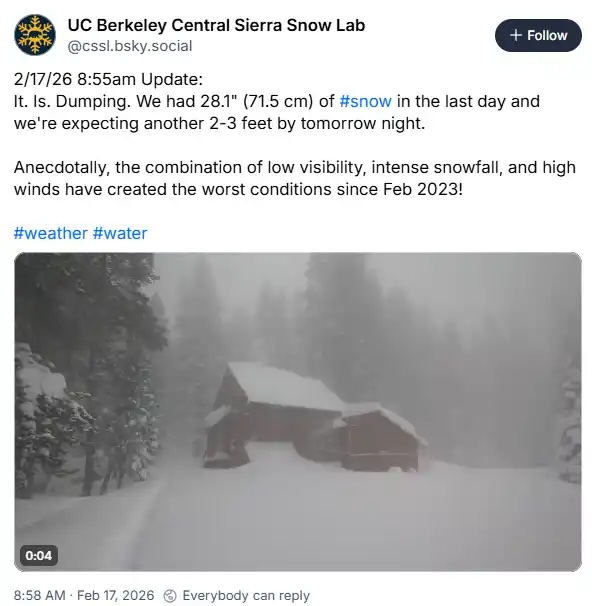
That weather created the “snow loading” situation. The human factor (poor decision-making or peer pressure) put those people in the wrong place at a dangerous time.
The causes were clearly short-term and local, not long-term global climate change.
Even within the media coverage, contradictions appear. One outlet invokes a “snow drought” while quoting a meteorology professor who stated the avalanche was “fairly typical for California’s Sierra Nevada” and not attributable to climate change.
That alone demonstrates the leap from a single event to false long-term climate attribution.
According to the Intergovernmental Panel on Climate Change (IPCC) Sixth Assessment Report (AR6), snow cover trends vary by region, with declines in some areas and substantial natural variability elsewhere.
IPCC AR6 discusses snowpack cautiously, emphasizing regional differences and observational uncertainty. It has not found that avalanches are increasing in frequency or lethality due to climate change.
Long-term western U.S. snowpack data show significant year-to-year swings rather than a simple linear decline. NOAA’s historical station records accessible through its Climate Data Online system document winters with below-average snowfall followed by winters with record accumulation. That variability predates modern greenhouse gas concentration increases and continues today.

The broader issue is the media’s reflexive pivot to claims that specific weather events are proof of climate change.
When drought strikes, it is climate change. When heavy rain falls, it’s climate change. When heavy snow falls, it is climate change. When there is little snow, it’s a “snow drought,” brought on by climate change.
This elasticity ensures every outcome reinforces the same alarming narrative, but does a disservice to science. A theory should suggest conditions that can be tested and thus at least possibly disproven, not outcomes that are contradicted by other diametrically opposed projections or outcomes.
A theory is not one based in science if it predicts multiple contradictory outcomes as possible.
The variety of headlines cataloged demonstrates something important: much of the media simply does not distinguish between atmospheric variability and long-term climate attribution. Instead, tragedy becomes narrative fuel.
Avalanches have been common throughout history in the broader region of the Western United States, long before greenhouse gas emissions began to rise, with some being much deadlier than the recent Lake Tahoe event.

Snow still falls in the Sierra Nevada. Avalanches still occur in the Sierra Nevada. They occurred in 1982. They occurred in 2017. They occur today. In fact, they occur so often that the NWS has an avalanche forecast page for the Sierra Nevada region.
Declaring each avalanche is evidence of “climate collapse,” despite avalanches being common or at least not unusual throughout history, even when temperatures were cooler and atmospheric greenhouse gas levels were lower, is not serious climate journalism.
It is agenda-driven storytelling dressed up as science. The media are doing what the media all too often do, creating scary and engaging headlines that have no basis in fact.
Perhaps this is why polls show trust in the media has fallen to new lows in recent months.
Read more at Climate Realism