


The prevailing narrative surrounding the power sector is that America’s grid is short of watts, and that we need to vastly increase our power generation capacity to avoid rolling blackouts and meet surging demand for data centers and reindustrialization. [some emphasis, links added]
Given the state of the discourse, it may be hard to believe that America has more installed electricity capacity on its grid than ever before. But it’s true.
The problem is, so much of this capacity is from unreliable wind and solar facilities that provide almost no reliability value to the grid.
We first introduced this concept in our piece, “Shocking Betrayal: Why Progressives Are Ditching Climate Laws and Dooming the Planet,“ but the implications are so significant that we concluded the graph merited a larger discussion.
“Capacity” Growth Exceeded Demand Growth
First, let’s set the stage.
The U.S. technically has more installed capacity on the U.S. grid than ever before, which has increased by 26 percent since 2004 and 12.5 percent since 2015.
Meanwhile, electricity demand has only increased by 8.5 percent and 5.6 percent, respectively, during the same timeframes.
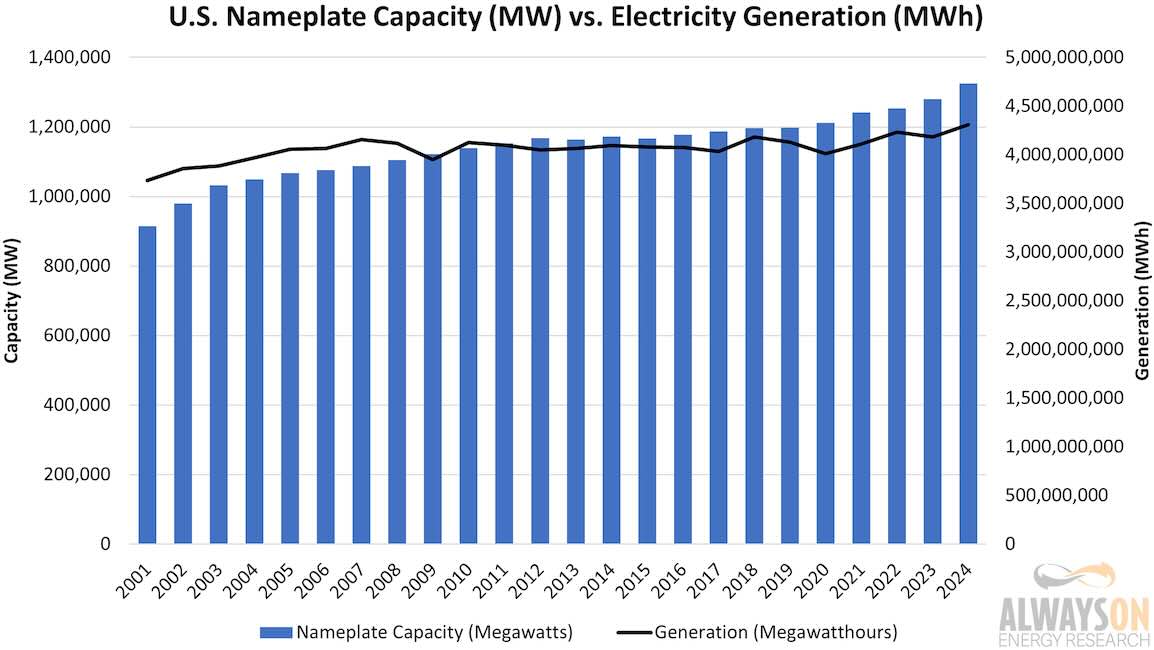
The result is that the country has more capacity (MW) per terrawatt-hour (TWh) of generation than ever before.
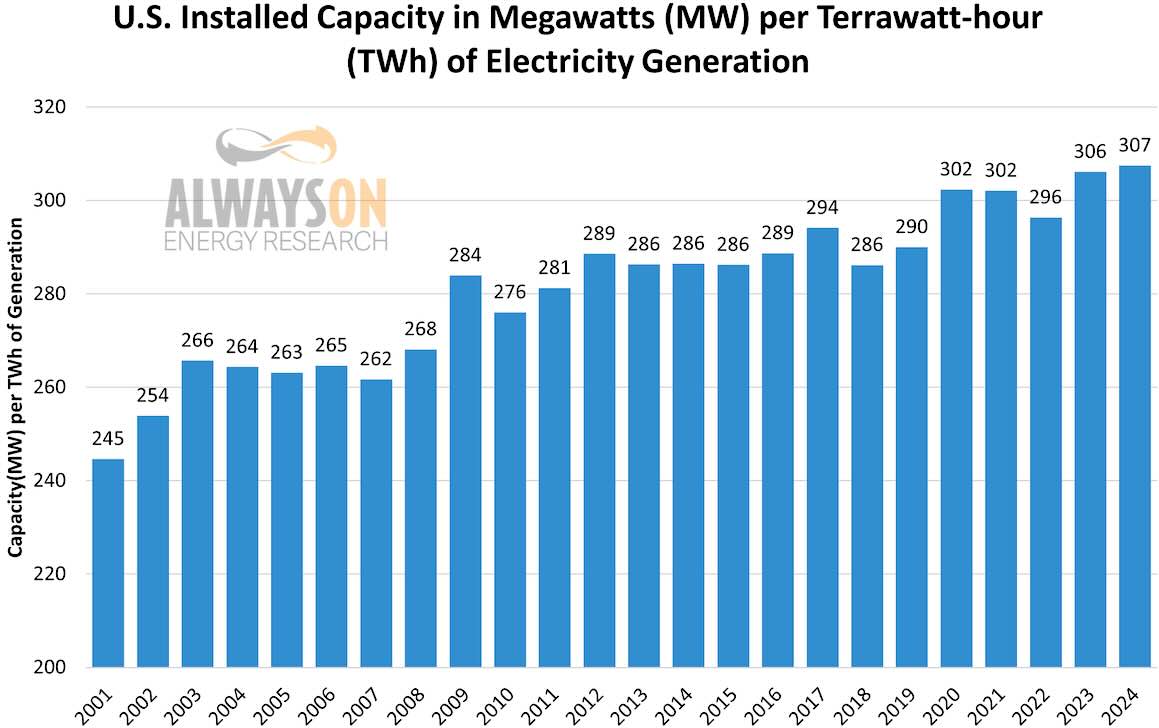
If “capacity” were the same across all resource types, this data would suggest that we should be more prepared than ever to meet growing electricity demand stemming from data centers and AI.
But we’re not. In fact, the opposite is true.
This begs the question: If the American grid has so much installed capacity on the system, why is it bracing for such severe supply shortages?
The short answer is that the capacity being built today—wind and solar—is far less reliable than the capacity it is replacing—coal and nuclear.
Capacity Doesn’t Always Equate to “Reliable” Capacity
Put simply, wind and solar capacity are not the same as dispatchable capacity due to their intermittency.
Intermittent generators are inferior to dispatchable resources for a number of reasons, but mainly because operators cannot control when they produce electricity and when they won’t.
We can forecast when they will or won’t fairly well (but not always), yet that doesn’t give us control over their production levels, similar to traditional resources like coal, natural gas, oil, and nuclear.
Not to mention, the entire point of forecasting wind and solar production is so that we can use other “backup” resources to supply demand when they aren’t able to, but this backup generation fleet is being retired more and more every year.
For example, the following chart shows that while intermittent resources like wind and solar have made up the bulk of net resource additions in recent years, firm capacity has been on the decline since 2011, except for a slight rise in 2024.
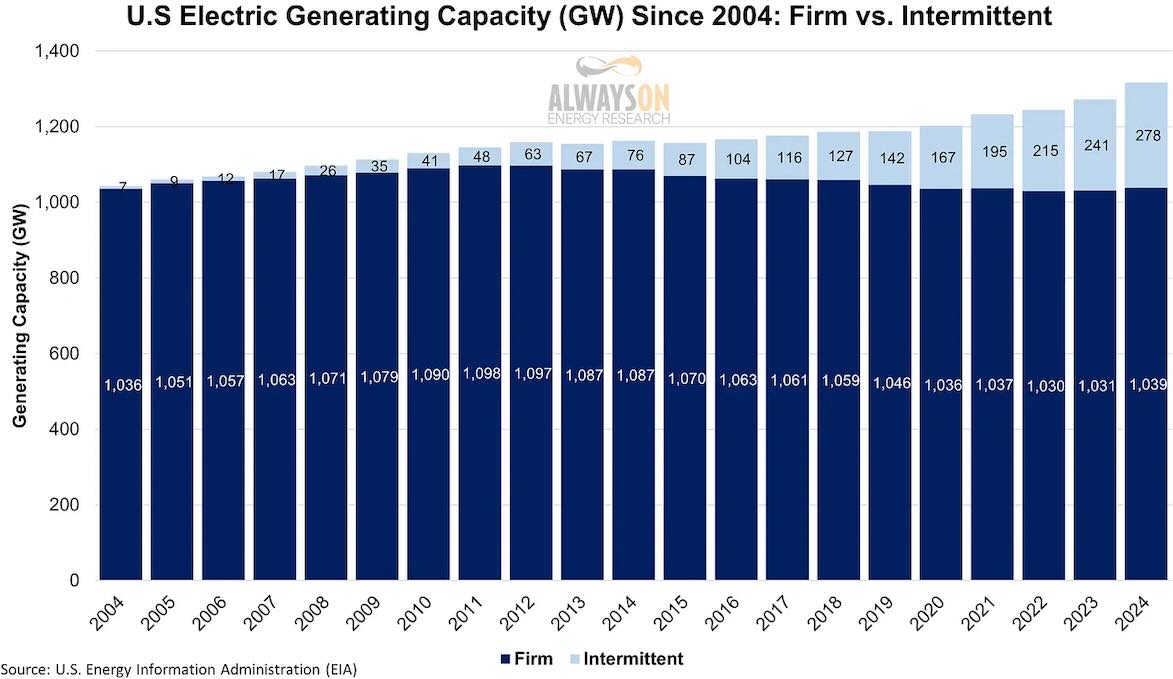
The result is that the U.S. is now at pre-2005 levels of firm capacity on the grid at a time when electricity demand is projected to have the largest increases in over a decade due to data center and AI growth and electrification efforts.
So, even though the grid as a whole has more capacity than it did 20 years ago, the growth is made up entirely of resources that may be producing no electricity whatsoever when needed the most, and the system has roughly the same levels of firm, reliable capacity online as it did in 2004.
The result of this trend is obvious: supply shortages.
And it’s happening in pretty much every regional grid in the country.
Regional Grids Show the Same Trend
The following regional charts are based on data from the Energy Information Administration (EIA) 860-monthly dataset from 2016 through 2025.
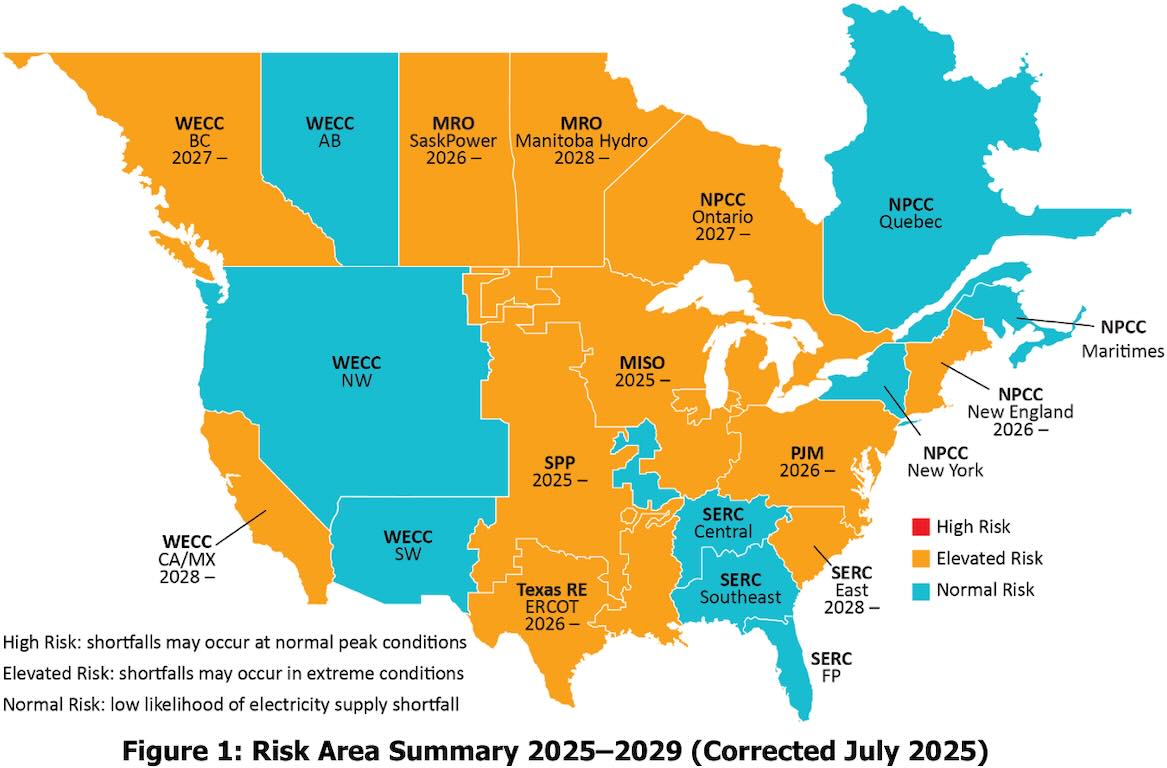
Data that includes each Regional Transmission Operator (RTO) only goes back to 2016, but the trend of diminishing dispatchable capacity can still be seen—and this is why despite every RTO having the highest installed capacity than ever before, the NERC Long-Term Reliability Assessment (LTRA) shows that many of them at elevated risks of capacity shortfalls in the near future, including PJM, MISO, SPP, New England, and ERCOT.
Read rest at Energy Talking Boys


The Energy Bad Boys are onto this.
The short story is that wind and solar have no place on the grid and they wouldn’t be there if the meteorologists had issued wind droughts or the world had noticed the work of the Australian wind watchers.
https://rafechampion.substack.com/p/rafe-champions-work-on-wind-droughts-3b8
Paul Burgess is king of the wind drought hill in Britain!
https://substack.com/home/post/p-180089713
The meteorologist knew because the first Assessment report of the IPCC recommended a survey of the wind resources of the world. They just didn’t want people to know. I wonder why? Join the dots.
The combination of wind droughts and lack of grid-scale storage guarantees that there will not be a transition to wind and solar because the ‘unreliables’ are simply not fit for purpose to power a post-industrial society.
It’s as simple as ABC.
A: The grid must have continuous input from generators to meet the demand, second by second.
B: The continuity of wind and solar input is broken at night when there is little or no wind.
C: Storage at the scale required to bridge the gaps is not feasible or affordable with current technology.
A chain is only as strong as the weakest link and nocturnal wind droughts are the weak links in the wind and solar chain. When we depend on wind and solar, wind droughts at night will turn out the lights and everything else that runs on electricity. Regardless of the amount of installed capacity.
Farmers are alert to the threat of rain droughts, but the meteorologists never issued wind drought warnings, and the wind farmers and the people who subsidise and mandate wind and solar apparently didn’t check.
And then there is the wind drought trap.
The US was only one Democrat Administration away from disastrous power failures because the country is in the jaws of the wind drought trap. It is up to the Trump Administration to get them out, and to show the way for all the other western nations where suicidal net zero policies are in place.
https://rafechampion.substack.com/p/defusing-the-wind-drought-trap-revised
Someone persuade Warren Buffett to take his money out of wind and go for data centres, co-located with coal stations for urban renewal in the rust-bucket states. Chris Wright and the President would like that.
When temperatures are very hot or very cold, the wind is often still, so there is no wind power. Yet, these are the times when power is needed the most.