We all know hurricanes are getting worse, don’t we? After all, the MSM keeps telling us so. [some emphasis, links added]
After Hurricane Melissa a few months ago, for instance, the BBC’s weathergirl, Sarah Keith-Lucas, was adamant that “The frequency of very intense hurricanes such as Melissa is increasing.”
Similar claims abound across the networks and newspapers every time a big hurricane comes along. And that’s before we even mention the fake climate attribution studies designed to make headlines.
The only problem is that the data does not agree!
Full data has now been published for hurricanes globally in 2025, and it again confirms that long-term trends remain flat, contradicting the fake news published by the media.
(Please note that scientifically, hurricanes are strictly referred to as “tropical cyclones”. However, colloquially they are referred to as hurricanes in the Atlantic, typhoons in the Pacific, and cyclones in the Indian Ocean – regardless of the name, they are the same weather phenomenon. For this article, I will refer to them all as hurricanes.)
The two charts below are published by the Dept of Atmospheric Science at Colorado State University. The first shows the number of hurricanes by year, and the second shows the major hurricanes – the most powerful ones categorised as Category 3, 4, or 5 on the Saffir-Simpson scale.
Data begins in 1980, which is generally regarded as marking the beginning of comprehensive, worldwide satellite coverage.
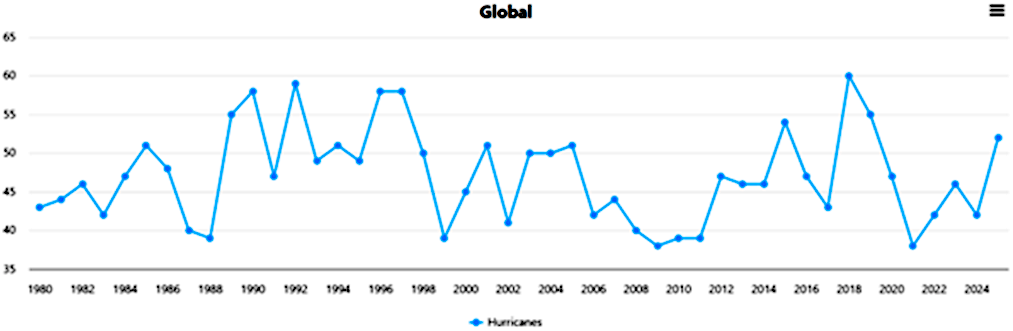
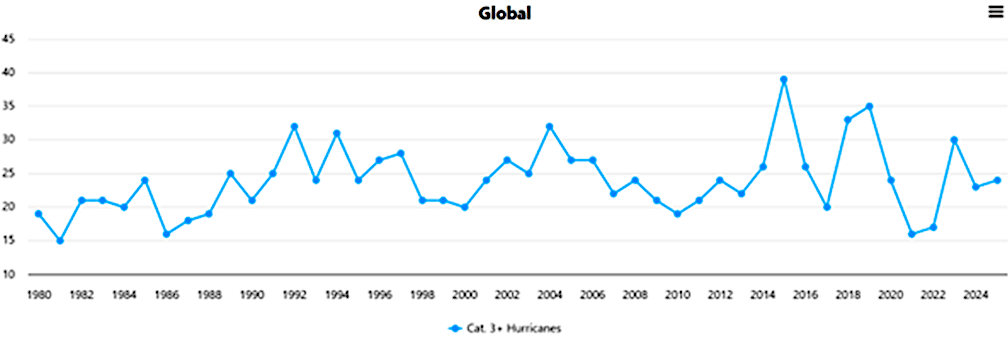
Total hurricanes numbered 52 last year, against the 30-year average of 47. Major hurricanes totalled 24, just below the average of 25.
There is no evidence of long-term increasing trends in either dataset.
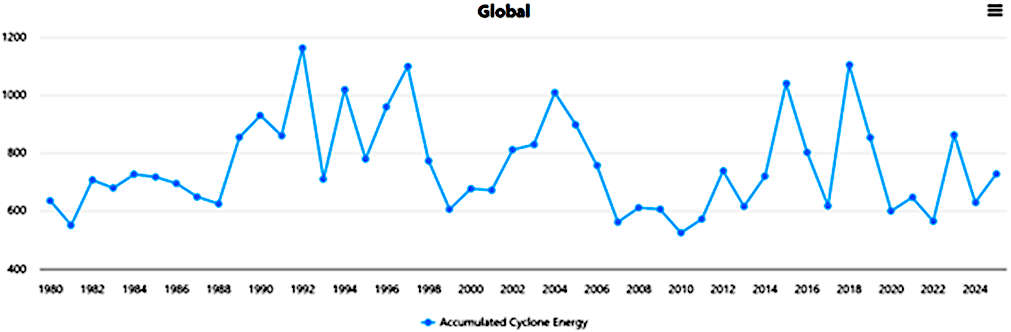
Hurricane scientists also monitor Accumulated Cyclone Energy, or ACE – this measures a combination of wind speeds and duration. So, a Cat 5 storm will likely have a high ACE, but so would a weak one that had been meandering the Atlantic for a week or two.
Again, as with the first two graphs, there is no increasing trend in ACE.
Inevitably, many more hurricanes are observed and counted nowadays than in earlier decades, simply because we have satellites to monitor them. Before 1980, many hurricanes stayed in the mid-ocean and were consequently never spotted.
There is, however, a robust database for hurricanes that have hit the U.S., going back to the late 19th century.
This data confirms that the absence of any worsening trend in hurricanes, whether frequency or intensity, goes as far back as the 1800s.
According to the US Federal climate agency, NOAA:
“There is no strong evidence of century-scale increasing trends in U.S. landfalling hurricanes or major hurricanes. Similarly for Atlantic basin-wide hurricane frequency (after adjusting for changing observing capabilities over time), there is not strong evidence for an increase since the late 1800s in hurricanes, major hurricanes, or the proportion of hurricanes that reach major hurricane intensity.”
Source: https://www.gfdl.noaa.gov/global-warming-and-hurricanes/
The lack of meaningful trends is apparent in the two graphs below:


Source: https://www.aoml.noaa.gov/hrd/hurdat/All_U.S._Hurricanes.html
Source: https://rammb-data.cira.colostate.edu/tc_realtime/season.asp?storm_season=2025
But the media are not interested in facts and hard data, or what the actual hurricane scientists say. They prefer propaganda.
Read more at Not A Lot Of People Know That