


The 2009 Endangerment Finding treated carbon dioxide as a pollutant that threatens public health and welfare. For more than a decade, that designation has functioned as the legal foundation for regulating fossil fuels, electricity generation, transportation, and much of the modern economy. [some emphasis, links added]
Now that the Finding is being reconsidered, it is worth stepping back from the regulatory framework and asking a much more basic scientific question.
What is the correct atmospheric concentration of CO2?
If carbon dioxide is truly a pollutant, then there must be a threshold. There must be some identifiable boundary at which CO2 shifts from being part of the natural carbon cycle to being harmful in a biological or climatic sense.
If such a boundary exists, it should be visible in geology, in plant physiology, or in the empirical record of Earth’s climate.
But when we begin to examine those lines of evidence, the clarity we are promised does not appear.
Deep Time Does Not Cooperate
In The Endangerment Finding Was Pre-Cooked, I walked through the Phanerozoic reconstruction of atmospheric CO2.
Over the last 550 million years, concentrations frequently exceeded 1,000 parts per million (ppm) and at times reached several thousand.

Life did not collapse under those conditions. On the contrary, biodiversity expanded. Forests flourished. Marine ecosystems diversified.
The idea that 400 ppm constitutes dirty air sits uneasily beside a geological record in which far higher concentrations coincided with biological abundance.
If today’s atmosphere is “endangering,” then vast stretches of Earth’s history would need to be reclassified as ecologically reckless. That conclusion should at least give us pause.
In Does More CO2 = More Heat?, I also explored the complex relationship between CO2 and temperature over deep time.
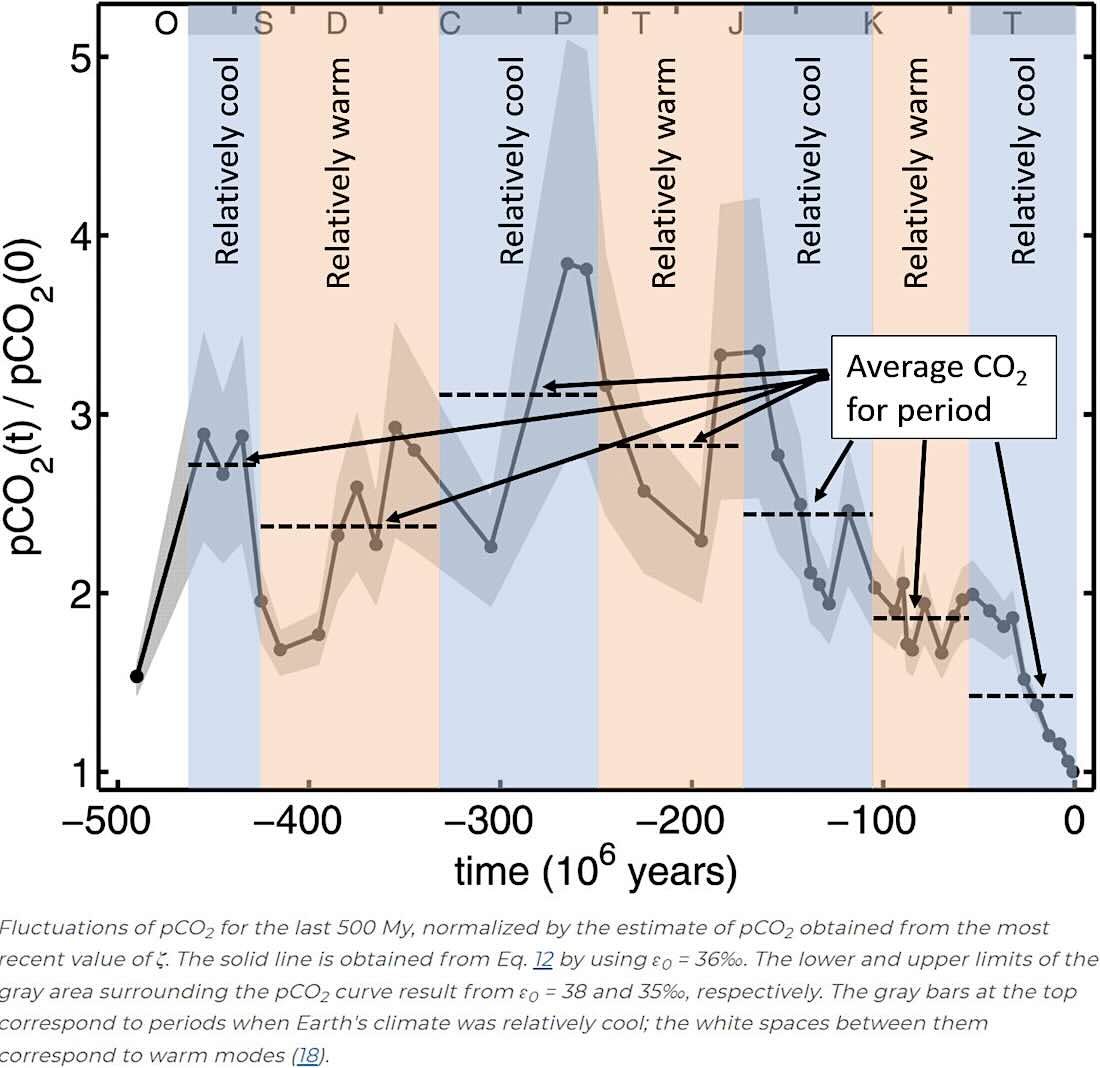
The geological record does not display a simple linear mapping between atmospheric concentration and climate state.
Continental configuration, ocean circulation, solar luminosity, volcanic outgassing, and feedback processes all shape global temperature. CO2 plays a role, but it is not the only control knob.
If there is an upper danger threshold, it is not obvious in deep time.
The Ice Age Constraint
The more recent record complicates things further.
In Atmospheric CO2 Concentrations of the Past and Do We Really Know the Surface Temperature or CO2 Concentration of the Past?, I discussed the proxy records and their limitations.
Even accepting the ice core framework at face value, atmospheric CO2 over the past 800,000 years fluctuated between roughly 180 and 300 ppm.
Those low points coincided with massive continental ice sheets. Glacial maxima were not periods of ecological flourishing. They were periods of climatic severity and instability.

Preindustrial levels near 280 ppm did not represent a golden age of climatic balance. They were part of a cycle of repeated glaciations driven by orbital forcing. The Earth system oscillated between ice ages lasting nearly 100,000 years and comparatively brief interglacials.
That history raises an uncomfortable possibility.
Perhaps 280 ppm was not an optimal equilibrium. Perhaps it was closer to a lower boundary of climatic stability.
The Modern Biosphere Response
Meanwhile, as CO2 rose from roughly 280 ppm to more than 420 ppm, something measurable occurred.
In Greening Earth and Booming Crops, I examined satellite evidence showing widespread increases in global leaf area.
Agricultural production has expanded dramatically over the past several decades. Water use efficiency has improved under elevated CO2 conditions.

Commercial greenhouse operators routinely enrich indoor air to concentrations between 800 and 1,000 ppm to maximize plant growth. They do not regard 280 ppm as biologically ideal.
CO2 is not a trace contaminant in plant physiology. It is the fundamental substrate of photosynthesis.
If rising CO2 were inherently degrading the biosphere, we would not expect to observe widespread greening.
The Sea Level Complication
Perhaps, then, the danger lies in the sea level.
That argument is often presented as straightforward. Higher CO2 increases radiative forcing. Higher temperatures melt ice. Melting ice raises the sea level.
But in Sea Levels Were Significantly Higher in the Mid to Late Holocene at PreIndustrial Levels of CO2, I reviewed multiple peer-reviewed reconstructions showing that regional sea levels during the mid- to late-Holocene were, in many places, higher than today. These highstands occurred while atmospheric CO2 remained near 260 to 280 ppm.
Evidence from the Arabian Gulf, the southwestern Atlantic, and the southeast Australian coast indicates elevated sea levels under what we now describe as safe preindustrial concentrations.
This does not mean CO2 has no climatic influence. It does mean that sea level does not map cleanly or uniquely onto atmospheric concentration. Glacio-isostatic adjustment, meltwater redistribution, and regional dynamics complicate the picture.
Once again, the boundary between safe and dangerous becomes difficult to identify.
Irrational Fear is written by climatologist Dr. Matthew Wielicki and is reader-supported. If you value what you have read here and would like to explore this and more analysis in depth, please subscribe and support the work that goes into it.
Read rest at Irrational Fear



According to the EPA, the maximum safe level of carbon dioxide for continuous exposure is 5,000 ppm. In addition, carbon dioxide concentrations are not a major driver for warming. See Terry Mains’s comment at https://climatechangedispatch.com/co2-data-challenges-warming-narrative/#respond
One possible answer for what is the ideal for earth is what is best for plants. Many green house operators supplement the carbon dioxide to 1,600 ppm, higher than mentioned in the article. The ideal for the plants is actually around 1,800, but higher than 1,600 runs into diminishing returns as far as cost. Angiosperms, most modern plants, evolved when carbon dioxide was at these higher levels. It is something to think about, but nothing that we can do anything about. Even if mankind tried, we couldn’t reach these higher levels.
I served in the US Navy’s submarine force as a reactor operator for several years. To maintain our climate to a livable level we had an O2 generator (using electricity we separated pure H2O into O2 and H2, bubbling the hydrogen overboard), CO burner that operated similar to our car catalytic converters that would convert 2CO and O2 into 2CO2. Finally we had a CO2 scrubber to remove excess levels from our atmosphere, bubbling it overboard. Our CO2 levels were around 2,000ppm without any health issues.
C3 food plants about 2/3 of calories and C4 food plants about 1/3 of calories
C3 plants can use up to 1300 PPM CO2
C4 plants will not benefit as much but will not be harmed by 1300 PPM
CO2 increase in the atmosphere is a minor factor for the increase in crop yields since 1960
the 110 PPM increase of atmospheric CO2 since 1960 probably increased the average food plant growth by about 10% to 15%
i have read over 200 CO2 enrichment plant growth studies since 1997 and i doubt if the author has read any
Thank you so much. I never for a moment believed the great CO2 lie.
In case you are worried about warming and CO2 emissions, just read a good book or two and relax!
https://www.amazon.com.au/s?k=Rafe+Champion&i=stripbooks&crid=GZ66NWUYZ193&sprefix=rafe+champion%2Cstripbooks%2C262&ref=nb_sb_noss
Warming, since the Little Ice Age has been unequivocally beneficial and we are still a degree or three short of the Roman Warm Period. That was the best time for living things in recorded history.
I suggest three or four times the current level will suit the plants.
Some local greenhouse growers boost by a factor of 2 or 3 because beyond that the supply of other nutrients in the brew become a limiting factor and there are diminishing returns.
no period in the past 5000 years was warmer than the average in the past 10 years and possibly not in the past 10,000 years
your claim about the roman warm period is science fiction not supported by any data even rough proxies
No Greene, your claim is specious and science fiction.
The Holocene Optimum was several degrees warmer than now and every warm period since then has been cooler, describing a linear downward trend. This is not specious but real fact. You are wrong.
I’m assuming you meant this as a reply to Greene and not me since my only comment was that Greene’s arguments are specious and not based on science although he was talking about the Roman Warming Period which was warmer than today’s temperatures.
There’s at least one university level anthropology textbook that mentions that during the Holocene Optimum there were probably areas of north America that were uninhabitable. Too darn hot.
The elites pushing the idea that increasing CO2 is causing a climate crisis are looking to control our lives more. And then they have the useful idiots out on the streets protesting with signs like “The Earth Is On Fire” and similar ignorant messages.
Where is the laboratory evidence that CO2 traps heat to any extent at all ? CERES satellite data show that the average surface temperature is entirely governed by solar irradiance and albedo. Which means CO2 does not trap anything. See Nikolov & Zeller 2024.
that is not what the CERES scientists say and albedo changes could not be the cause of the majority of warming which is at night