


Whatever happened to the climate crisis?
In 2021, Bill Gates was warning that the equator would become unlivable as he promoted his book, “How to Avoid A Climate Disaster.” In October, he effectively said, Never mind. “Climate change won’t wipe out civilization,” he wrote. [emphasis, links added]
Former United Nations Special Envoy for Climate Action and Finance Mark Carney became Canada’s prime minister this year and promptly scrapped Canada’s consumer carbon tax. He has just announced a major new pipeline project.
Democratic billionaire Tom Steyer built a presidential run in 2020 around climate. Now running for governor of California, the word appears nowhere in his launch video.
Why have climate alarmists suddenly gone quiet? The science and economics haven’t really changed: carbon emissions are still rising, and the climate is still warming.
What’s changed is the politics. Climate warriors persuaded the public to take climate change seriously, but not to pay for it, especially after the cost of living shot up in the wake of the pandemic and Russia’s invasion of Ukraine.
The share of respondents calling climate and the environment their most important issue has dropped from 14% in early 2020 to 6% now, according to YouGov. By contrast, 25% describe inflation that way.
In short, the climate crisis clashed with the affordability crisis, and affordability won.
How much of a difference does this shift in political winds make to the future of the climate? Less than you might think. It makes policies to mitigate climate change harder to implement, though many, such as a carbon tax, were probably never going to happen anyway.
However, emissions are likely to head lower regardless, thanks to the falling cost of low-to-zero-emissions energy and storage.
Indeed, the retreat of climate catastrophism has made room for a less strident but more sustainable climate realism, focused on innovation and the commercialization of low-carbon technologies.
The scientists and economists who study climate change have long agreed that carbon dioxide (CO2) emissions from human activity are leading to rising temperatures that, in time, would hurt the economy via sea level rise and increased frequency of some forms of extreme weather, such as [regional] drought.
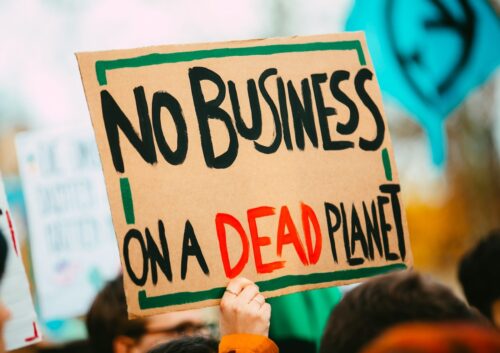
But climate advocates routinely went further than these carefully researched findings could support. They cast global warming as a doomsday machine that required an immediate, whole-of-society response.
With the end of the Cold War, global warming became the “great global multilateral project,” said Ted Nordhaus, founder of the Breakthrough Institute, which promotes technological solutions to environmental problems.
It’s no coincidence the movement peaked toward the end of President Trump’s first term. “Climate catastrophism is tied up in the liberal internationalist reaction to Trump and the rise of the populist right,” Nordhaus said.
Prodded by the likes of teenage Swedish climate evangelist Greta Thunberg, the global corporate establishment began prioritizing climate as well.
“Climate risk is investment risk,” Larry Fink, chief of BlackRock, the world’s largest asset manager, declared in 2020. BlackRock is “making sustainability integral to portfolio construction and risk management.”
Running for president that year, Joe Biden did not adopt the progressives’ Green New Deal, but he did adopt their framing.

Days after taking office, he signed an executive order declaring: “There is little time left to avoid setting the world on a dangerous, potentially catastrophic, climate trajectory.”
Biden officials implicated climate in everything from racial inequality to civil strife in Syria and Yemen. Democrats pressured financial regulators to discourage lending to the fossil-fuel industry.
But the public mood was shifting. In 2021-22, as the economy reopened from Covid lockdowns, and then Russia invaded Ukraine, inflation shot up, led by energy. Inflation and energy security became the public’s and politicians’ priorities.
Corporate America had already sensed the shift in the political winds when Trump was re-elected last fall. In a letter to investors in March, BlackRock’s Fink wrote: “Prosperity is once again defined by our ability—and our willingness—to produce and consume more energy.” He did not mention climate.
Trump and Republicans in Congress have since diluted or repealed rules and subsidies designed to curb fossil fuel emissions and promote renewable energy. Earlier this month, Trump rolled back stringent fuel economy standards enacted by Biden, claiming this would make new cars more affordable.
At first glance, this looks like a disaster for the climate cause. Researchers at Rhodium Group estimate U.S. emissions will be roughly 10% higher than otherwise as a result of these changes.
On the other hand, the move returns the U.S. roughly to the path it was on before Biden’s Inflation Reduction Act.
Emissions will keep falling, though more slowly. In fact, Roger Pielke, a longtime climate scholar at the American Enterprise Institute, notes U.S. emissions have been remarkably impervious to presidential terms: relative to economic output, they have declined steadily for decades.
The reason is that policy shifts often take years to bear fruit, and they are often overwhelmed by other factors. Natural gas from shale hastened the demise of coal, and China’s solar manufacturing build-out slashed the cost of panels.
As for the climate itself, the United Nations Intergovernmental Panel on Climate Change (IPCC) hasn’t changed its projections much, but the uncertainty around them has narrowed.
Signatories to the Paris Agreement in 2015 aspired to hold the rise in temperatures to 1.5 degrees Celsius above preindustrial levels. What was aspirational then is virtually impossible now.
Read rest at WSJ


Just remember that posted signs at Glacier National Park back in 2010 that the glaciers would ne gone in 10 years and in 2020 the signs were removed because Glaciers don’t abide by the mindless nonsense from Eco-Freaks and Politicians