

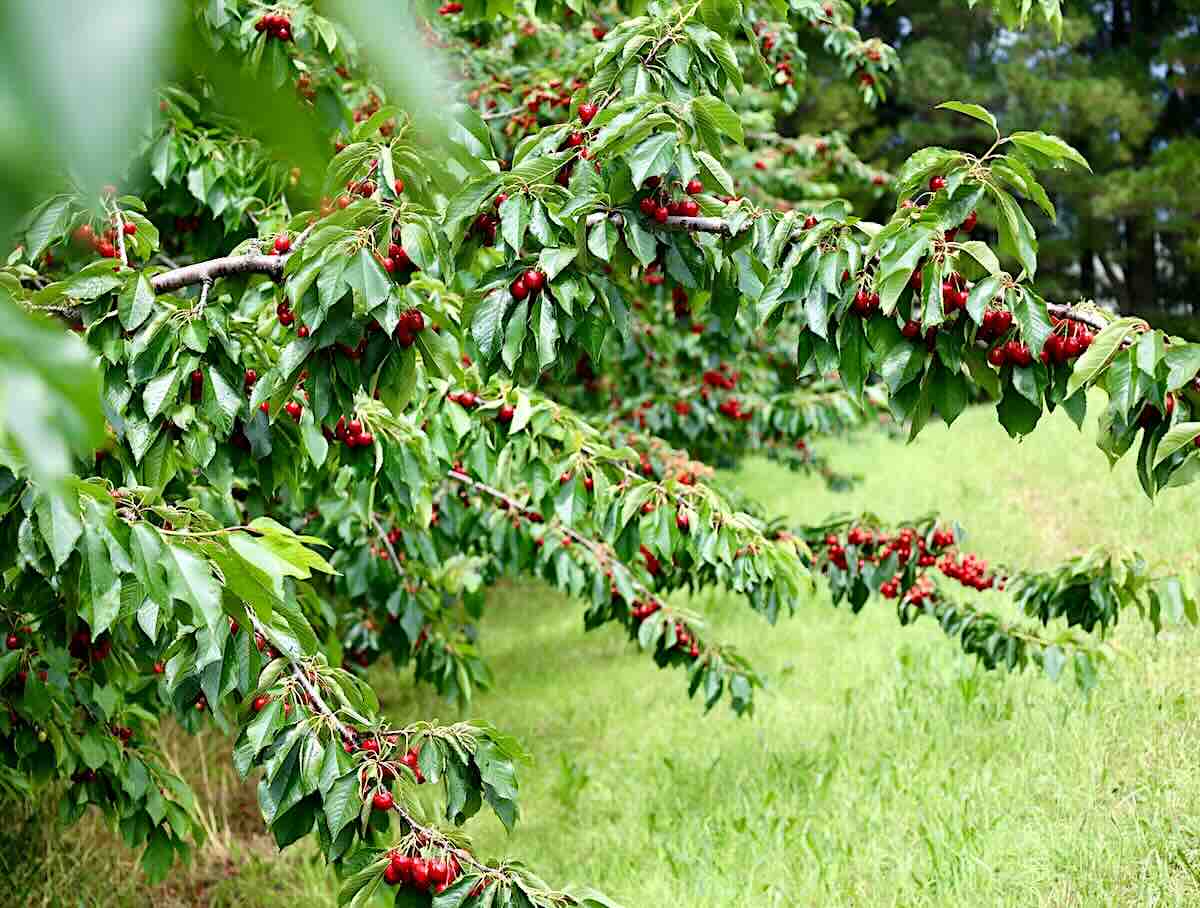
The Cool Down (TCD) claimed in a recent article, “Supply of popular fruit plummets as severe storms devastate crops: ‘On course for its worst season,’” that Argentine cherry crops are being devastated by severe rain and hailstorms due to climate change. [some emphasis, links added]
This is mostly false.
While it’s true that a recent season of cherries was ruined by bad weather, there is no evidence that a single year of bad weather is a sign of climate change.
There is no long term trend of worsening weather in Argentina, and cherry production there over the past three decades has risen considerably.
TCD claimed that cherry growers in Argentina are having a bad season, “with severe rain and hailstorms” that TCD classifies as a “change in climate.”
Of course, a single season of bad weather is not climate change. Climate is measured over a long period of time, so one year of severe storms and hail cannot be indicative alone of effects from climate change.
TCD says that “frequent extreme weather events, which have been increasing, damage agricultural yields.”
There is no easily accessible data about severe downpours in Argentina and their trends, which are likely different depending on the region of the country.

It’s important to note that Argentina has everything from ice and penguins to tropical rainforest to mountain deserts, and natural climate change will impact regions differently.
But the World Bank does collect average annual rainfall data for Argentina, which shows that precipitation varies from year to year, and rose gradually through the 1970s and early 2000s, before beginning to decline again afterwards. (See figure 1 below)

The World Bank says that annual fluctuations in rainfall in Argentina are driven largely by the El Niño Southern Oscillation (ENSO) pattern in the Pacific Ocean, which is a natural phenomenon.
During the 2025 growing season, there were El Niño conditions present, which generally cause an increase in heavy rainfall in most parts of Argentina, especially in the spring.
So, existing data undercuts TCD’s assertion that weather extremes are increasing in Argentina.
However, the next best data to look at to determine whether climate change is destroying Argentina’s cherry industry is cherry production yields.
According to data from the United Nations Food and Agriculture Organization, Argentina has seen a fairly steady increase in cherry production over nearly the entire period during which human-caused climate change is said to have occurred.
As evidence, from 1990 to 2024, the last year for which the FAO reports data, Argentine cherry production increased by approximately 37 percent. (See figure 2 below)

Argentina’s all-time production high was set in 2010, with 2024 coming in second for the highest cherry production on record.
TCD doesn’t seem to understand what farmers throughout time have known: weather is fickle, with floods and droughts all too common. Nothing has changed in this regard.
A single bad harvest is not evidence of climate change; only a long-term trend in worsening weather and falling production might indicate climate change is causing harm, but such trends don’t exist.
TCD is an environmental advocacy website, billing itself as “America’s mainstream climate brand.” Thus, it should come as no surprise that every bad weather story is being used to prop up a climate alarmist perspective.
There is no evidence that climate change is harming Argentina’s cherry industry; that’s an inconvenient truth that TCD evidently can’t handle.
Read more at Climate Realism



We have a few fruit trees at our place, southern NSW Australia and every year, the crop results are different. On average, we have a good crop every 3 – 4th year. Growing fruit is hard. There are the birds. Bugs that fly in. Bugs that come out of the soil. Too much rain. Not enough rain. Too much cloud – not enough sun to rippen the fruit. This year, I think we are going to give up on trying to grow fruit. All the effort that I put in, money spent on various materials vs what we get out of it – it just ain’t worth it. We’ll buy from the supermarket from next season.
Here along the Front Range of Colorado it isn’t worth trying to have most types of fruit trees due to very good chances of a snow or at least a freeze after most of the trees have blossomed. Fruit trees in Colorado mostly come from the west slopes around Grand Junction where they don’t have the late freezes/snows. And the temps are hotter that the fruit seems to like. Their peaches and plums are delicious!
I have an apple orchard in Oregon at an altitude of 4,100 feet. If frost hits at the wrong time, there is no fruit. Without frost, there is a bumper crop. One way climate does impact crops in some areas is with frost. Warmer climate means less frost.
The Cool Down Scam Artists their sounding a lot like the Save the Rain Forests Scam Artists back in the 1990s their typical way they can get the typical suckers to donate to them