TIME Magazine recently posted an article titled “New Study Finds Air Conditioners Will Exacerbate Climate Change As Planet Warms,” claiming that expanding air conditioner use will harm the planet by increasing warming, and that people should “transition” away from refrigerants and use less AC. [some emphasis, links added]
This is nonsense. Even according to their own models, massive expansions in AC use would only result in marginal temperature change. By contrast, modern air conditioning has been demonstrated to save thousands of lives each year.
The article references a study published in Nature Communications, written by scientists from the Beijing Institute of Technology, a Chinese Communist Party (CCP) founded and run university.
Their study used “a combination of climate science, energy modelling, and inequality analysis to map out future scenarios ranging from strong climate action to high emissions.”
Their results were that as air conditioning use expands, it will add more to greenhouse gas emissions and contribute an additional 0.015°C to 0.05°C by 2050.
The study’s lead author warns that “if all low‑income regions gained the same access to air-conditioning as rich regions, related global emissions would jump dramatically—adding up to 0.05°C extra warming even in the most climate‑friendly scenario.”
The authors clarified that “air conditioning is not the solution to rising temperatures” while noting that “low-income countries cannot be left behind when it comes to keeping cool in a warming world.”
The scientists recommend that people transition “away from traditional refrigerants,” as well as prioritize “decarbonizing power grids, and prioritizing other adaptive measures, like better insulation and shading. And people will need to learn to change their behaviors—avoiding using AC during peak hours, and turning the air conditioning down.”

One should be extremely skeptical when CCP-affiliated researchers promote studies that recommend other countries “decarbonize,” as China currently maintains a near-total monopoly on green technology and is increasing its fossil fuel use.
China is fond of telling other countries to decarbonize while also building up its own coal-powered infrastructure.
The scientists predict a positive feedback loop of warming: warming causes increased AC use, which causes more emissions, which causes more warming, which causes more AC use, and so on.
However, the study says that “income-driven AC growth adds 14–146 GtCO2eq and a further 0.003–0.05 °C of warming by 2050, even under SSP119.” SSP119 is a low-end emissions model scenario.
But notice those numbers: 0.003-0.05 °C extra over the next 24 years, with a lot of assumptions built into them. Those values are also the average global temperature change.
No one is going to feel that small a change, and no weather dynamics are going to be impacted by that minor variance.
These are not new claims. The United Nations has been saying for years that AC use makes climate change worse, as every human activity apparently does. Our World in Data estimates that all AC use contributes just 3 percent of total greenhouse gas emissions.
Eliminating all AC use would have no noticeable impact on warming.
For example, during the COVID-19 pandemic, global emissions dropped more sharply in 2020, and it doesn’t even appear on the carbon dioxide (CO2) measurement station data at Mauna Loa. (See figure below)
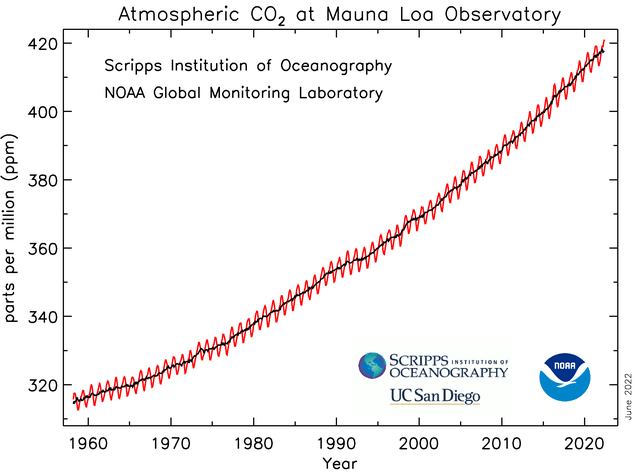
Cutting AC will have even less impact.
There is no evidence that human emissions are causing any dangerous runaway warming or that eliminating emissions from various economic sectors has impacted warming trends over the past few decades.
The paper recommends that governments adopt dynamic pricing on electricity in wealthy countries to discourage people from running AC during peak daytime hours, which is an attack on consumer choice and safety.
Since the researchers involved in the article are tied to the CCP, it is interesting to note that the government buildings they work in are fully air-conditioned, as are the homes and offices of CCP leadership.
In addition, China’s air conditioning use has grown massively over the past decade. From 2010 to 2020, annual AC sales nearly doubled to 100 million units.
By 2024, China’s stock of residential ACs continued to grow rapidly, doubling the per-household average over the previous decade, with cooling now estimated to account for 15 percent of electricity demand.
In China, air conditioning is common in urban areas and cities, but remains relatively rare in rural areas. Perhaps this article is an attempt to tamp down the hopes of rural Chinese, a suggestion that they forego adopting air conditioning for patriotic reasons to help the CCP fight climate change. If so, it is the height of hypocrisy on behalf of the CCP.
Studies published in the Journal of the American Medical Association’s Internal Medicine and by the International Energy Agency (IEA) show that air conditioning saves tens of thousands of lives each year and serves an even greater role in preventing unnecessary premature deaths if the world continues warming in the future.

During normal summer heat and even more so during periodic heatwaves in countries that naturally experience high temperatures, the widespread adoption of air conditioning use is rapidly becoming the most effective life-saving measure.
“Lack of access to indoor cooling puts much of the global population at high risk for heat stress, adversely affecting thermal comfort, labour productivity, and human health,” says the IEA report.
“[A]ccess to effective cooling has saved tens of thousands of lives … the average annual number of heat-related deaths averted by AC increased 3-fold, reaching an estimated 190 000 lives saved per year during 2019-2021.”
Accordingly, any effort to limit the expansion of air conditioning use is logically going to lead to more sickness and probably death, especially in vulnerable populations like the elderly.
As mentioned in the introduction, misplaced fearmongering concerning the minuscule role of AC in climate change could lead to real-world harms if governments take these scientists seriously.
Limiting air conditioning use will result in more people suffering from heat-related illness and discomfort.
No one should listen to Beijing. China has a vested interest in promoting the so-called “green” technologies that it monopolizes, even as wealthy Chinese urban elites and government officials have air conditioning in their offices and homes.
TIME should stand with the people in need of air conditioning and vet their reporting better, rather than becoming a shill for propaganda from the CCP.
Top: People swelter under an intense city heatwave. Access to air conditioning prevents thousands of heat-related deaths each year.
Read more at Climate Realism