A recent article at Climate Change News discussing this week’s 2026 World Economic Forum (WEF) meeting at the Davos, Switzerland, ski resort worries that climate change is no longer such a high priority for the attending global elites, while also attempting to reassure readers that the topic hasn’t disappeared entirely. [some emphasis, links added]
Climate change is indeed dropping on the list of elites’ concerns, but that is not a bad thing, although the attendees’ concerns are still wildly out of step with the concerns of ordinary people who are impacted the most by the policies discussed and pushed at Davos.
The article, titled “Ahead of Davos, climate drops down global elite’s list of pressing concerns,” was written before the Davos event kicked off Monday, January 19, and focuses on a survey conducted by the WEF’s Global Risks Perception Survey of “experts” and leaders in advance of the meeting.
This year, the survey found that for the first time in years, “climate change, pollution, and biodiversity loss have dropped down an international ranking of short-term concerns for high-profile business leaders, academics, and politicians,” as priorities shifted towards more concern over “economic risks like geoeconomic confrontation, economic downturn, inflation, and asset bubbles bursting.” (See the graph, below, from the WEF).

Considering the organization is the World Economic Forum, this shift should never have been necessary in the first place, as economic troubles should have always remained a top priority for these elites.
Economics are consistently a concern for everyday people, after all, with climate change in particular generally ranking very low.
Polling in the United States and Europe shows that climate policies that would impact economic opportunity, like carbon taxes and banning combustion engine vehicles, among others, are broadly unpopular, and that other concerns rank higher.
Ipsos, a market research company that the WEF itself frequently looks to, reports in its annual “What Worries the World?” survey that climate change barely makes the top ten issues most people in the world are concerned about. (see the graph, below)
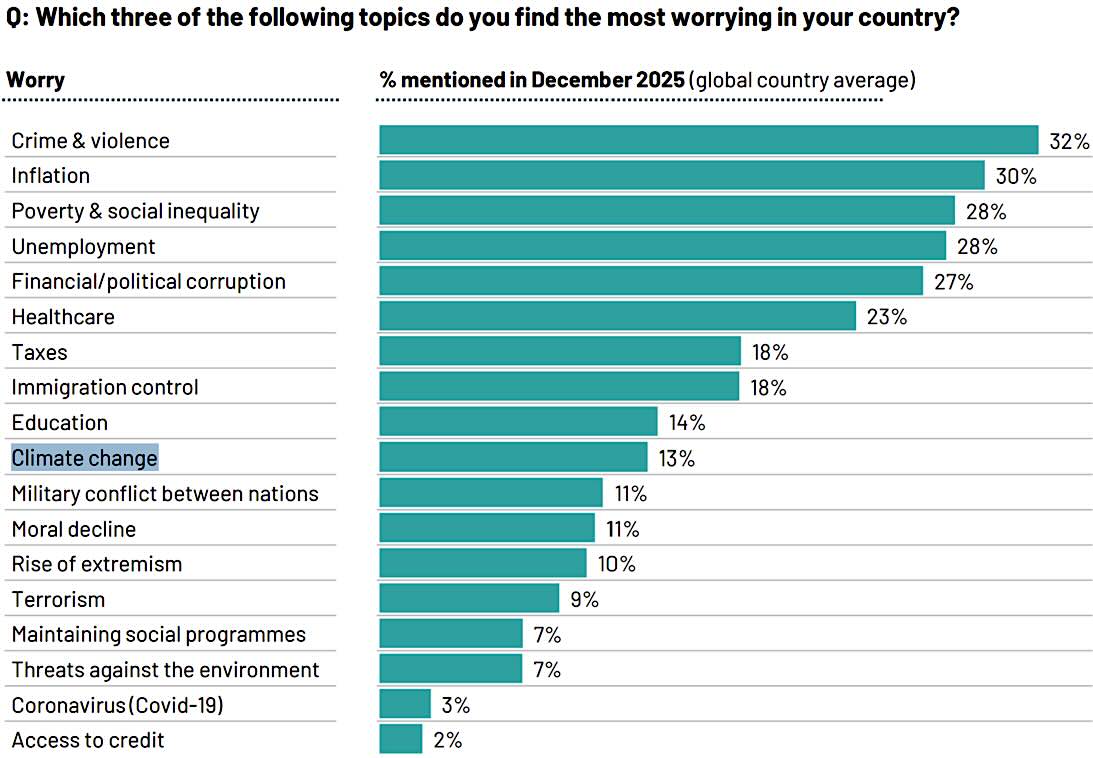
Crime and violence are number one, and even immigration ranks above climate change.
By contrast, neither of those issues, nor others that average folks said they were more concerned about than climate change, like education and poverty, made the top ten concerns at the Davos survey, unless you count the nebulous “social polarization” category:
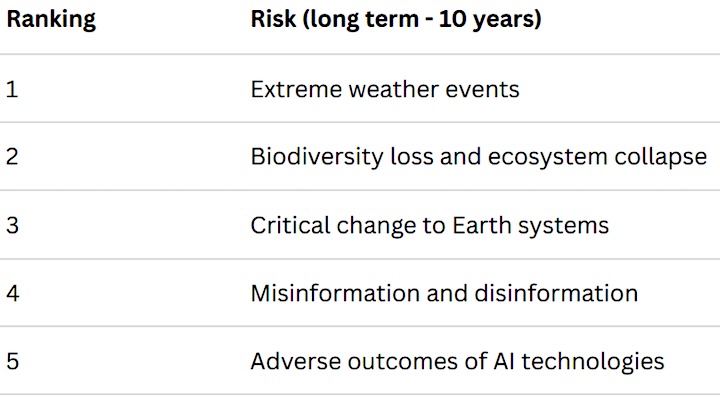
In surveys specifically about environmental issues, pollution is one of the top environmental concerns for the average person, yet it ranks lowest for Davos attendees, while climate-related issues are the elites’ top concern, an exact reversal of the common man’s priorities.
Johan Rockström, the director of the climate alarmist Potsdam Institute for Climate Impact Research (PIK), assured readers that “priorities shift, but it doesn’t mean that they’re not interconnected” and that “to reduce inequality also means providing energy in the cheapest way possible – and that’s with renewables.”
This is false, but it is a common claim from renewables peddlers and climate alarmists. If renewables like wind and solar were so cheap, they would not need to be propped up by government subsidies and special aid from global banks.
In addition, if they were so cheap, energy prices in places that have invested in renewables the heaviest would not be higher, and rising faster, than in states and countries that still rely primarily on traditional sources of electric power, like coal, hydropower, natural gas, and nuclear.
Rockström may be talking about biomass, which is often classified as a renewable, but burning wood and animal dung for cooking fuel and energy is not a positive in most of the world.

In fact, data show that fossil fuels are the cheapest energy sources, even with government subsidies giving wind and solar a leg up. Cheapest of all is natural gas, and these resources are also the most reliable, able to work in conditions where wind and solar fail.
This article and the poll underlying it reinforce the fact that global elites really are disconnected from the concerns of the rest of us—and reality.
Scientific data show that climate change is not an existential threat, not to humanity and not to the planet, which even fellow-elite Bill Gates recently affirmed.
Climate Change News and the WEF should get with the program and realize that their concerns do not reflect the needs of the people they are supposed to represent.
These business leaders and politicians have an outsized power over the rest of us, and it is worrying that their priorities have long been and remain so out of step with the needs and priorities of the vast bulk of the human population.
Read more at Climate Realism