There is a point where science stops asking questions and starts issuing commands. We are there. [some emphasis, links added]
A Canadian startup now claims it can suppress lightning to prevent wildfires. The logic is simple and increasingly familiar.
Lightning ignites fires. Fires release carbon dioxide. Carbon dioxide contributes to climate change. Therefore, lightning itself has become a problem to solve.
But that conclusion only makes sense if you accept a much deeper assumption.
That natural systems are errors.
And that we are capable of correcting them.
The Real Shift No One Is Talking About
This is not about lightning.
It is about a fundamental shift in how nature is being framed.
Natural processes are no longer something to understand. They are something to control.

Fire is no longer an ecological process. It is an emissions source. Lightning is no longer atmospheric physics. It is a liability. Even biological systems are now being reconsidered through the lens of optimization.
Once you accept that framework, there is no limit to what becomes a target.
A System That Was Never Broken
Long before climate models and emissions inventories, fire played a central role in shaping ecosystems. Forests across North America evolved with frequent, low-intensity burns that maintained balance by clearing underbrush and recycling nutrients.
That balance did not disappear because of climate change.
It disappeared because of how we chose to manage fire.

For decades, fire suppression became the dominant strategy. Every ignition was treated as a threat, and every fire was something to eliminate. In the short term, this created the illusion of stability. Fewer fires meant less visible damage.
But beneath that surface, fuel was accumulating.
This shift is something I’ve explored in detail when examining how wildfire behavior reflects land management decisions far more than climate signals. (New study shows that large wildfires are likely due to poor forest management, not climate change.)
The Fuel Problem We Created
Forests that once burned regularly are now dense with underbrush, dead material, and accumulated fuels. Instead of small, frequent burns, we now experience long periods of buildup followed by rare but extreme events.
This pattern is clearly visible in wildfire data, where variability dominates, and outcomes differ significantly across regions and time (A tale of two wildfire seasons).

When viewed over longer time scales, it becomes even clearer that fire is not a new or unprecedented phenomenon. In many regions, historical fire activity was more frequent and widespread before suppression policies were implemented (The Wildfire Myth: Historical Data Debunks Climate’s Role).

We did not eliminate fire.
We delayed it.
And when it returns, it returns with greater intensity.
So, Now We Remove Lightning?
Into this already altered system, we are now introducing a new idea. If lightning contributes to ignition, then perhaps the solution is to reduce lightning itself.
But suppressing ignition does not eliminate fire risk; it increases it. If lightning is reduced while fuels continue to accumulate, the eventual outcome is not fewer fires.
It’s larger ones.
We have already seen this dynamic play out through decades of fire suppression. Repeating the same mistake at a different point in the system does not change the outcome.
Who Is Funding This… And Where Is It Happening?
This is not just an idea on paper. It is being funded and moved toward real-world deployment.
The company behind this effort, Skyward Wildfire, has raised millions in venture capital aimed specifically at climate intervention technologies.
These are institutional investors placing bets on the ability to manipulate natural systems at scale.

The company is not operating in isolation. It is working with utilities, insurers, and land managers in wildfire-prone regions, meaning these concepts are already moving beyond theory and into application.
That raises an obvious question.
Where is this being done?
Because wherever it is happening, people are living underneath it.
What Is Being Released Into the Atmosphere?
According to reporting, the method involves dispersing conductive materials into storm systems to alter electrical behavior. These materials are described as similar to atmospheric “chaff,” designed to influence how electrical charge builds and discharges.
But the critical questions remain unanswered.

How much material is required? How far does it travel? How long does it remain in the system?
And most importantly, where does it end up?
Because once something is introduced into the atmosphere, it does not stay confined. It disperses across landscapes, watersheds, and ecosystems.
What About the People Below?
If materials are being released into storm systems, then by definition, they are being released over broad geographic areas.
That includes communities.
Do the people living in those areas know this is happening?
Do they know what is being released?
Do they know what the long-term exposure pathways might be?
These are not abstract questions. They are fundamental to understanding risk.
And yet, even in the limited reporting available, there is clear uncertainty around the environmental and health implications, as well as the scale required for these interventions to be effective.
A Broader Pattern of Intervention
This is not an isolated proposal. It is part of a broader trend where natural processes are reframed as problems, and increasingly aggressive interventions are presented as solutions.
Weather modification provides a clear example. Techniques like cloud seeding involve introducing particles into the atmosphere to influence precipitation.
While the physics may be straightforward, the outcomes depend on complex atmospheric conditions and are often difficult to verify (Geoengineering through cloud seeding).
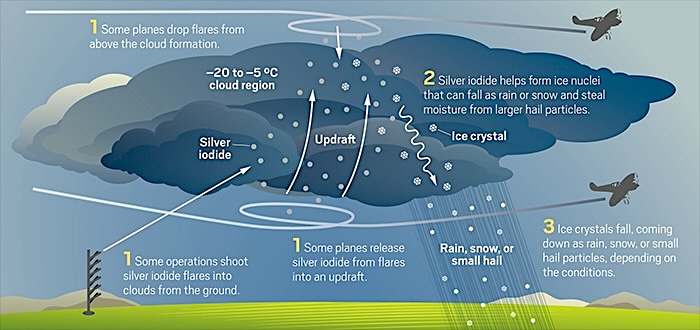
This is not theoretical. These interventions are already happening, and I have explored the assumptions and uncertainties behind them in more detail when examining whether we can truly engineer weather systems (Can We Engineer the Weather).
Irrational Fear is written by climatologist Dr. Matthew Wielicki and is reader-supported. If you value what you have read here, please subscribe and support the work that goes into it.
Read rest at Irrational Fear