Climate changes fostered by “unforced natural climate variability” may be more than an order of magnitude larger than the climate changes commonly attributed to anthropogenic forcing. [some emphasis, links added]
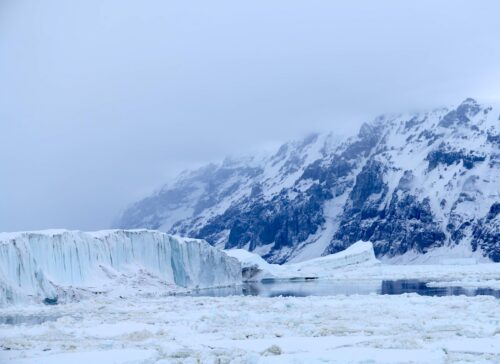
In a new study, scientists have attempted to identify the mechanisms explaining Greenland’s many historical (~80,000-11,700 years ago) climate changes that amounted to 10-15°C “in a decade or two.”
Greenland’s warmer climate endured for centuries, and the ice sheet’s meltwater contributed to the 20-40 meters of sea level rise during these interstadial periods.
Greenland’s abrupt climate changes were likely induced by circulation shifts in ocean heat storage linked to the Atlantic Meridional Overturning Circulation (AMOC), which were, in turn, triggered by volcanic forcing and spontaneous, random “internal variability” or “noise”.
“…the AMOC can undergo spontaneous transitions between these [climate] states solely due to internal noise.”
“…unforced natural climate variability can modulate the likelihood of a transition occurring under volcanic forcing.”

In contrast to the dramatic climate shifts tied to volcanism and “unforced natural climate variability,” modern Greenland has not warmed (net) in the last 100 years despite the foreboding “anthropogenic forcing” that we have been warned about since the 1980s.
Furthermore, the Greenland ice sheet has contributed just 1.2 cm to sea levels from 1992-2020.
This is a far cry from the dozens of meters of meltwater contribution induced by internal climate variability, volcanic forcing, and/or “noise” throughout the last glacial.
Read more at No Tricks Zone