A recent article in The Week titled “As temperatures rise, US incomes fall” by Devika Rao claims that rising temperatures have already reduced U.S. wages by about 12 percent and that climate change is quietly depressing incomes nationwide. [some emphasis, links added]
Hard data debunks this claim: Over the recent period of modest warming, U.S. income data show wages rose substantially.
The article leans heavily on a recent modeling study to argue that “global warming has cut incomes in the U.S. by 12 percent since 2000,” asserting that temperature changes ripple through productivity, prices, and trade to reduce paychecks even in places without notable warming.
Readers are told this is happening now, broadly and invisibly, across the economy. Perhaps it’s invisible because it has not happened.
Readers are not told that this is not a measurement of wages. The claim is based on an unverified and unverifiable counterfactual model that imagines what incomes might have been in a hypothetical world without warming and then labels the difference as a loss.
Even worse, the study’s estimated income hit ranges anywhere from -2 percent to -22 percent, depending on assumptions, even when excluding losses from specific extreme weather events.
That enormous uncertainty band is an admission that the headline number is not robust. Change the assumptions, and the “loss” changes or disappears. That is not empirical economics; it is scenario-building.
This is an exercise in dark wish fulfillment. The modelers have no way of knowing what people might have been paid in a world without slightly lower global average temperatures (less than one-degree Celsius difference in temperature) over the past quarter-century.

Would people have shopped more, traveled more, dined out more, or farmers grown more food but for a less than one-degree temperature change, a change unnoticeable by the average person? This is speculative in the extreme.
More importantly, measured wage data tell a dramatically different story.
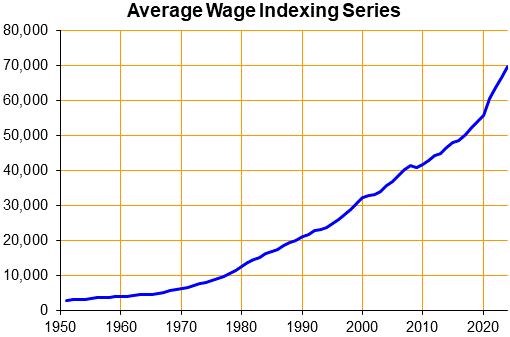
The National Average Wage Index, published by the Social Security Administration (SSA), shows that U.S. wages have risen dramatically and consistently over the modern warming period.
According to the table spanning 1951 to 2024, the index increased from $32,154.82 in 2000 to $69,846.57 in 2024, more than doubling over the period, as seen in the SSA-provided graph in Figures 1A and 1B below.

The article’s logic also fails another reality check. The U.S. economy over the past quarter century has seen higher output, higher productivity, and far greater resilience to weather variability than in cooler earlier decades.
These outcomes are inconsistent with the notion that modest warming has been quietly hollowing out incomes.
To sum up, The Week cites a single, unverified study to assert that incomes have been slashed by 12 percent due to climate change. The SSA wage index data show that there is, in fact, no correlation between rising U.S. temperatures and falling wages, because wages did not fall.
Obviously, comparing real-world data of wages and temperature shows that the report and the study it references are patently false. The data are not a subtle effect or a statistical quirk.
There is a clear long-term upward trend documented year after year in official federal data that blows the claim made by The Week right out of the water.
By presenting modeled counterfactuals as if they were observed declines in pay, The Week misleads readers about both climate impacts and economic reality. Actual wage data show Americans earning more, not less, as temperatures have modestly risen.
When measured outcomes directly contradict a model’s conclusion, the problem lies with the model, and with the flawed reporting, not with reality. Either The Week is incompetent at doing research and factual reporting, or purposely ignoring reality to spread a false climate narrative.
Read more at Climate Realism